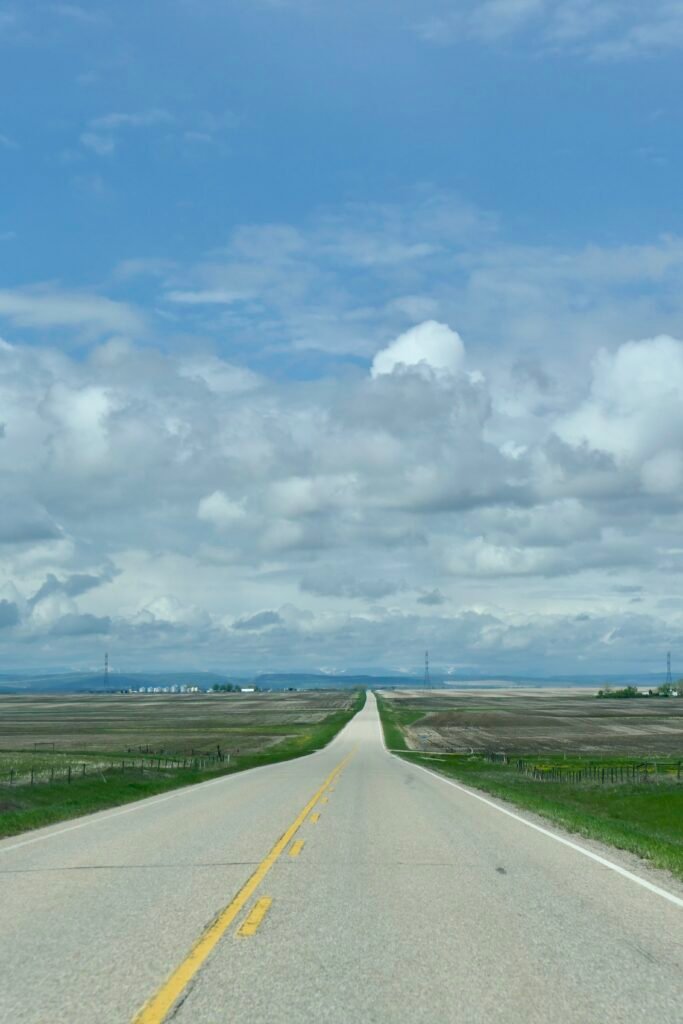
Category: Road Trips Page 1 of 2

Glacier National Park, USA from Calgary

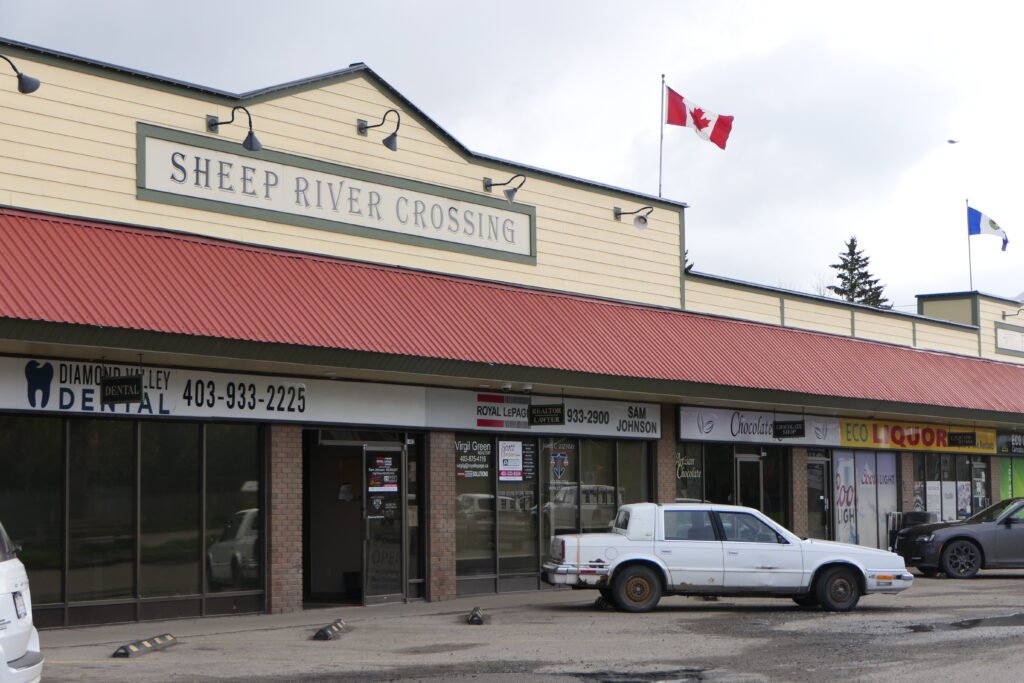
I like Calgary. It’s a nice town, but leaving is no great hardship considering the extraordinary sweep of plains and towering mountains that surround the city. I’m heading on a four day circular trip to Glacier National Park. Once on the road south, it’s not long before I enter Diamond Valley which is anything but diamond-like, and the few outlets at the intriguingly named Sheep River Crossing don’t help to enhance the area either. There is little sign of any sheep, and no crossing to distinguish either, which I take to be a judgement by most of the herd that this is a place to avoid. I guess they decided to cross somewhere else. 
I scoot out of town to my next stop, the strangely named Okotoks Erratic lying just a short detour down Route 7. Nicknamed “The Rock that Ran”, it turns out to be a large piece of split quartzite rock sitting in the middle of a huge field.
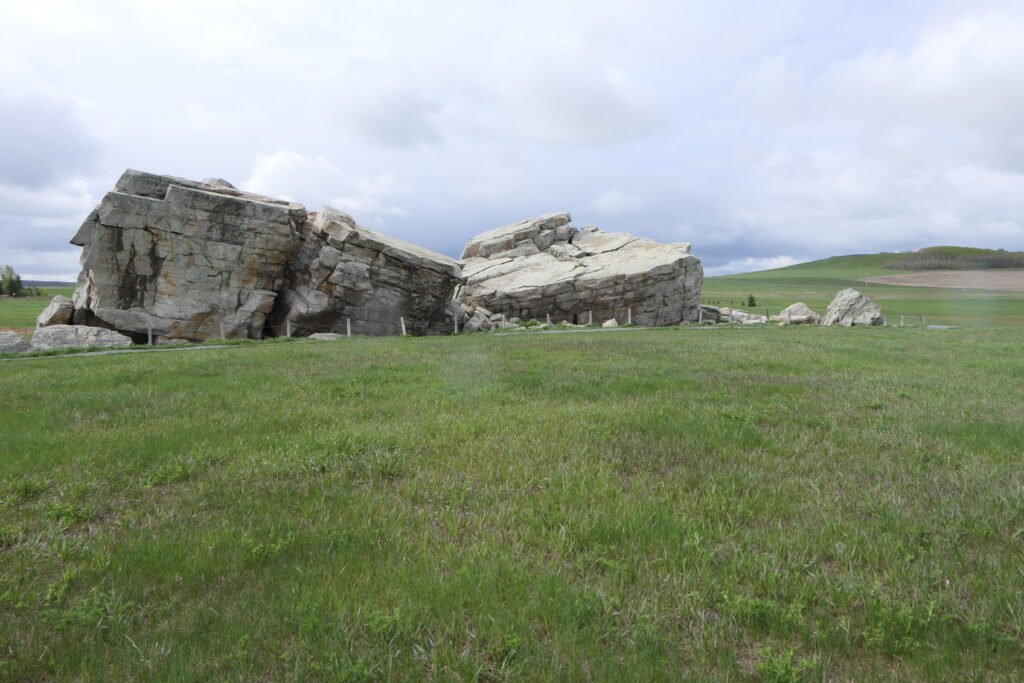
Clearly the Albertans have been taking lessons from their American neighbours on how to create a tourist attraction out of nothing. To be fair, there are two other people in the car park, but it turns out they’re sitting in their van eating what appears to be lunch with little interest in the rock sitting proudly on the grasslands in front of them. As I walk down the path towards the monolith, I learn from the various noticeboards about the great spiritual significance this rock has for the Blackfeet People. Legend tells of the story of Indian warrior Napi who sheltered by the rock and was allegedly chased by it. Not wanting to question the reliability of the story, but it does seem improbable that this 30 ton piece of mountain could have chased anyone – at least at any speed that is.

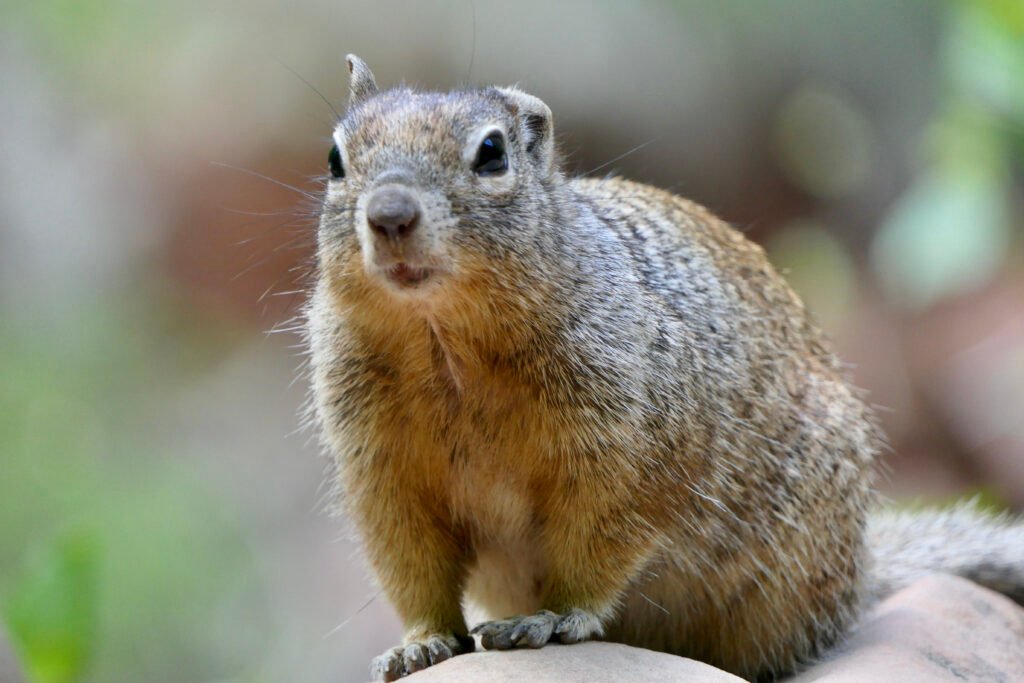
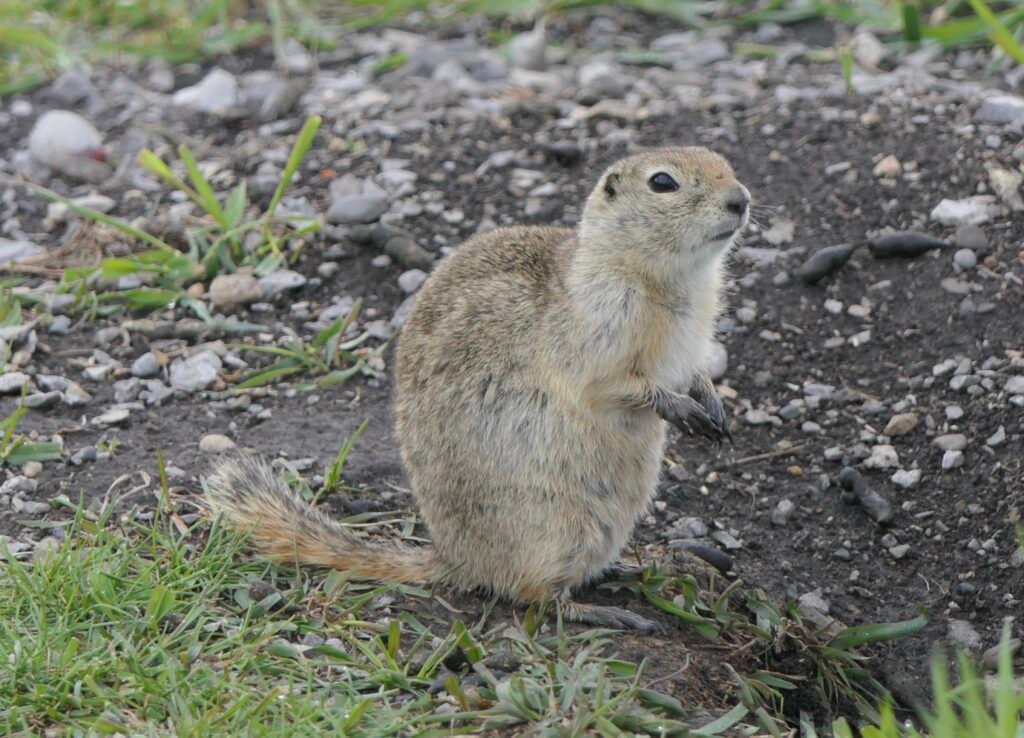
The rock is definitely interesting, but it is still only a rock, whereas the surrounding grasslands are fascinating because they are covered in prairie dog burrows, populated unsurprisingly, with hundreds of prairie dogs.
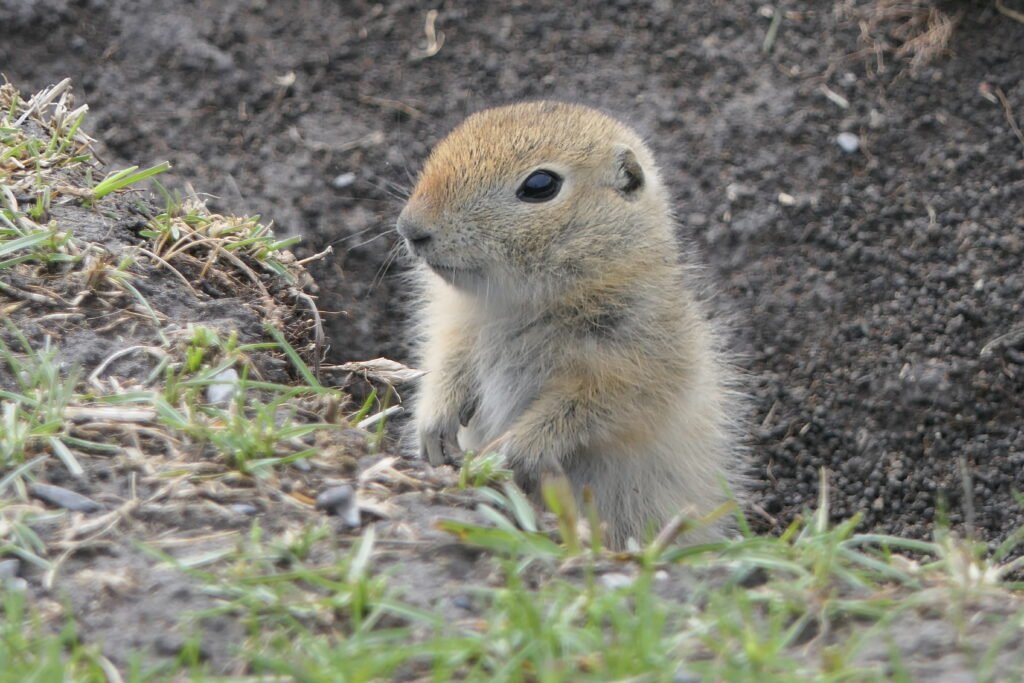
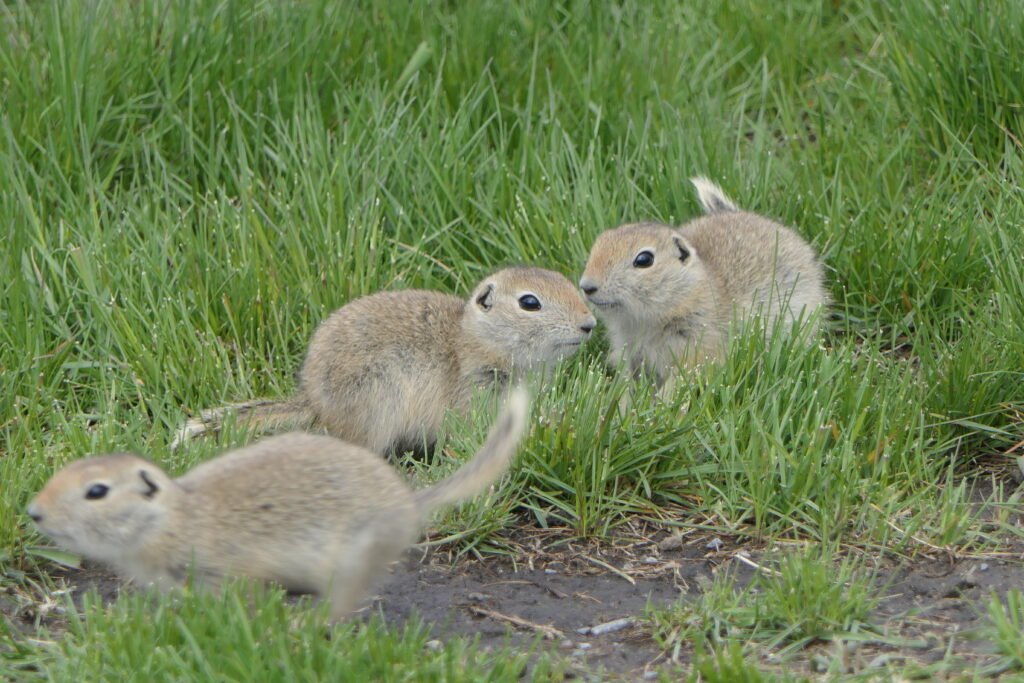
These sweet looking creatures are everywhere, popping up from their caves and then disappearing again. I could watch them for hours. Apparently, these animals support at least 136 other species through their various activities. So basically, they are the Chicken McNuggets of the grasslands. With their complex underground dog towns, their entire annual mating season is apparently only an hour long. Males, apparently jump from group to group—but the females stick together for life – mimicking humans I suppose.
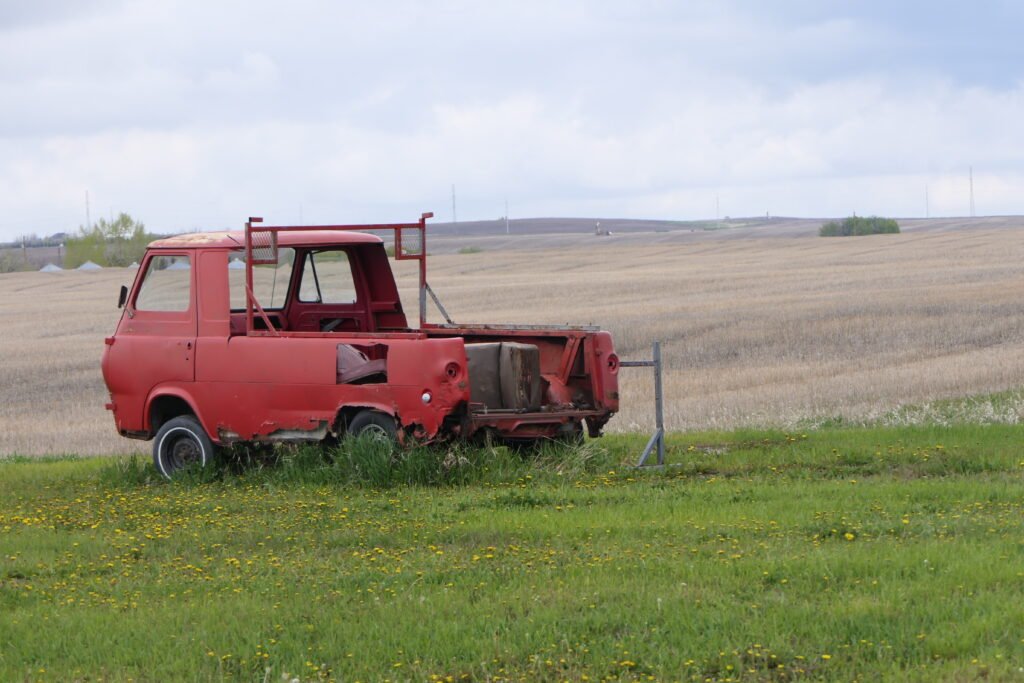
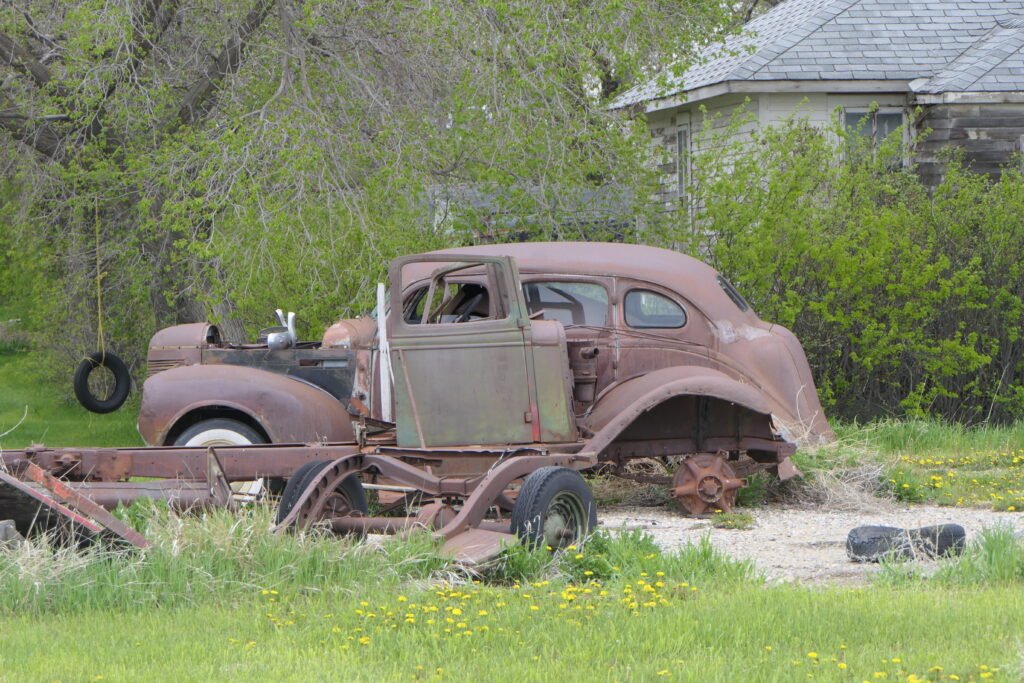
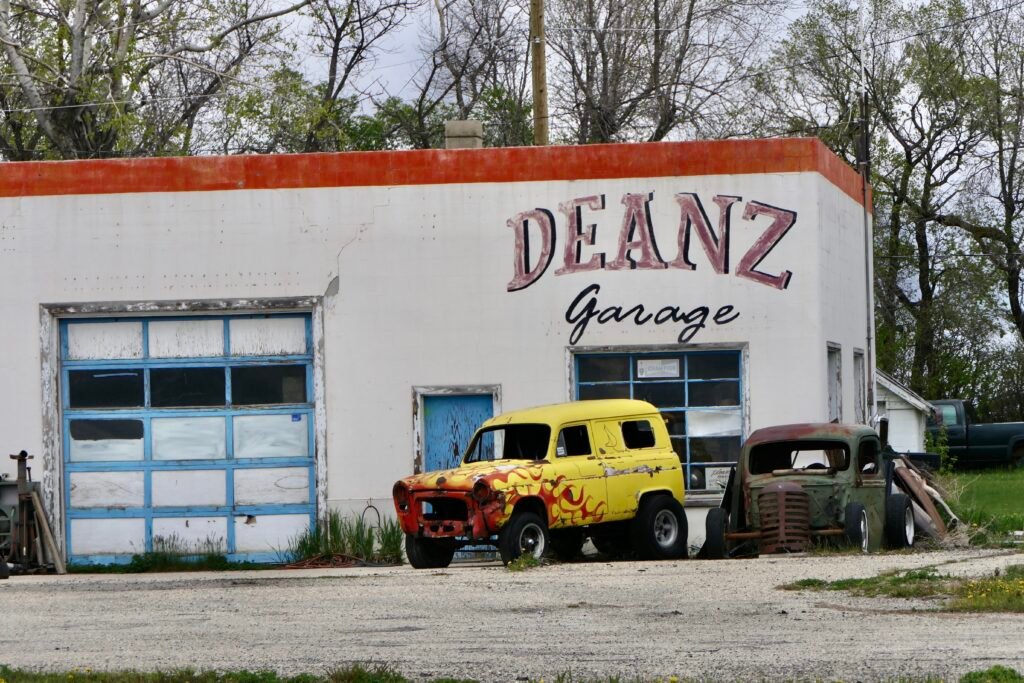
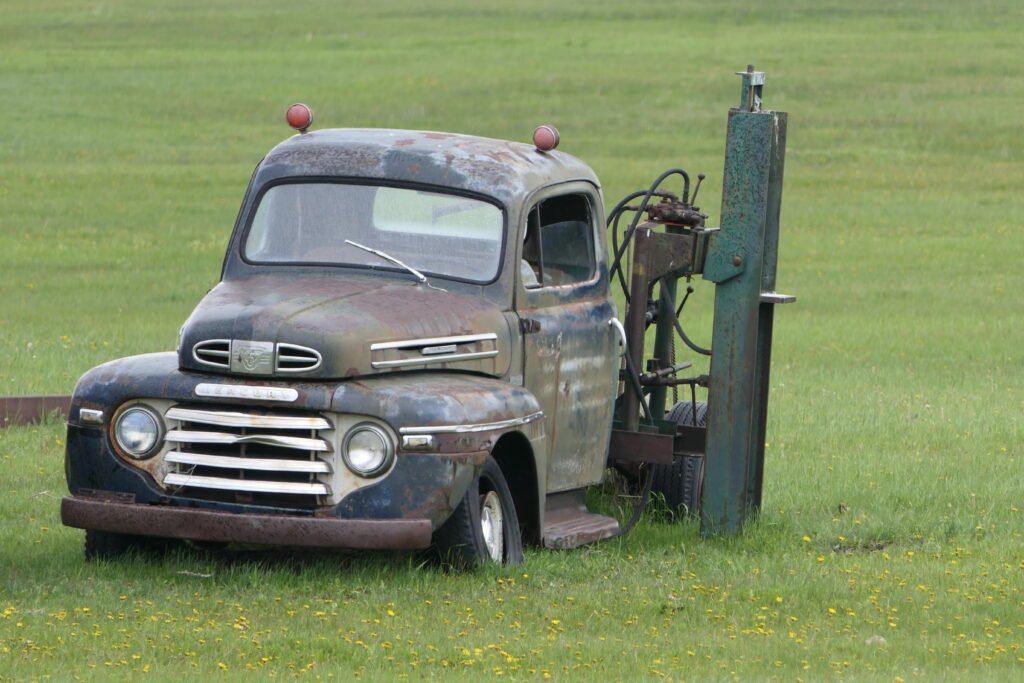
As I move further down the highway toward the US border, the detritus of a broken economy litter the landscape. Not in an ugly way because there is a kind of beauty to the ageing, rusting vehicles and farm equipment that lie embedded in the fields and homesteads that appear by the roadside. Gentle reminders that people once lived, worked and sweated the land around here. These artifacts are left as little monuments, so we do not forget their toils, otherwise what was it all for? I ache for the ghosts of the past to be able tell the stories that lie behind these broken dreams.  
It’s another world out there……..

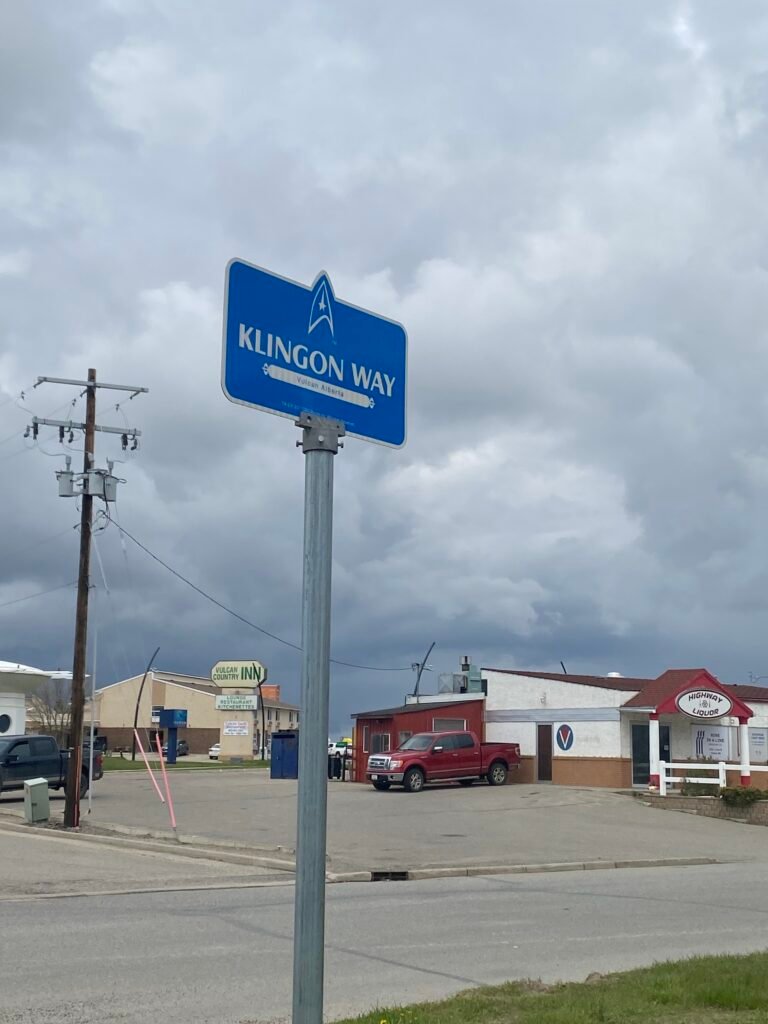
A few miles southbound on route 2, I take another detour at Nanton and travel eastwards to the alien sounding destination of Vulcan. Sadly, its name originated not from any thoughts of the universe, rather in 1910 a Canadian Pacific Railroad surveyor who had a fondness for Roman Mythology, named the town after the Roman god of fire.
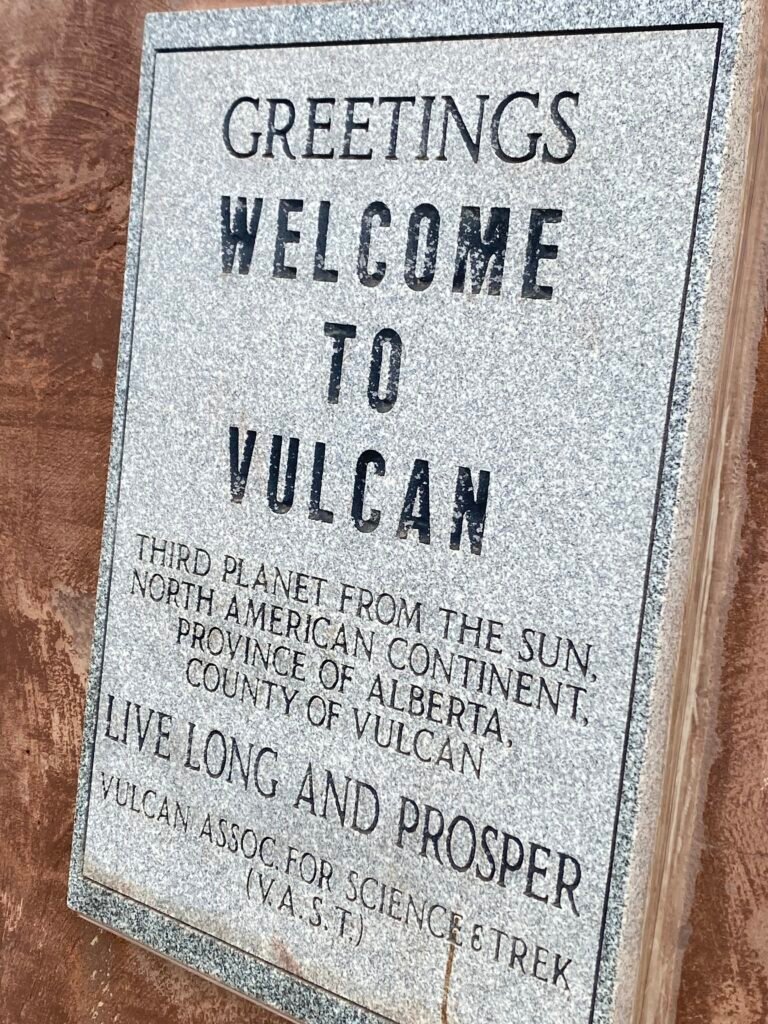
However, this sleepy town has not been resting on its laurels. Awakening the entrepreneurial spirit, in November 1995 the town created a space-themed visitor centre to tap into the growing curiosity surrounding the town’s name. The idea quickly grew into a group effort between the various local bodies and the wonderfully named V.A.S.T. (the Vulcan Association for Science and Trek). The Trek Station’s official grand opening was on October 23, 1998 and was designed to look like a landed spaceship.
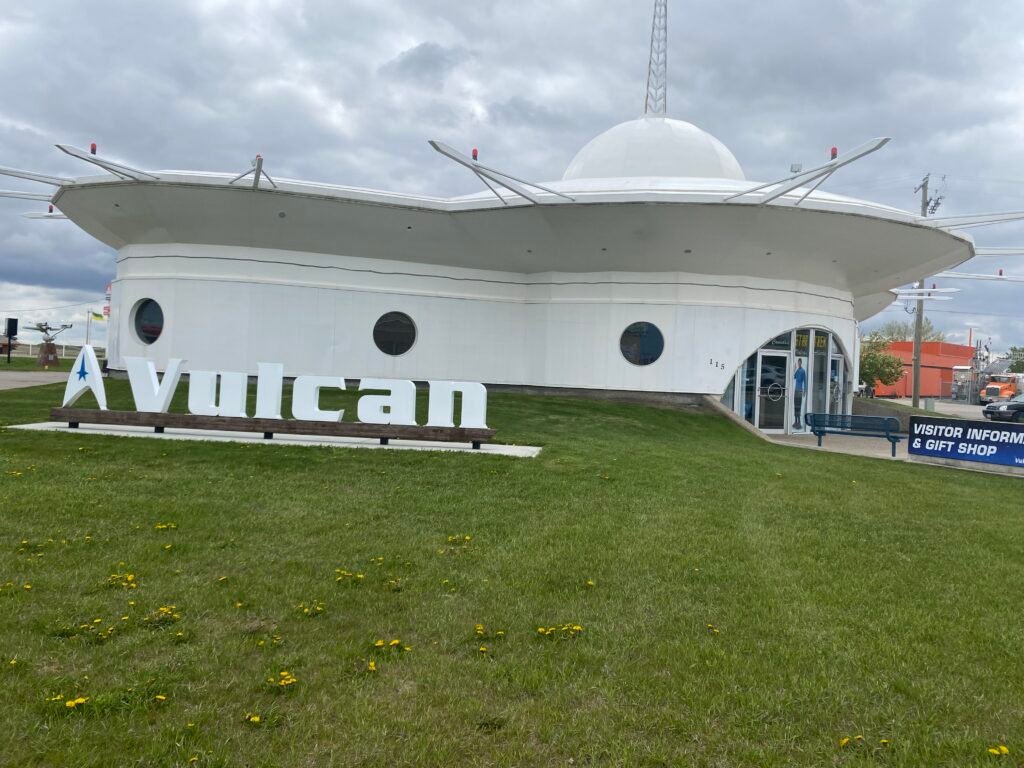
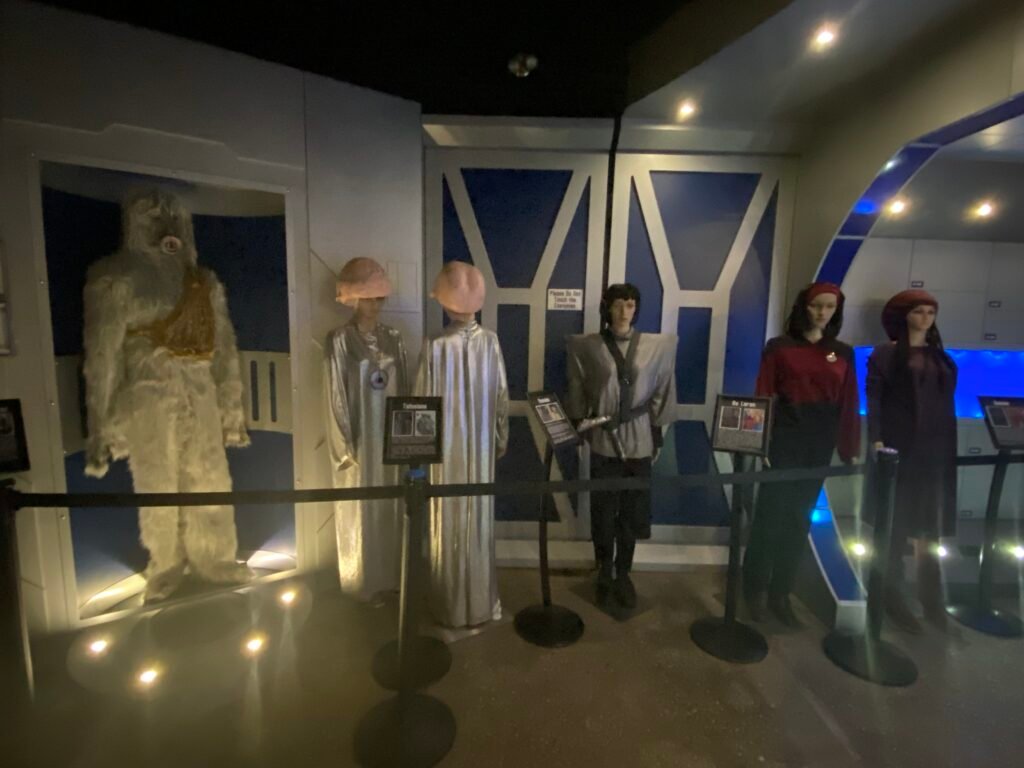
Apparently, thousands of people from all over the world and beyond, make the “Trek” to Vulcan to visit this unique attraction. However, some far travelled aliens (foreigners) might feel somewhat let down when they visit from a galaxy far, far away. Entry to the “museum” is by way of a donation, and I drop in five dollars thinking that is a fair price. Not even close. The dollar bills go into a slot which operates an electric door. The door opens and I step into what can only be described as a large closet stuffed with mannikin’s. I say stuffed but I think I only count ten Star Trek characters, but the place feels full. They are paraded in a small semi-circle before another door opens and I am transported immediately back to the visitor centre reception I’d left only seconds ago. I personally don’t feel cheated as it had already been on my route, but I pity the poor souls arriving from out of state expecting a Star Trek extravaganza.
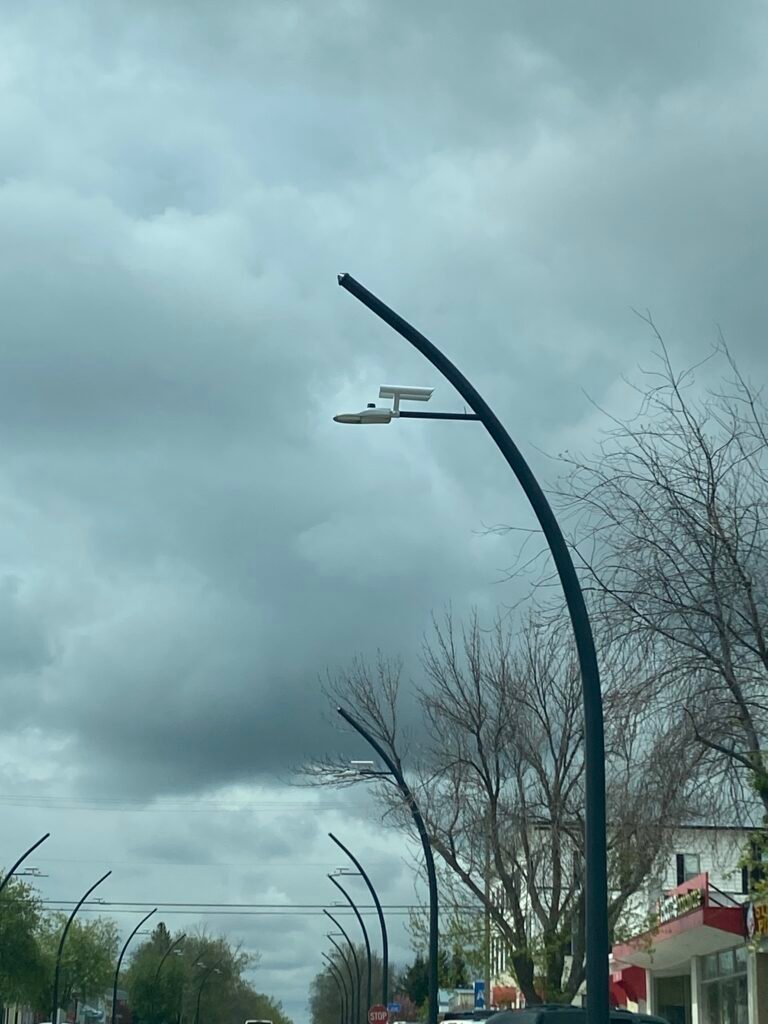
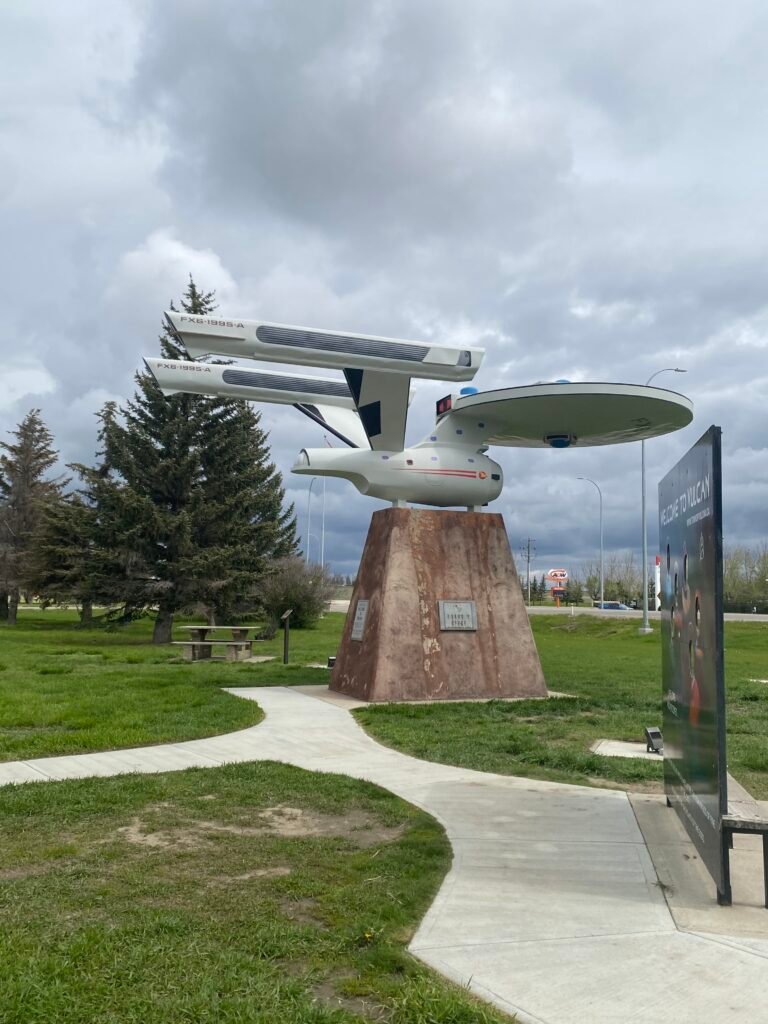
However, the large replica of the Starship Enterprise sitting high on a plinth outside the visitor centre does make up for the lack of substance inside. What really makes me smile though, is all the street-lights along the centre of town are made of mini-Starships. Now that’s worth visiting for. Vulcan, may the force continue to be with you. 
Fort Macleod and Buffalo Jumping

I leave that galaxy and move on, passing through Staveley and Claresholm without even noticing, possibly because there isn’t anything to distinguish these settlements, before reaching my namesake, Fort Macleod, just in time for a late lunch. The fort was named in honour of the then Commissioner of the North-West Mounted Police, Colonel James MacLeod who was born in my homeland in Drynoch in the Isle of Skye, Scotland in 1836. Founded as the Municipality of the Town of Macleod in 1892, the name was officially changed to the already commonly used Fort Macleod in 1952. Another Scots boy done good !
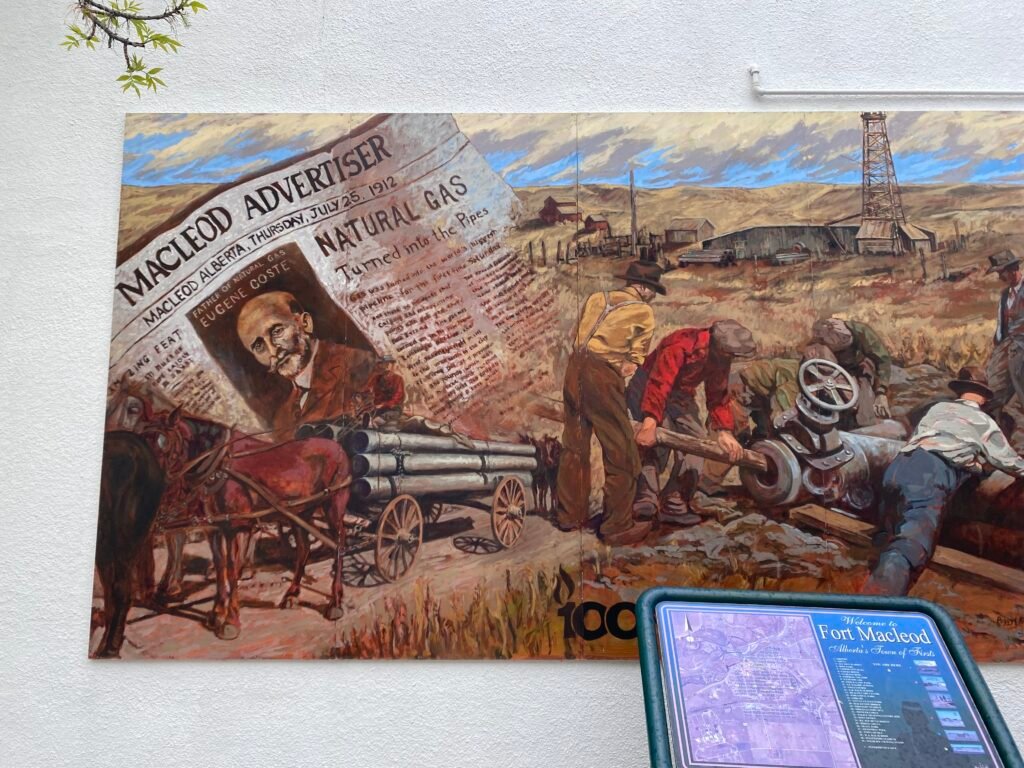
I choose, quite naturally, to lunch in Macleods Restaurant behind Main Street, and then somewhat regret that decision as soon as I walk in. It is dark and dingy, with only a couple of old timers getting their daily sustenance – probably gravy and grits. I order Spaghetti Bolognese and it turns out to be very, very good. Once again, the MacLeods save the day…….

Later, I walk down the deserted main street as the silence is only broken by the muffled roar of huge trucks trundling up and down the two highways that lie on either side of town. The shops look closed but as I pass them, through the dusty windows I can see lights inside. I walk past the lawyers, the accountants and the beautiful, elegant old Empire Theatre.
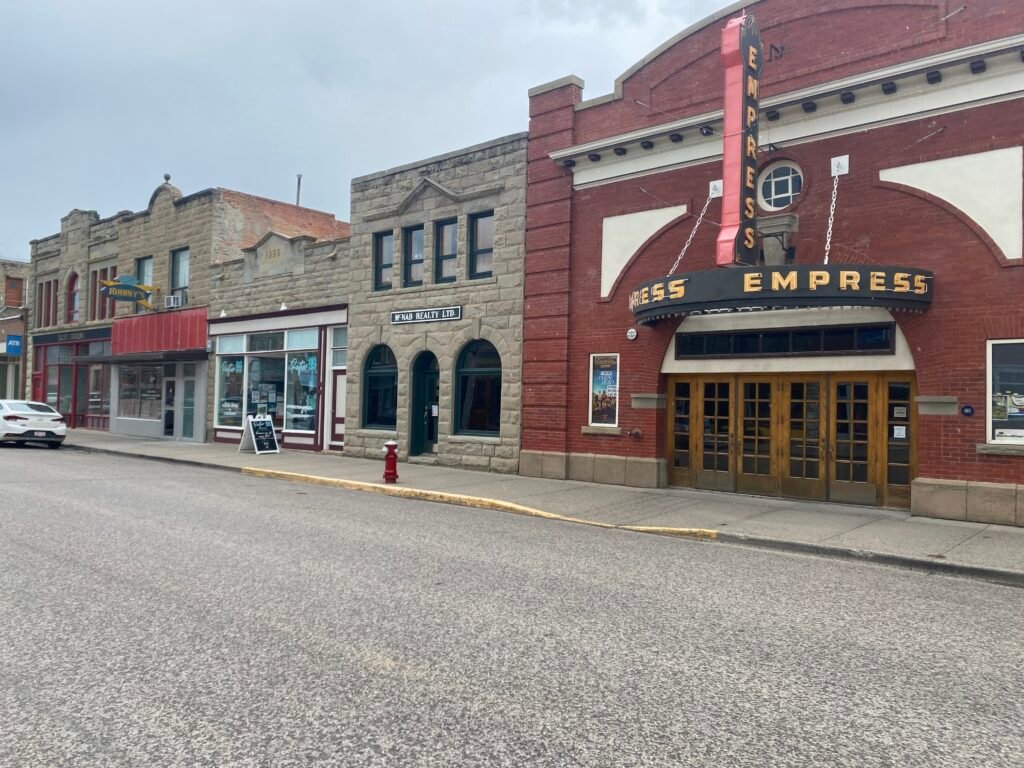
Somehow, I get the impression that people are peering out from behind their curtains wondering who the stranger is walking slowly through their town. Maybe if I had a kilt on, they wouldn’t be so afraid. Two people appear from nowhere and walks towards me. They promptly cross the street, so now I’m feeling paranoid until I realise they’ve just gone into Subway for lunch. 

Fort Macleod claims it has 3,297 residents and growing according to the last census. Apart from my friends in the restaurant I’ve only seen two. Maybe it’s siesta time, although we are some distance from the Mexican border.

Apparently 19 movies have been filmed in Fort Macleod although I only recognise a few of them. Ghostbusters, Interstellar, Brokeback Mountain and In Cold Blood. More notably it’s been a location for the TV series – The Last of Us. Its other claim to fame is that Joni Mitchell the singer, was born here in 1943. 

At the east of town down an alleyway, I cross the main highway and find myself at the actual Fort Macleod. Rebuilt somewhat from those heady days of the 1800’s, when after a gruelling two-month, 1,300 km trek across the prairie from Dufferin, Manitoba, Colonel James F. Macleod and his contingent of North-West Mounted Police arrived here on the banks of the Oldman River.
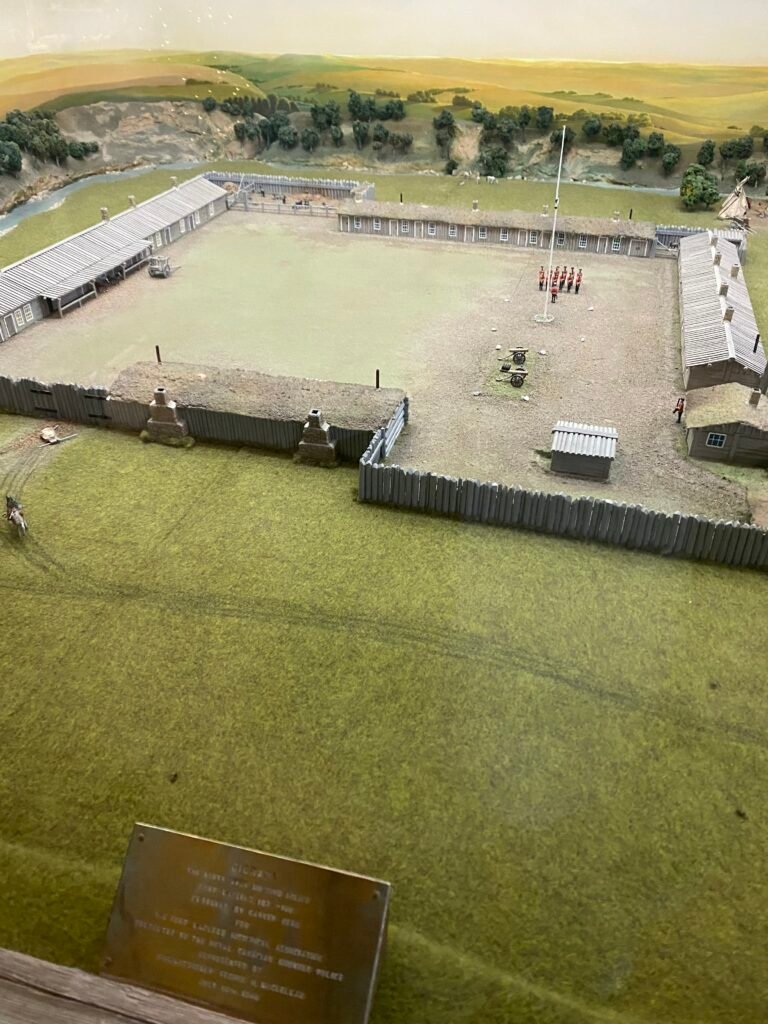
The North-West Mounted Police were sent to the prairie with the purpose of stomping out the illegal liquor trade, which was wreaking immeasurable harm on the Blackfoot people of the area. Macleod and his men raced against the oncoming frost to construct a fort that would house them through the winter, effectively establishing what would one day become a thriving community, if you can call a town of 3,297 residents thriving. 
.

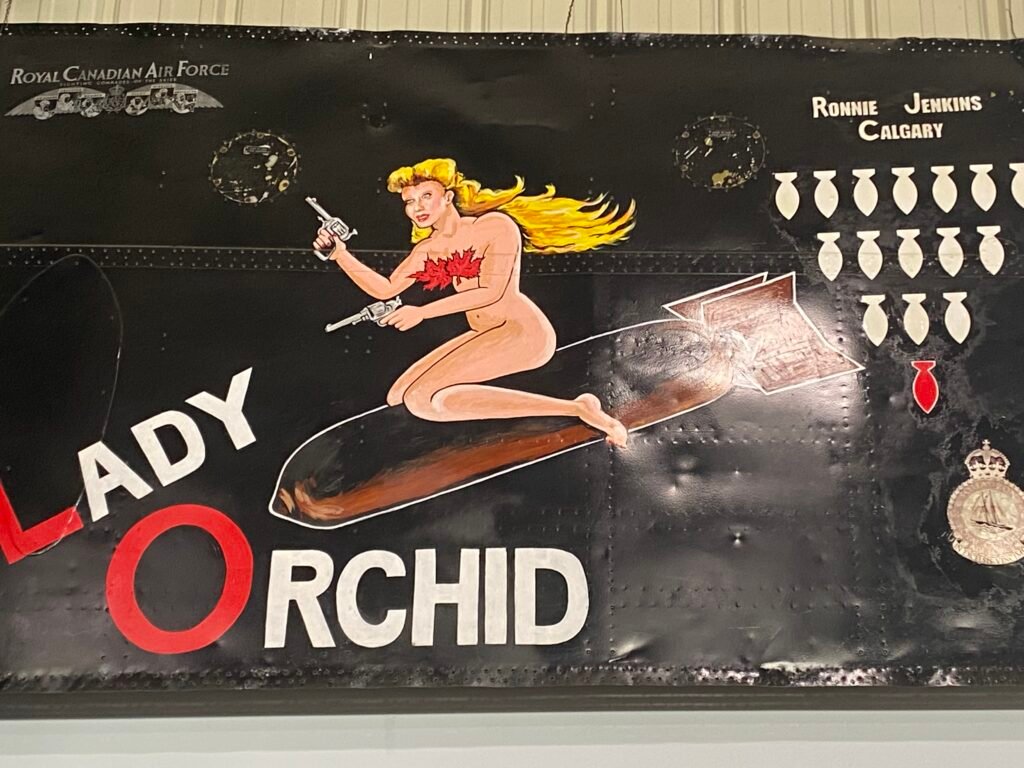
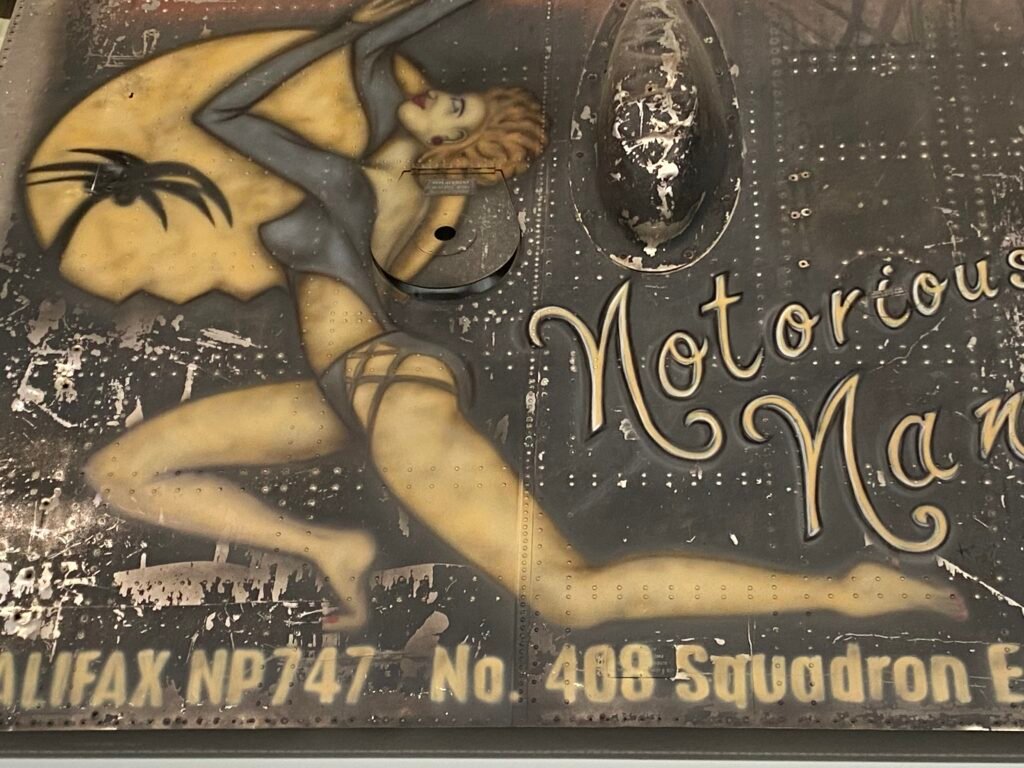
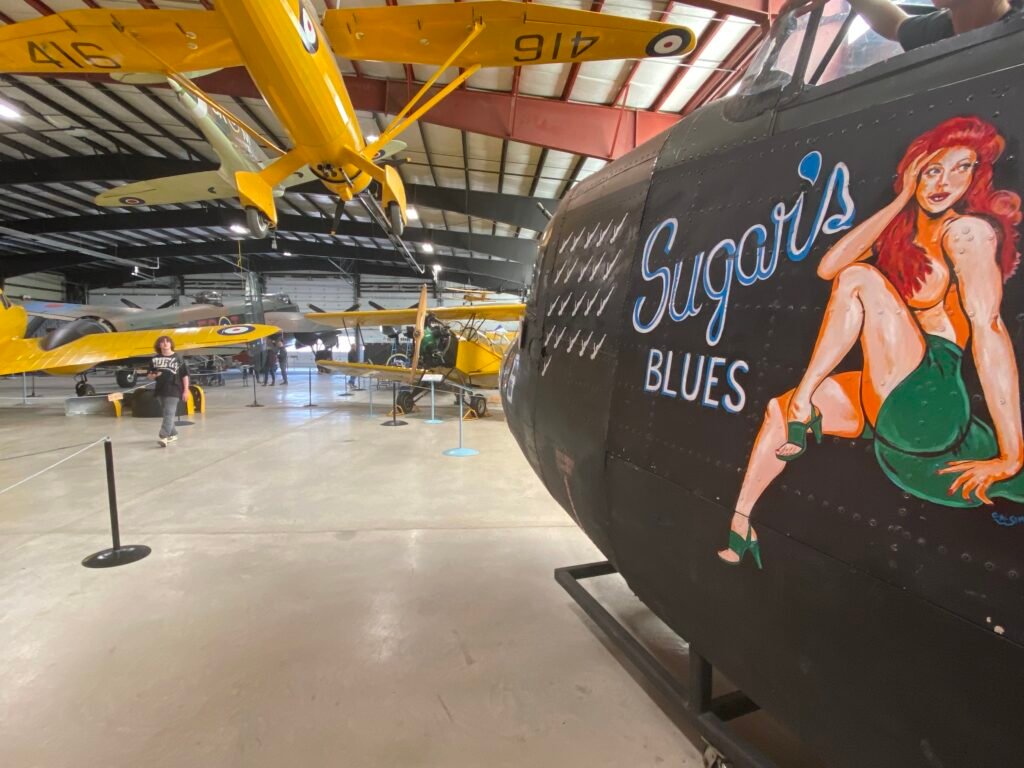
Fort Macleod has more surprises in store. As I turn into the car park of what looks like a huge warehouse, this is the home of the Bomber Command Museum of Canada, where the building is in fact a huge treasure trove of military aircraft and memorabilia.
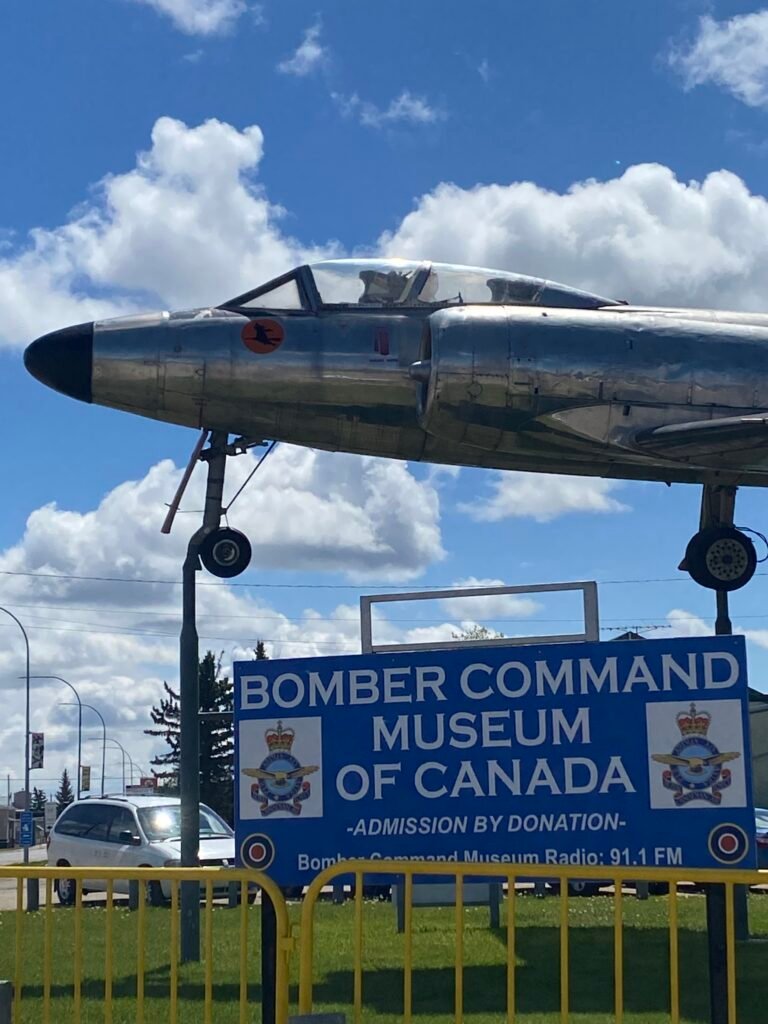
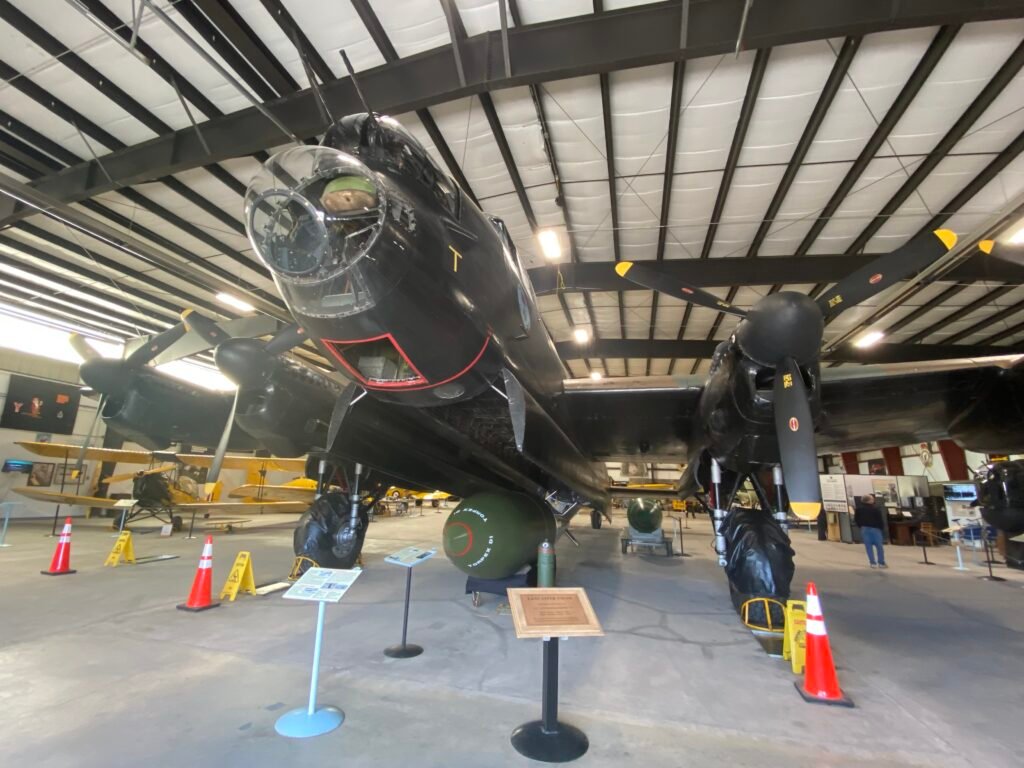
So good is it, that I spend over two hours here, marvelling at a restored Lancaster bomber in all its glory. I happen to make a comment to a fellow gawper called Frank, who it turns out is a Westjet pilot on a trip to see the museum and shares so many facts and figures with me, I can’t keep up.

We wander among the warplanes and the not-so-war planes as I listen to his great stories about some of these bygone relics. I realise I am way behind schedule, so I say goodbye to my new best friend, and he disappears into a distant engine repair room. Although he obviously felt I wasn’t a big enough best friend to offer me a discount on Westjet.  
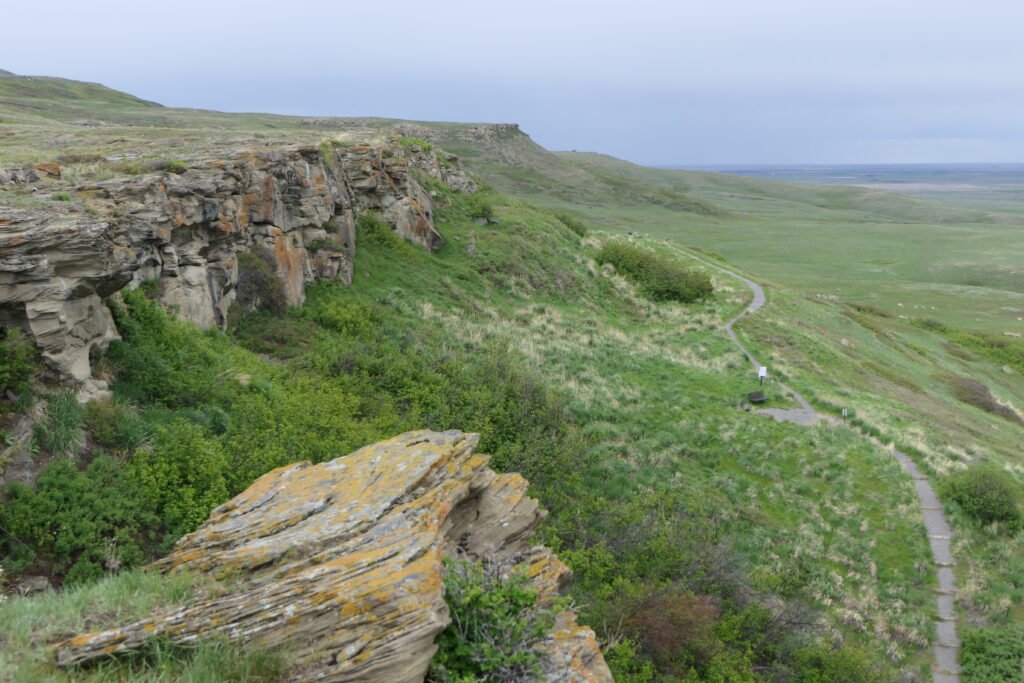
I tear myself away from this diamond in Diamond country and head out to the hinterland and my next destination of Head-Smashed-in-Buffalo-Jump World Heritage Site. This remarkable museum is built into the cliffside from where you get a real sense of the vastness of this country as the Rockies stretch majestically into the distance towards the west, and the sweep of the Great Plains is laid out for hundreds of miles to the east.  
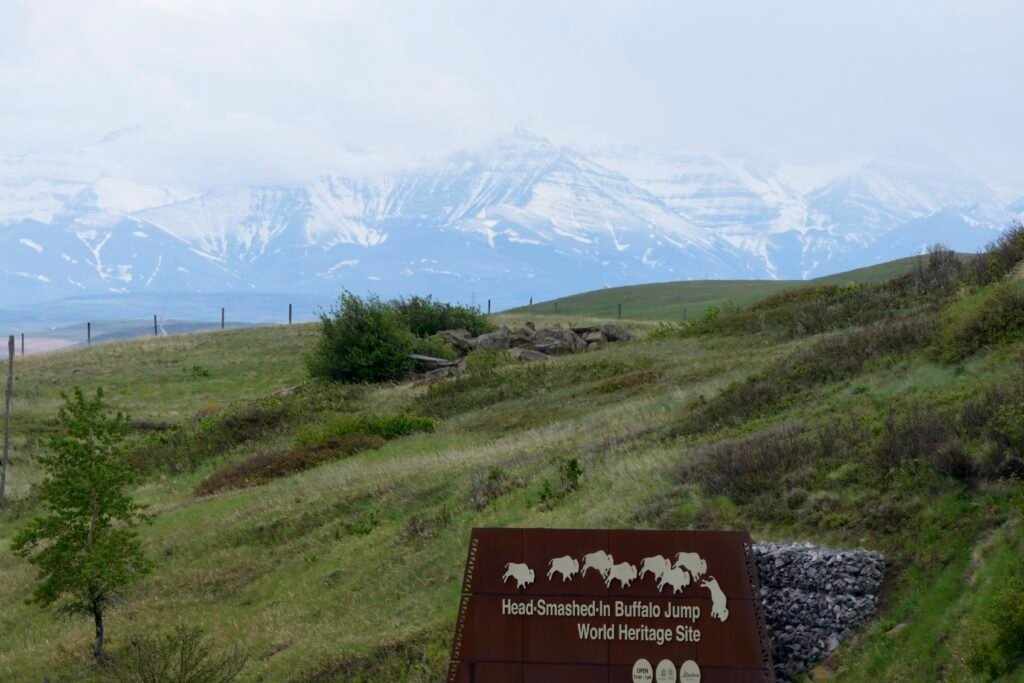
Head-Smashed-In Buffalo Jump is the best-preserved example of communal hunting techniques that the Plains people engaged in, thanks to the massive herds of bison that existed in North America for over five thousand years. 
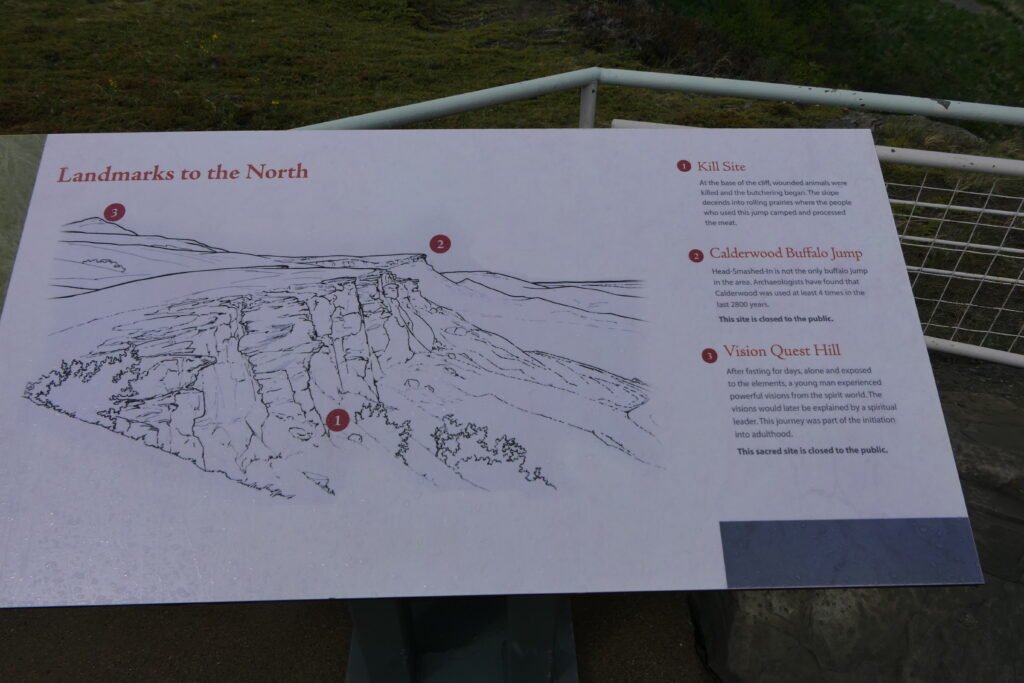
When the Europeans arrived, they came with guns and ammunition which led to the bison being hunted almost to extinction. The museum is a stunning example of how a museum should be, which maybe is the wrong adjective to use when the subject matter is about killing bison by landing them on their heads.

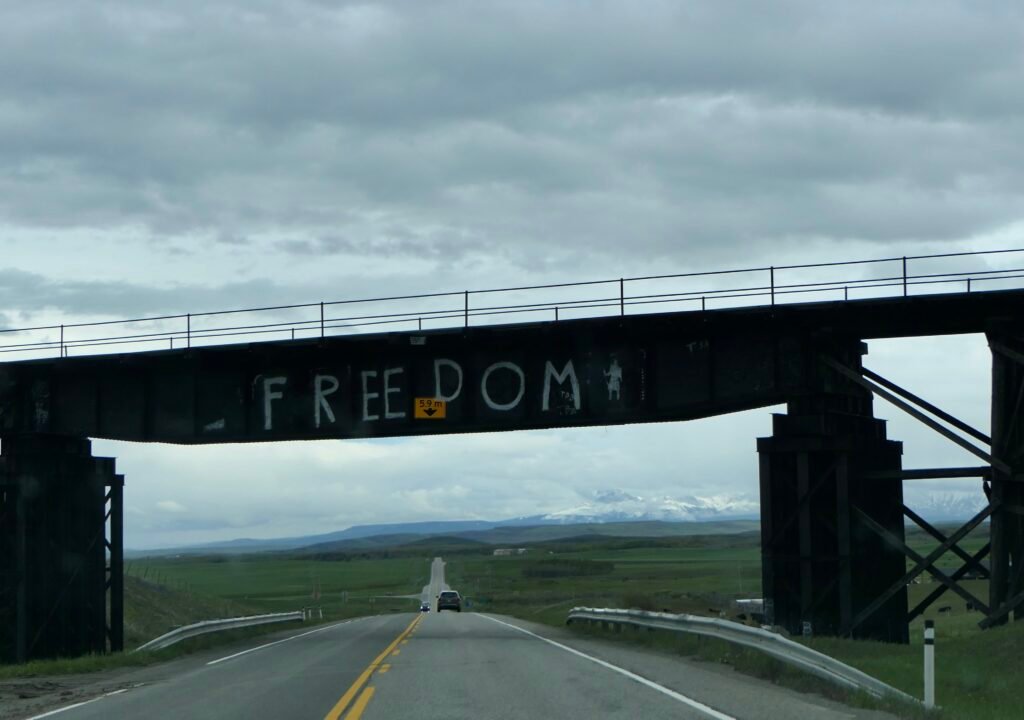
As I head south again towards Glacier National Park, I come across a rail bridge over the road where the graffiti letters spell “Freedom” accompanied by a little hand-painted white kilted warrior Braveheart beside it. I almost feel like I’m back home…..
Waterton and Glacier National Park

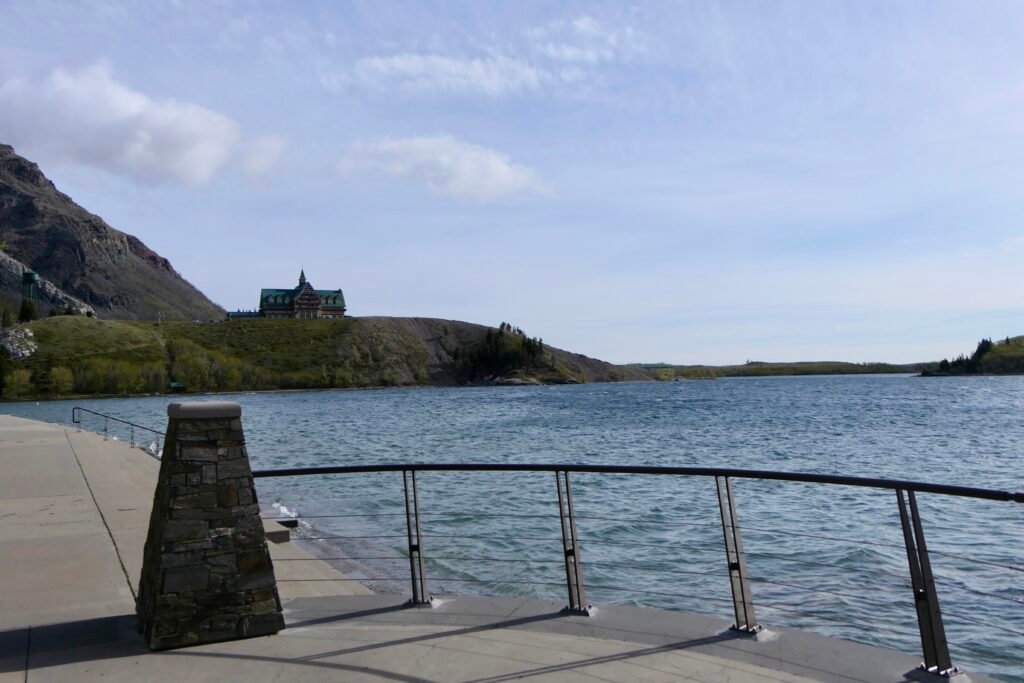
I leave the main highway and take the road to Waterton entering Glacier National Park. The first building I see is the extraordinary Prince of Wales Hotel, a huge alpine-like structure on a promontory overlooking the lake. 
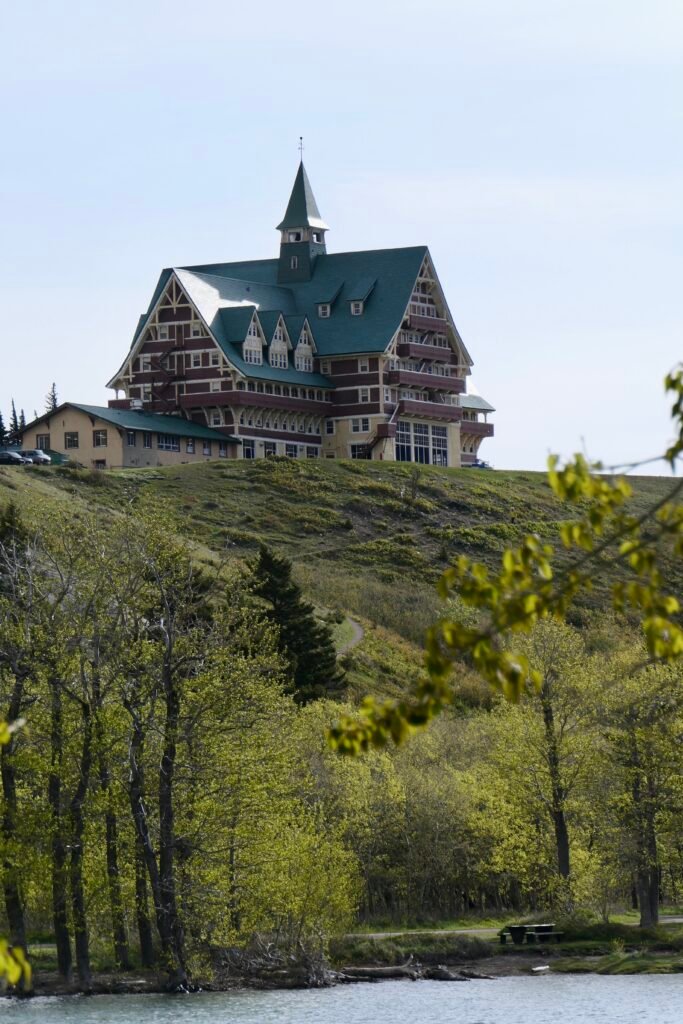
My own accommodation for the night is Kilmory Lodge in Waterton, which while being just a little less luxurious, nonetheless has the same spectacular views and is the perfect spot for relaxing in the bar and restaurant. My window looks onto the Prince of Wales Hotel just to keep me in my place and not to get above my station. 

I take a walk around town, but it’s a holiday so everything is shut. I say everything but there are a couple of bars open, and one restaurant. This is a quiet place and reminds me very much of Loch Lomond in Scotland. The choppy waters, the brisk wind, the snow topped mountains, the mobile ice-cream van……
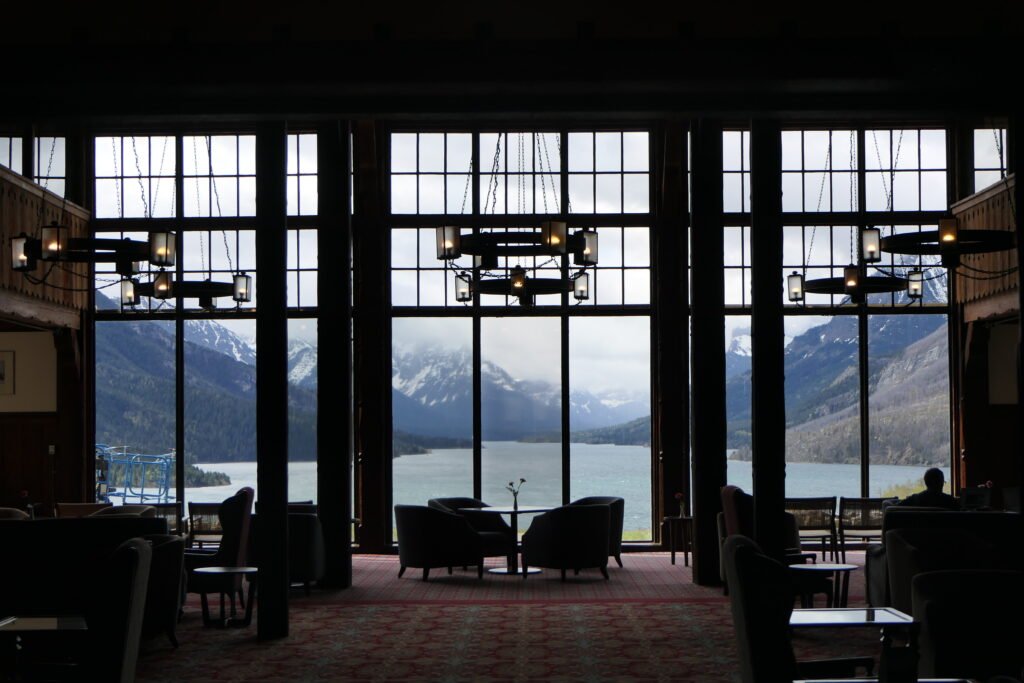
Visiting the now familiar hotel on the hill, it can be seen from every vantage point in town. It’s hard to take a photo without it being in the frame. There are numerous hotels round the world named after various Prince of Wales but none I imagine have scenery surrounding them quite like this one. With water on three sides, it sits proudly like a king surveying his kingdom. The entrance hall and lounge to the hotel is breath-taking as you gaze through the huge floor to ceiling windows in the reception area, all the way along the length of Waterton Lake to the monster 10,500 foot Mt Cleveland in the distance. Snow topped mountains line the length of the lake in front of the hotel, disappearing into the far distance.
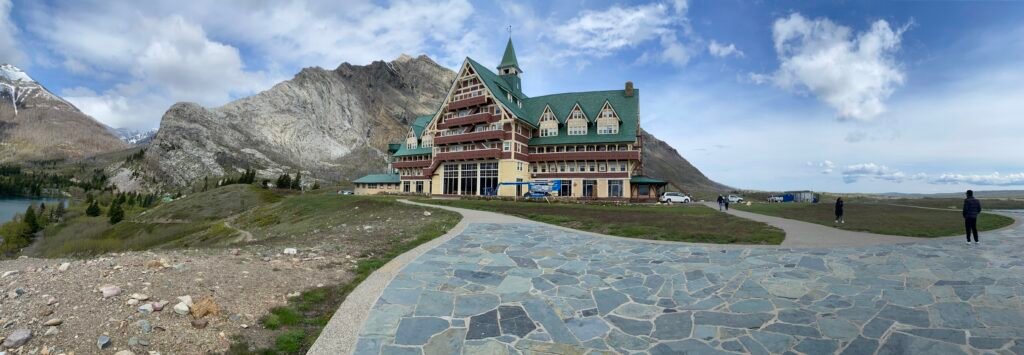
As I pass by, I wonder to myself if the Prince of Wales gets free rooms in any of these hotels. I think it’s the least they could do after pinching his title. The hotel lays claim to having the oldest working elevator in North America. A survivor from the golden age of railway construction in Canada the hotel was built in 1927 by the Great Northern Railway company and quickly became an oasis for thirsty, deprived Americans from just over border in the US, where prohibition was still enforced. Canada was a prohibition free zone as they would call it today, which is basically why the rail company didn’t build the hotel next to a railroad but situated it miles away in a beauty spot where visitors might like to stay awhile and therefore drink more. 
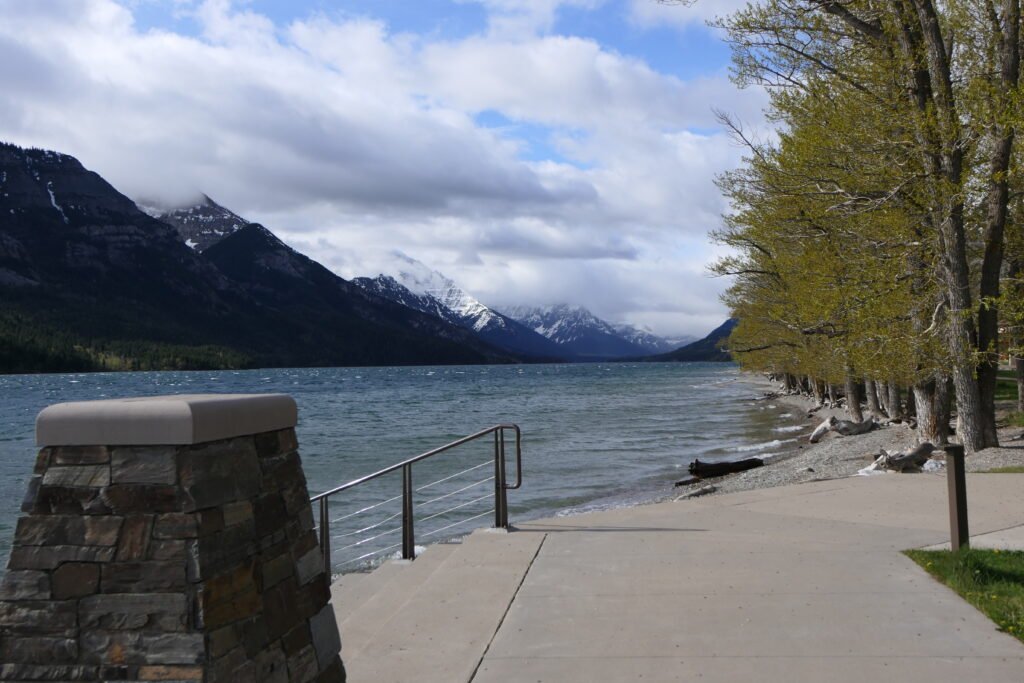
After a blissful night of deep sleep in Kilmore Lodge’s most comfortable of beds, I drag myself away and set off for the border, retracing my steps to the main highway and on to the USA.
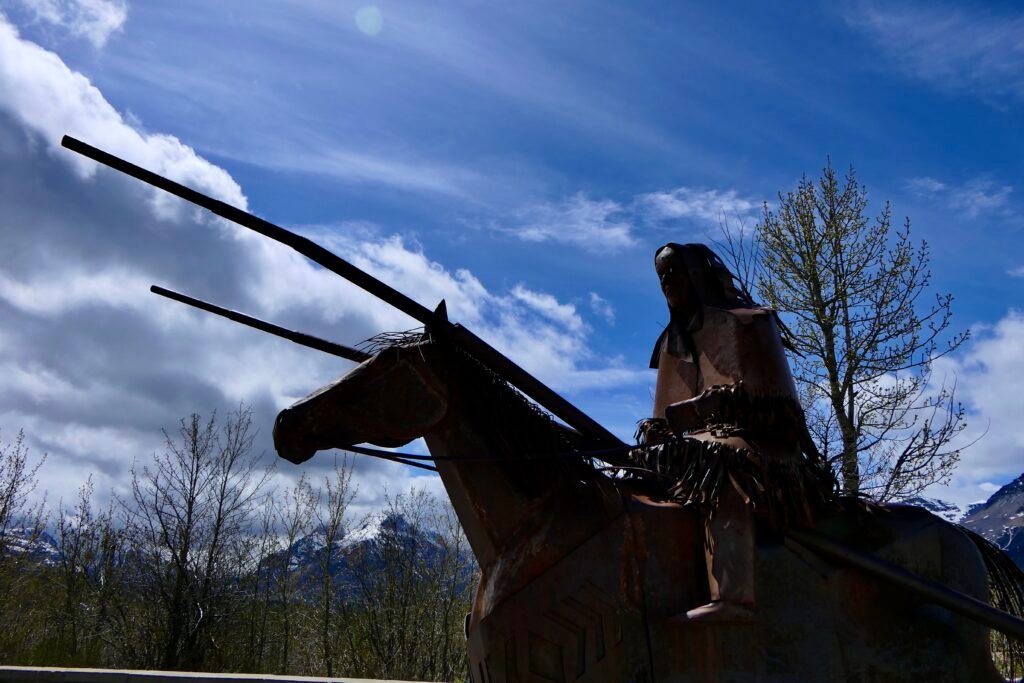
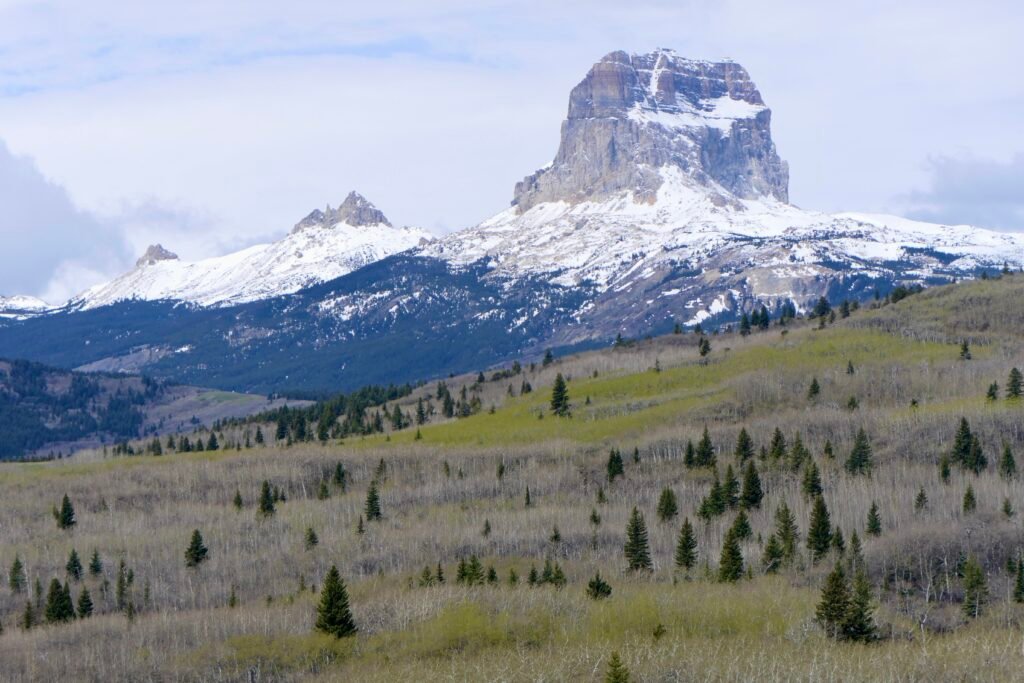
Spectacular scenery abounds as I pass around Chief Mountain, a magnificent example of a great mountain, as its chunky shape with flat top suggests power and gravitas. I guess that’s why it’s called the chief.  
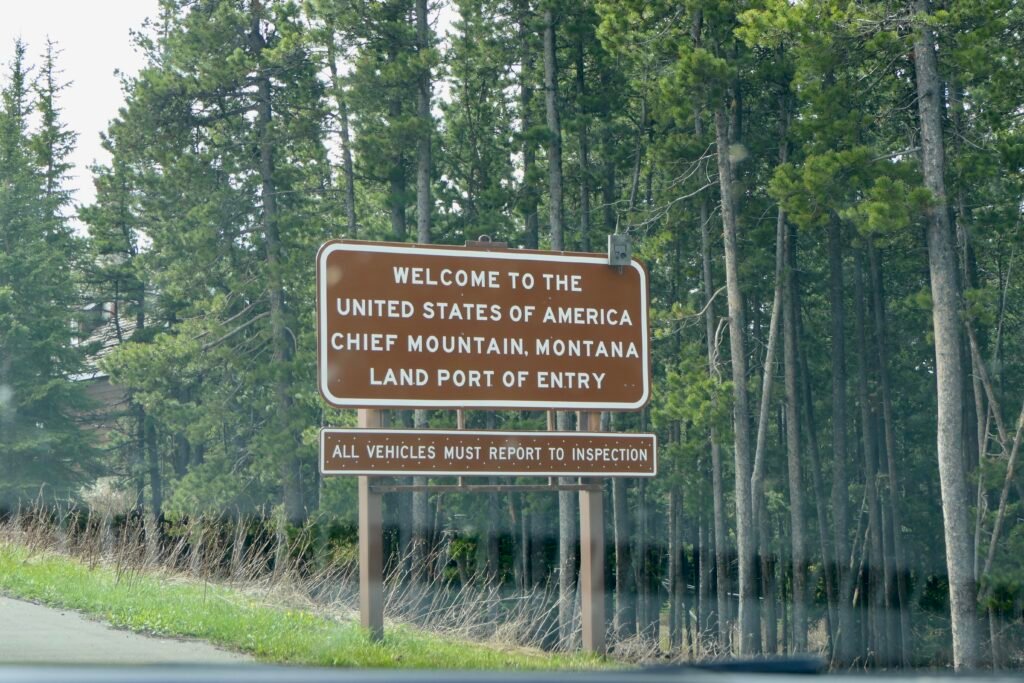
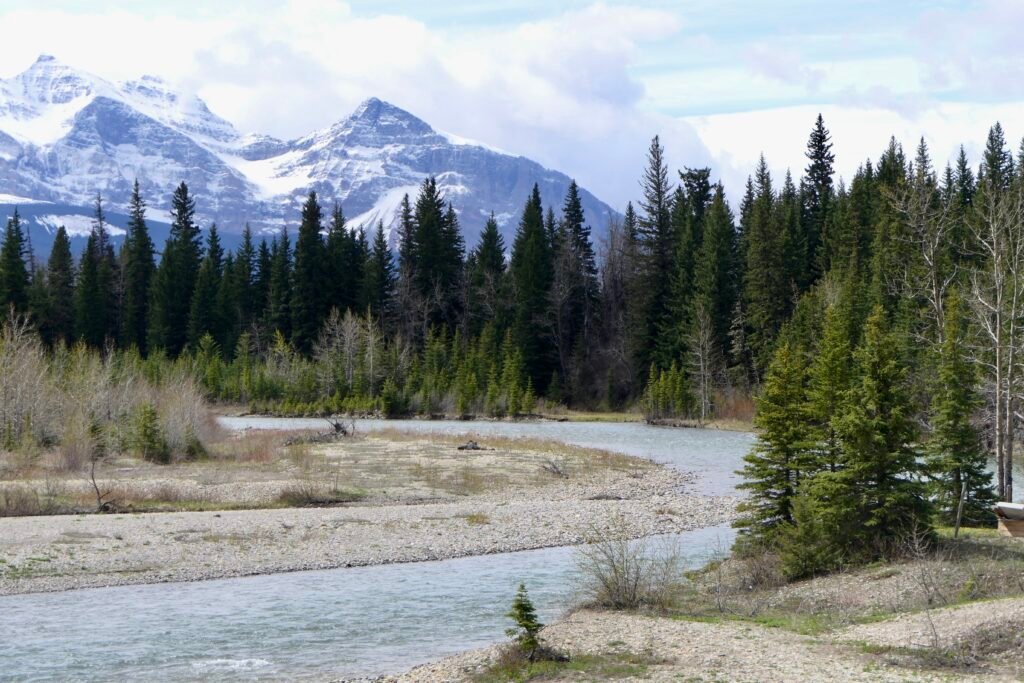
Flowing rivers disappear under bridges and on into deep pine forests amid some captivating valleys and mountains while the road climbs high into the hills. Due to the harsh winters and its high elevation, Chief Mountain USA border crossing only operates from May to September, and lucky for me it has just opened. Surprisingly, considering the scenery that is available, it only gets 65,000 “guests” coming through the crossing every year. This is probably why, since I am one of their first customers of the year, they want me to get out of the car, step into the office and get questioned. They probably just need someone to talk to. I opt out of asking about the effects of loneliness in this distant posting, as they may be here as a punishment or maybe, even a bonus. The questioning is gentle, but they can’t make their mind up about my UK driving licence, which doesn’t come as a surprise since my picture makes Shrek look handsome on a bad hair day. 
Just remember, if you look like your photo, you’re too ill to travel. We part on friendly terms – theirs of course, and I suddenly find myself in Montana. Now this is a big deal. I’ve wanted to come to Montana ever since I could read a map. It’s been a fascination for some considerable time. I think it’s the majestic empty spaces, the frontier spirit and the big sky. It is most definitely the big sky ! How can a sky be bigger than anywhere else on the planet, but here it most certainly is. 
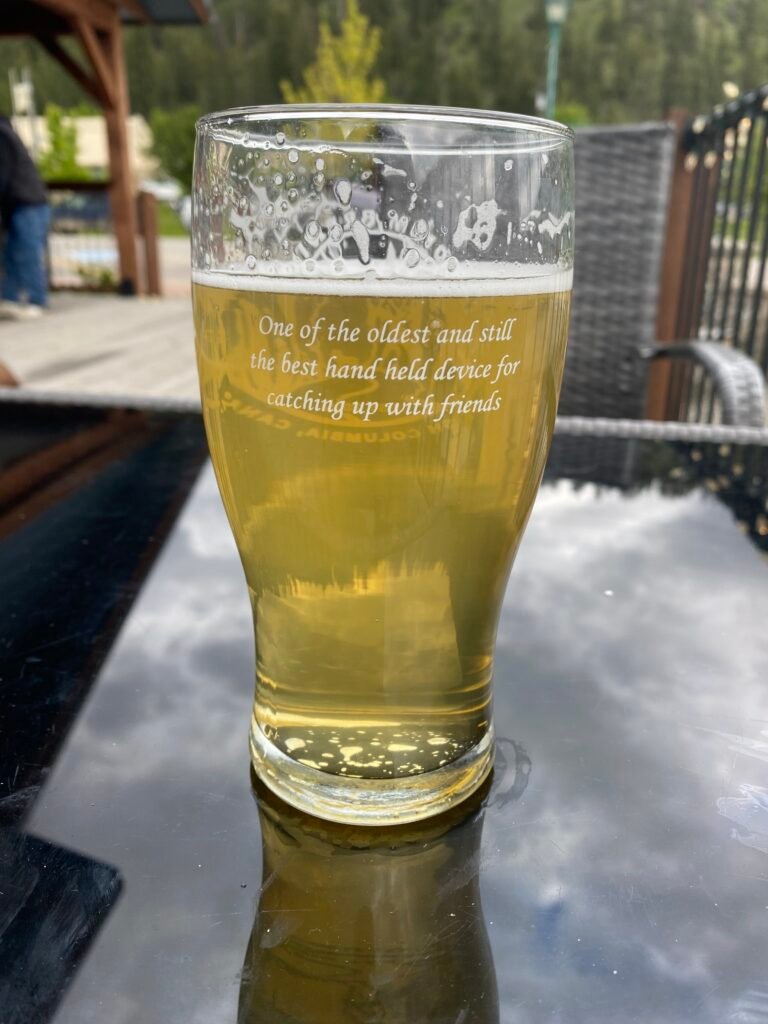
America has now changed the route number on my road to 17 and it’s another hour to St Mary’s at the beginning of the Going-To-The-Sun Road across the Glacier National Park mountains to Lake McDonald. Sadly, there is no going to the sun for me as the road is still snowbound with fifteen foot drifts but it just gives me a reason to come back. I make it as far up the road as Jackson Glacier where I can still see the effects of the Reynolds Forest Fire way back in 2015 which burnt through 2,000 acres.  

With my tail between my legs, I drive back down the mountainside to St Mary’s and take the long way round the park which doubles the mileage. However, it’s a wonderful drive and I soon get over my disappointment with a healthy lunch at some wayside diner which has seen better days but they do know how to make a great French Toast with a supply of endless coffee.
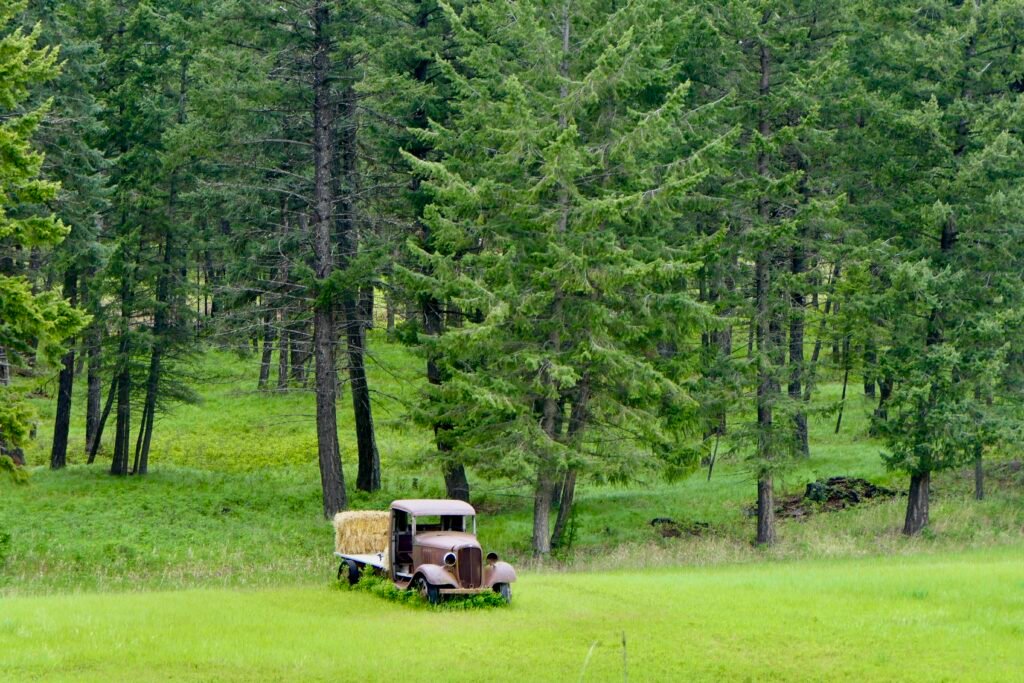
Two hours later I arrive in Whitefish and drop my bags at Grouse Mountain Lodge. It doesn’t have a lot of grouse but does have a lot of golfers.

The sun streams through the window at 6am, and I make for breakfast before heading out to Lake McDonald Lodge on the shores of its namesake. Among other things the lake is famous for are the coloured stones which pepper its shores. All the pictures you see in the brochures of these pebbles are somewhat enhanced, but nonetheless it is a remarkable sight.
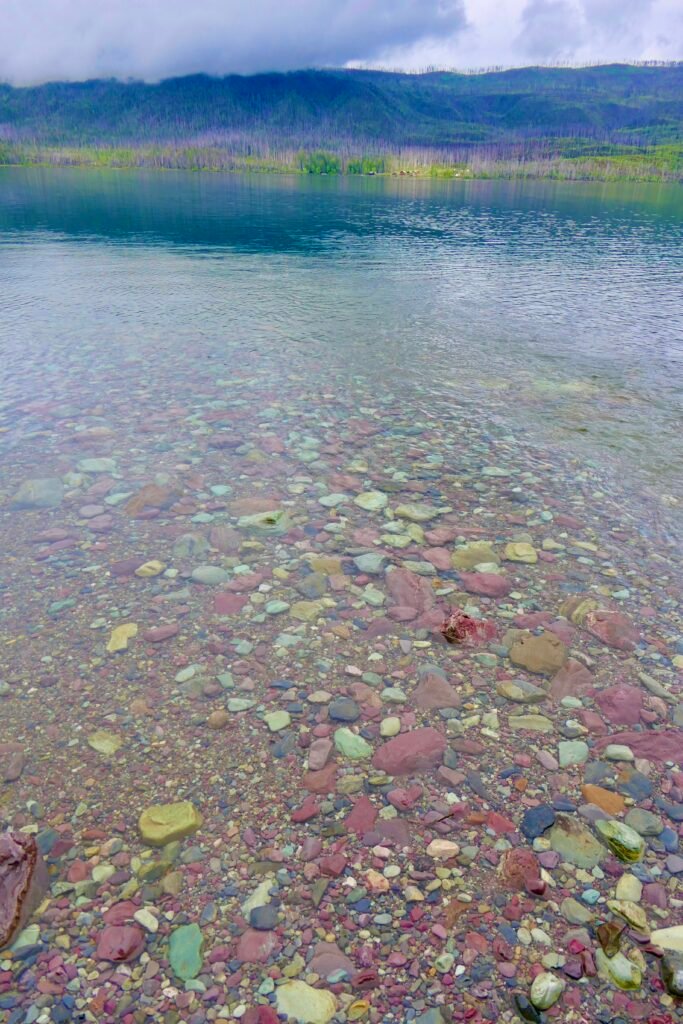
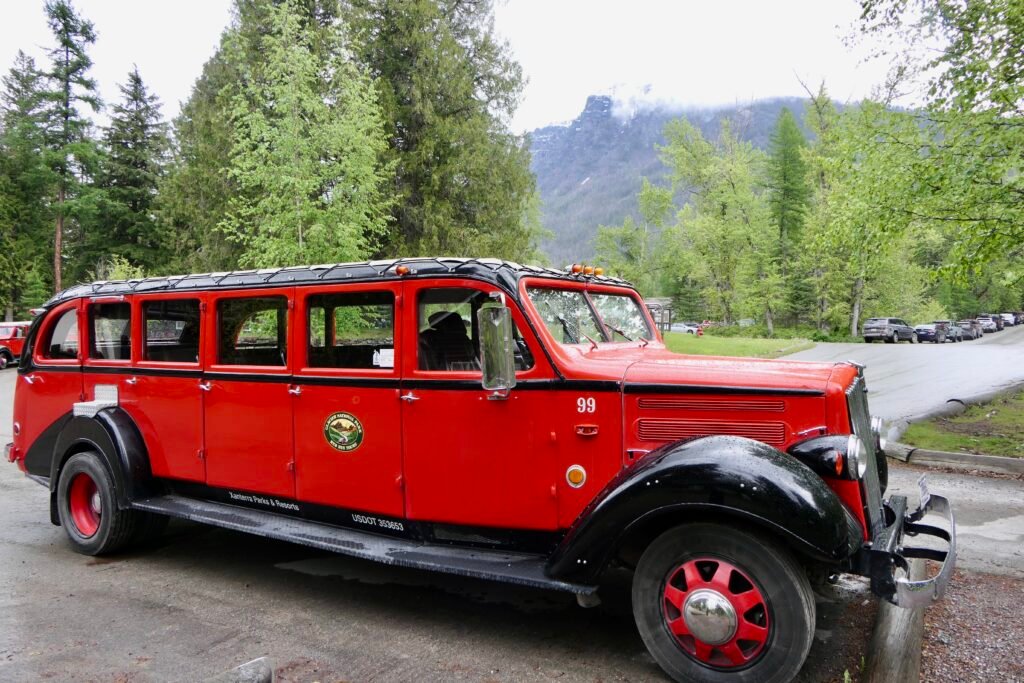
The surface of the lake is mirror-like while a dusty mist hovers over it this early morning. The famous red tour buses sit silently outside the doors of Lake McDonald Lodge and the stillness of the surrounding forest begs for the silence to continue for the rest of the day. Slowly at first, then with a growing hubbub, the tourists start to arrive and soon the place is awash with activity and noise spoiling an otherwise perfect scene.    
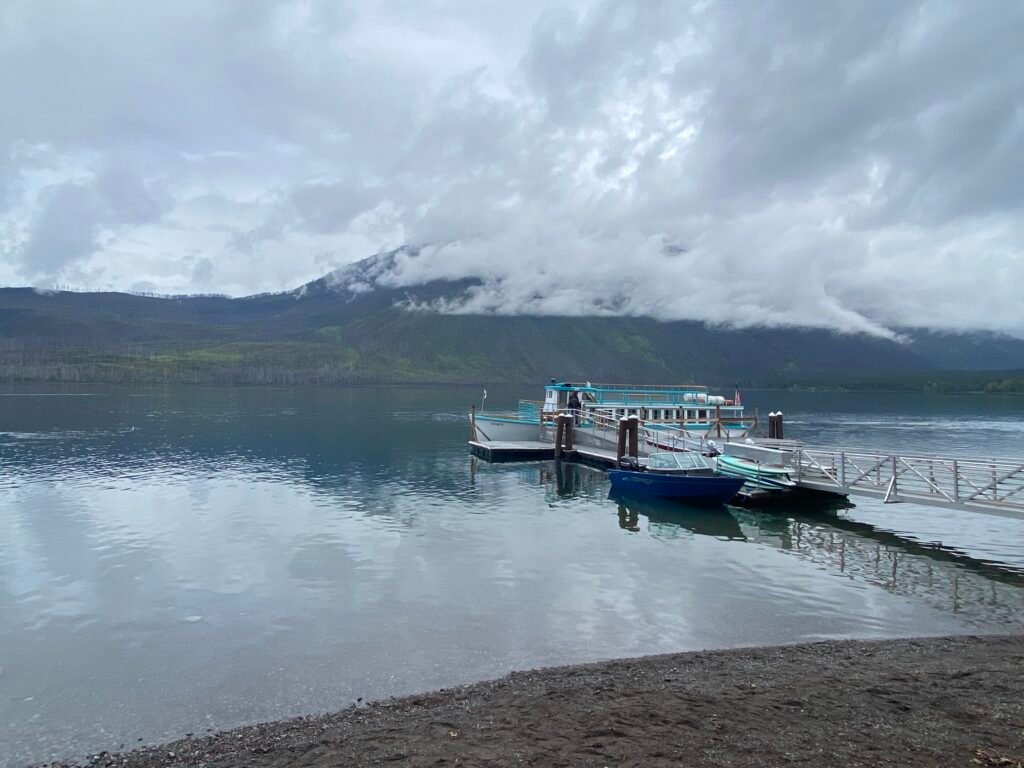
 

To escape these annoying tourists (I never count myself as one – I’m a traveller) I decide to take to the water on a guided one-hour tour on the Motor Vessel De Smet, built way back in 1930 with the wooden seating still lovingly polished. It’s easy to forgive the slightly hard benches as we glide across the water because it is a beautiful old cruiser. The commentary is entertaining and informative and as we reach the opposite shore, the full extent of the fire back in 2015 becomes apparent.
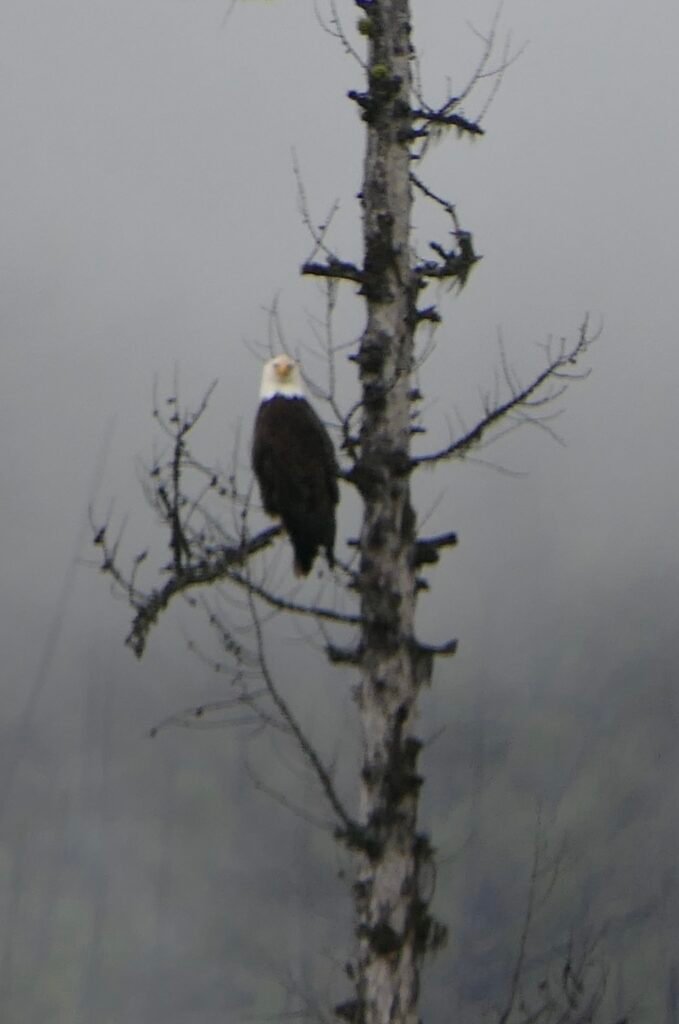
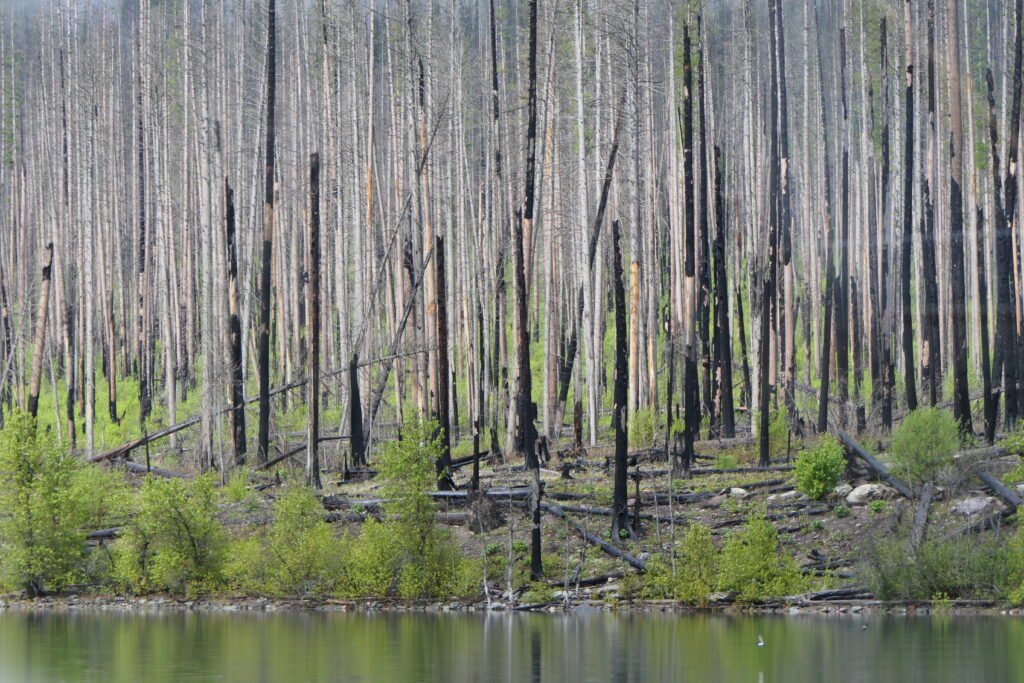
Bare, burnt trees stand at attention seemingly in black shrouds stretching way back from the bank of the lake, devoid of foliage, with the few green shoots hardly making an impact on the practically dead forest. It is an eerie scene with the mist hanging around the base of the trees. What it does do though, is give a clear line of sight to a family of eagles close to the shoreline, high up in one of the more substantial trees. We watch for a while to see if they take to the air, and while the passengers are patient, the captain is less so, as he has a timetable to run to. Wild eagles don’t do timed performances, but to see these extraordinary kings of the sky in the wild is an uplifting experience in more ways than one.
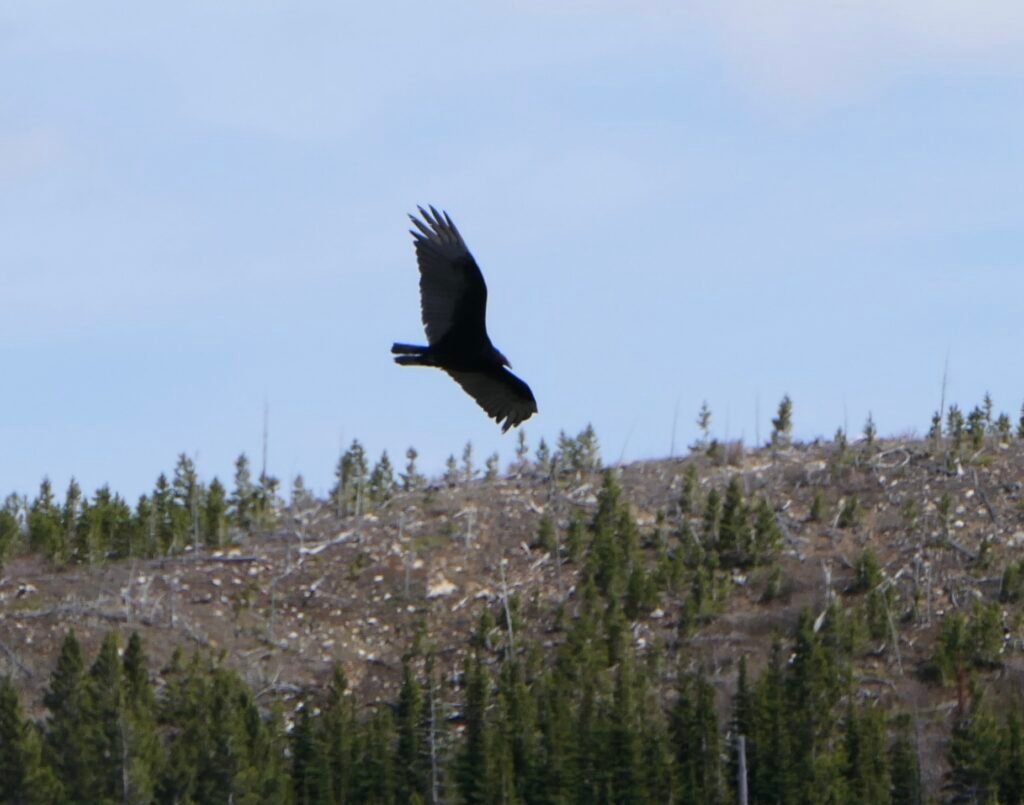
The following day I make the long run to get back across border to Canada stopping for coffee in Eureka before crossing at Roosville. I’m booked overnight at the Destination Inn in Radium Hot Springs and it turns out to be a nice upmarket motel, its best feature being its location, situated right behind a local bar that brews its own beer. After a couple of refreshments in the pub for research purposes, I set off looking for food and came across The Old Salzburg Restaurant. There doesn’t seem to be any particular reason why an Austrian restaurant has landed in this outpost, but it’s been a feature of Radium Hot Springs for over fifty years. The place is up for sale, but it is busy, busy, busy. The food is very good if a little slow in delivery.   
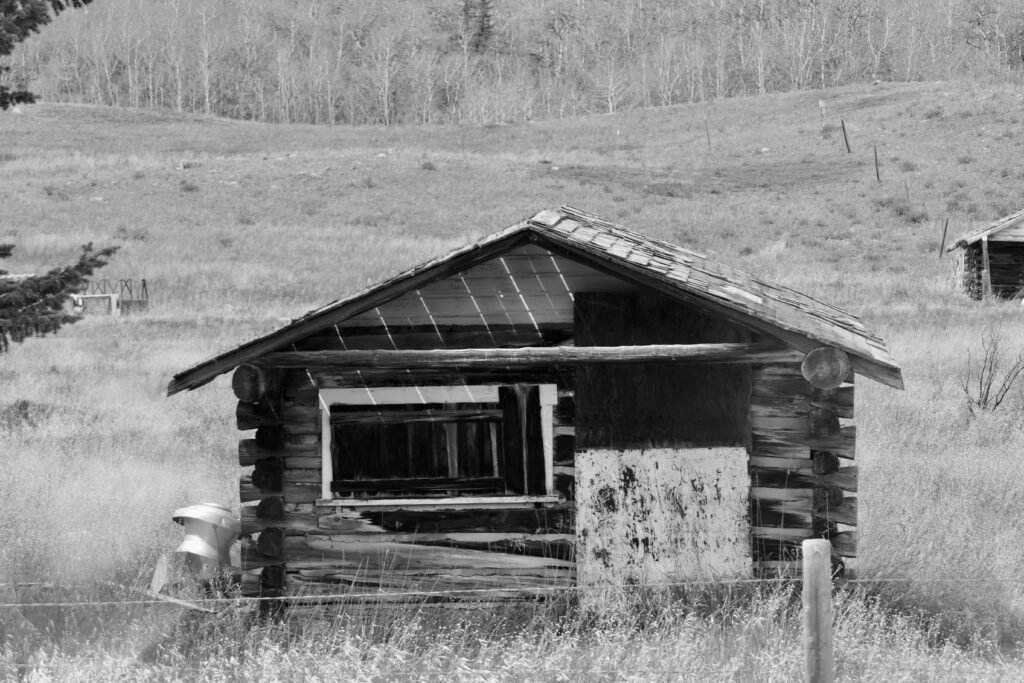
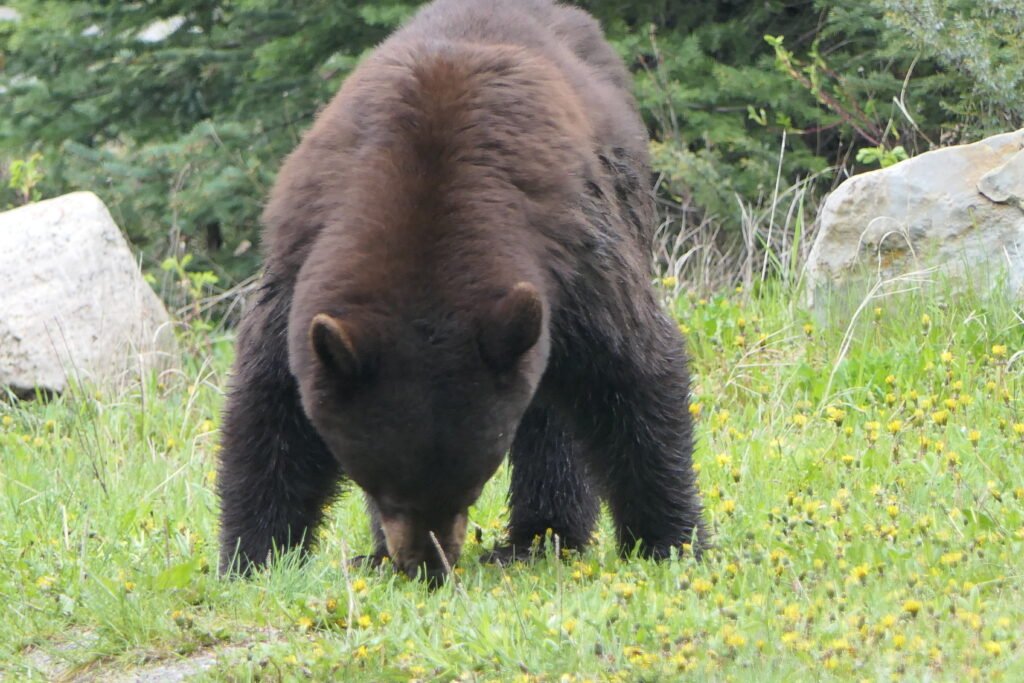
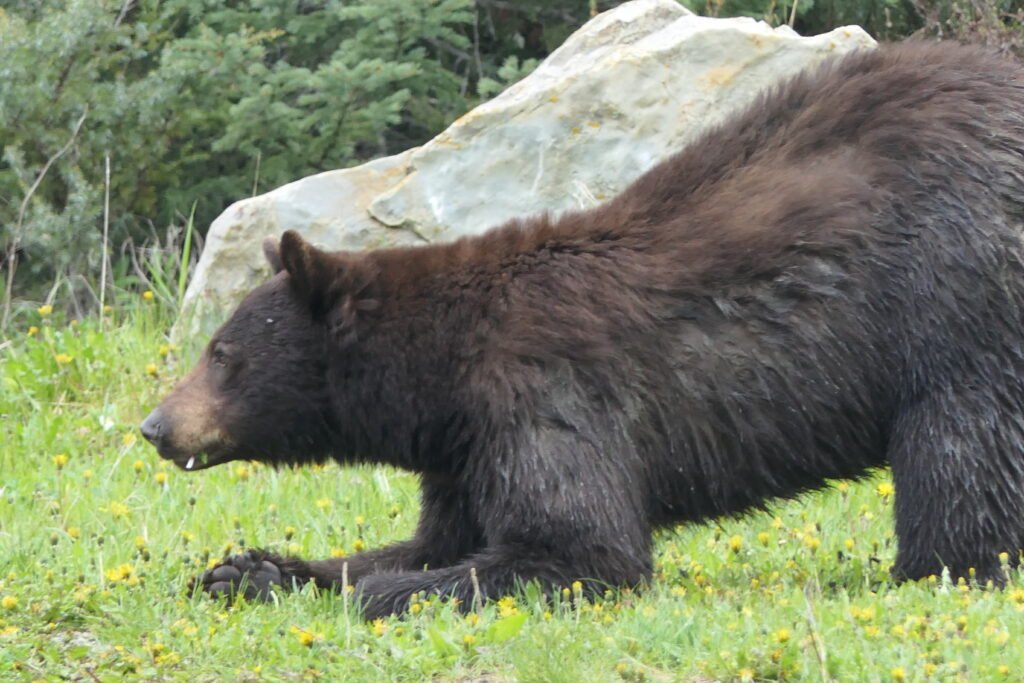
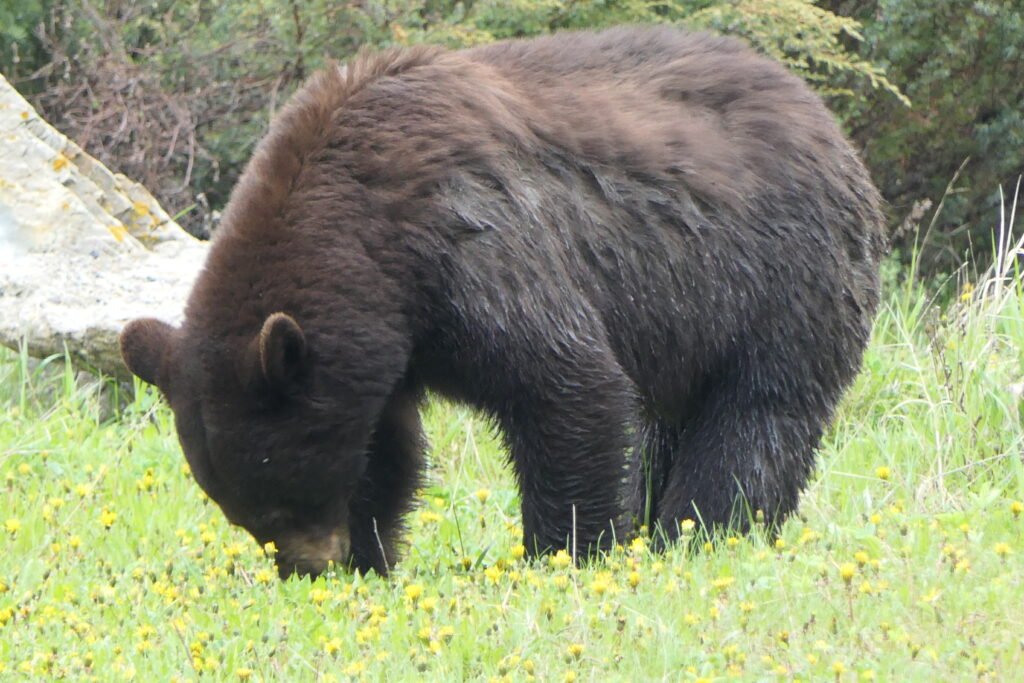
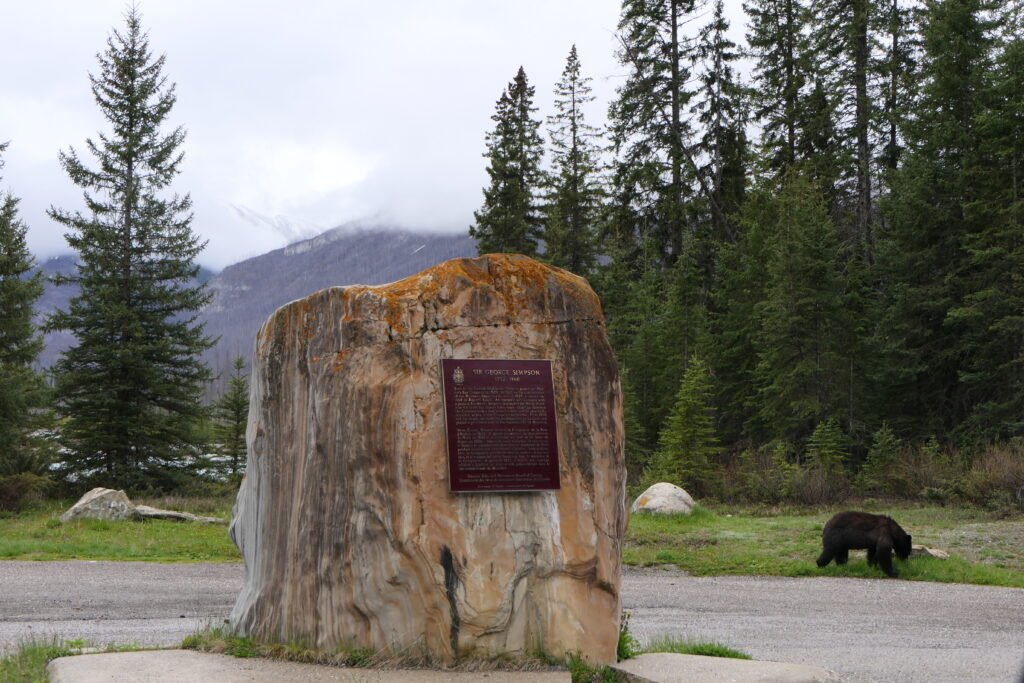
Morning arrives and I make an early start. I pass McLeod Meadows (spelt the correct way) and into the Kootenay Valley. I haven’t seen any wildlife since I’d left Lake McDonald. I don’t know why, but on route 93 just half a kilometre south of the Simpson River Trailhead at Vermilion crossing, I pass a pull-out, and look back to see what the view by the river is like. I decide to turn round and drive back to take a few last photos. As I park, a huge bear came out from a large plinth right in front of the car. I get a real surprise to see it standing so close. The odd vehicle passes on the highway, but none stop. For the next half hour, I have Mr Big Bear all to myself and what a joyful and exhilarating experience it is enjoying our time together – just him and me. Mind you, it could have been a her and me, but we were never introduced so I’ll never know. 
There was a plaque on the large plinth, which said it was dedicated to Sir George Simpson, a Scotsman who ran the Hudson Bay Company who ultimately became Governor of Northern Canada.
 

As I cross the Continental Divide in Kootenay National Park at an altitude of 5,382ft heading home, I amuse myself that somehow it was the ghost of my fellow Scotsman who tapped me on the shoulder and told me to look back at the pull-out, suggesting I stay awhile and have some bear-time. Another Last Flight Out moment.

The Road to Yellowstone

Yellowstone National Park

Some places don’t just sit on your bucket list. They move into your mind, unpack and occupy your thoughts for years. Yellowstone is one of those places.

We enter the Park from the south at 12:25pm. The time is important because I’ve been waiting for this moment for over 25 years, ever since I saw a film about the introduction of wolves to the park and how they changed the course of the rivers. The science may have been romanticised but the idea stayed with me. Now I’m here, Yellowstone does not disappoint. 

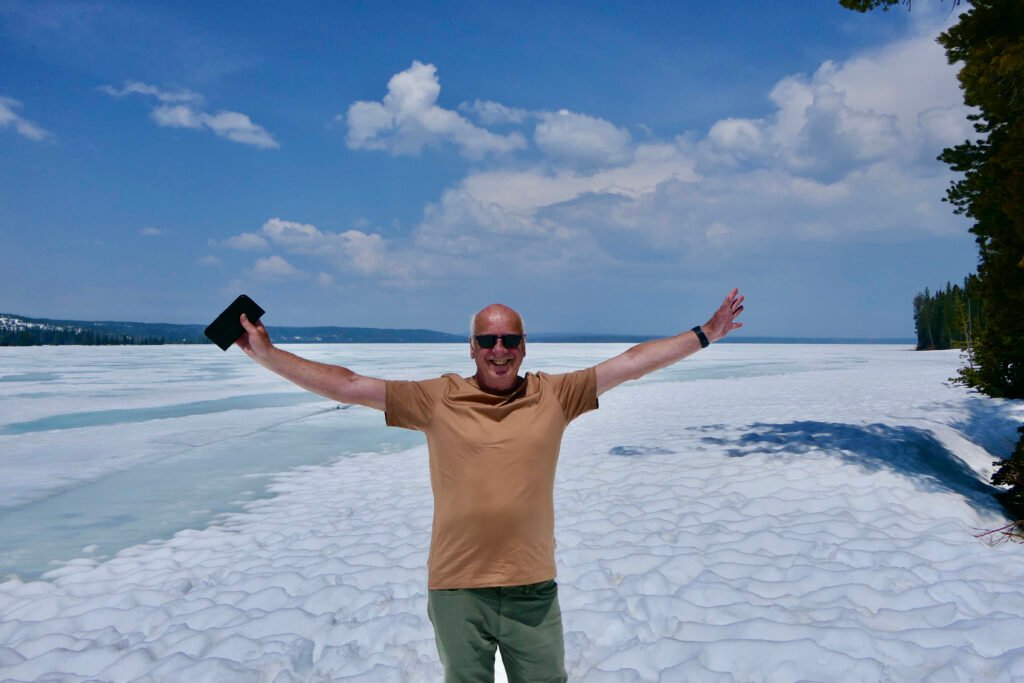
Our first stop is Lewis Lake, where snow blankets the frozen water from shore to shore, blindingly white making it impossible to tell where the land ends and the lake begins. We slip and slide the hundred yards or so towards the lake from the car park in footwear clearly not designed for winter exploration. Snowshoes would have helped, however we have this wonderful scene all to ourselves, but it is cold. Not the mind-numbing cold that takes your breath away, but a fresh, crisp, clear air cold that makes you feel alive and free, thanking nature for all it has to offer. We’re under-dressed for this part of Yellowstone, so reluctantly we leave this pristine scene and move on.

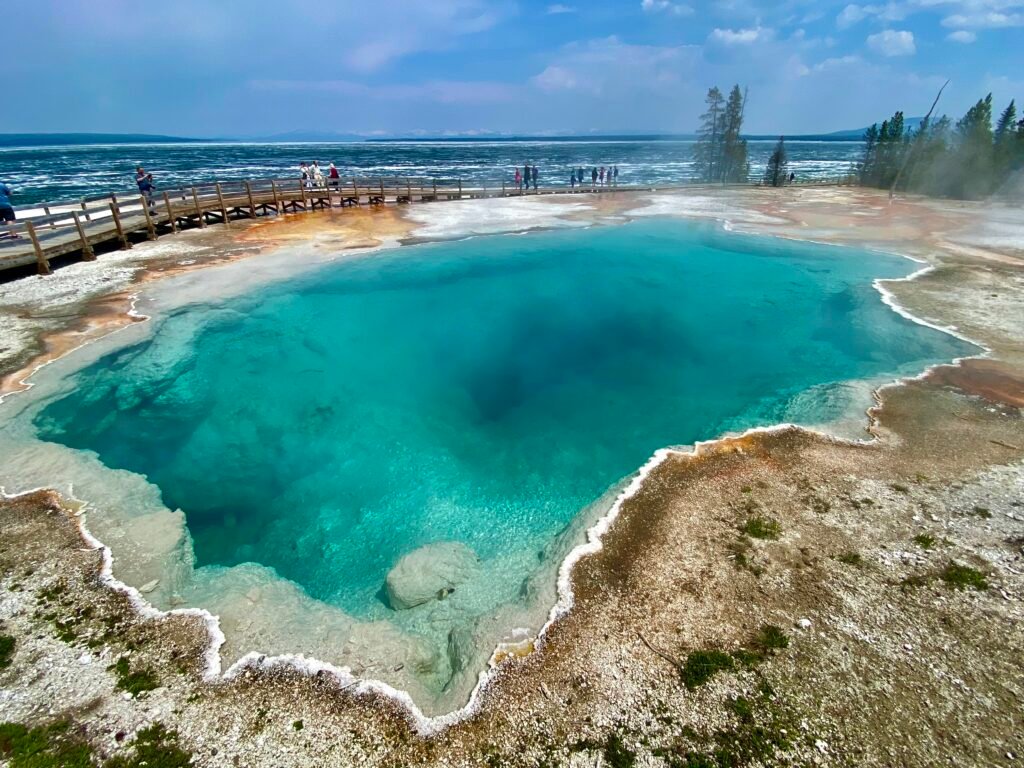
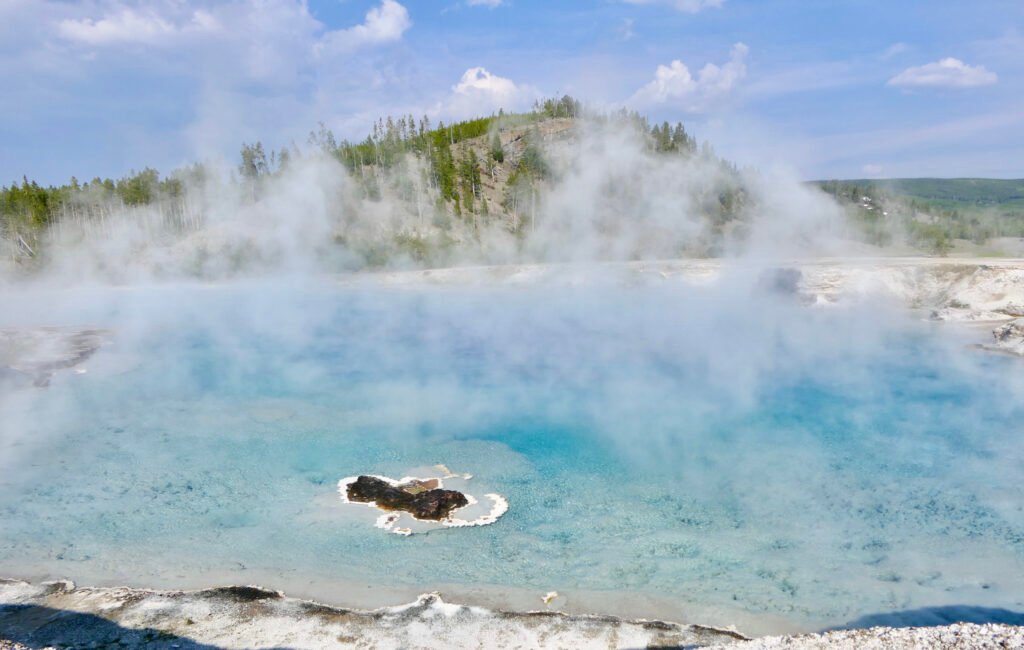
We move on to civilisation and the expected comfort and warmth of Grant Village, however the small collection of deserted buildings haven’t woken up for the season yet.  There isn’t much to open here anyway but a mobile coffee van wouldn’t have gone amiss if only to be able to talk to someone. The automatic filling station allows us to top up on gas as refuelling opportunities are few and far between in the park.  At West Thumb, mud pots bubble and small geysers spout beside an ice filled lake, steam drifting upward like breath on a winter morning. However, I start worrying for the rest of the day about what happened to East Thumb? It’s nowhere to be found. Maybe it succumbed to frostbite.  

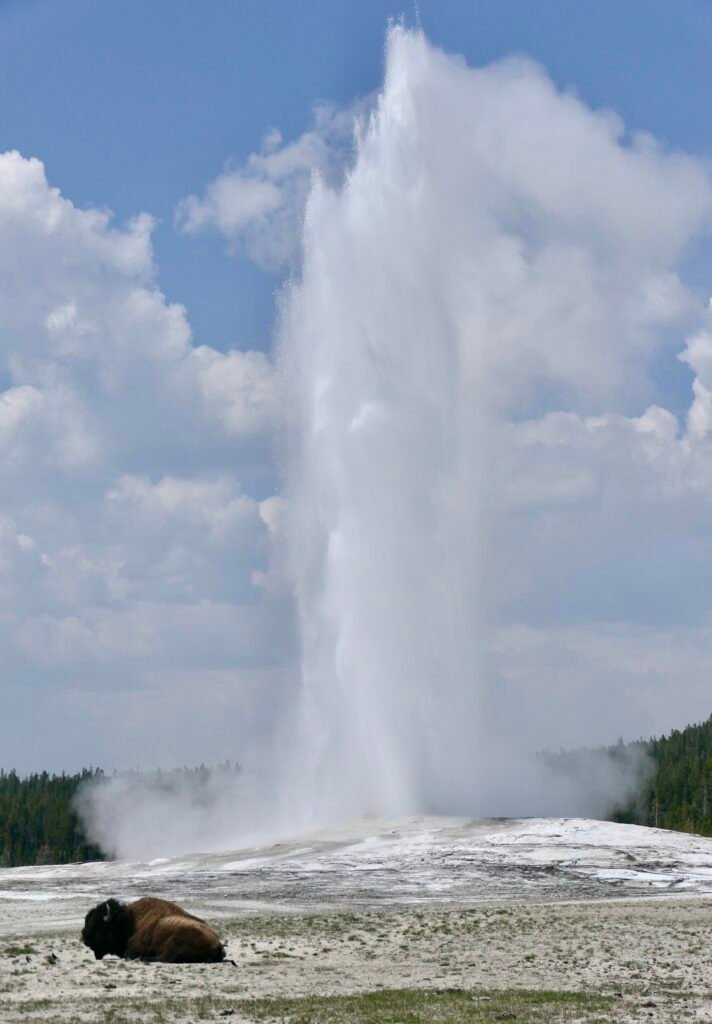
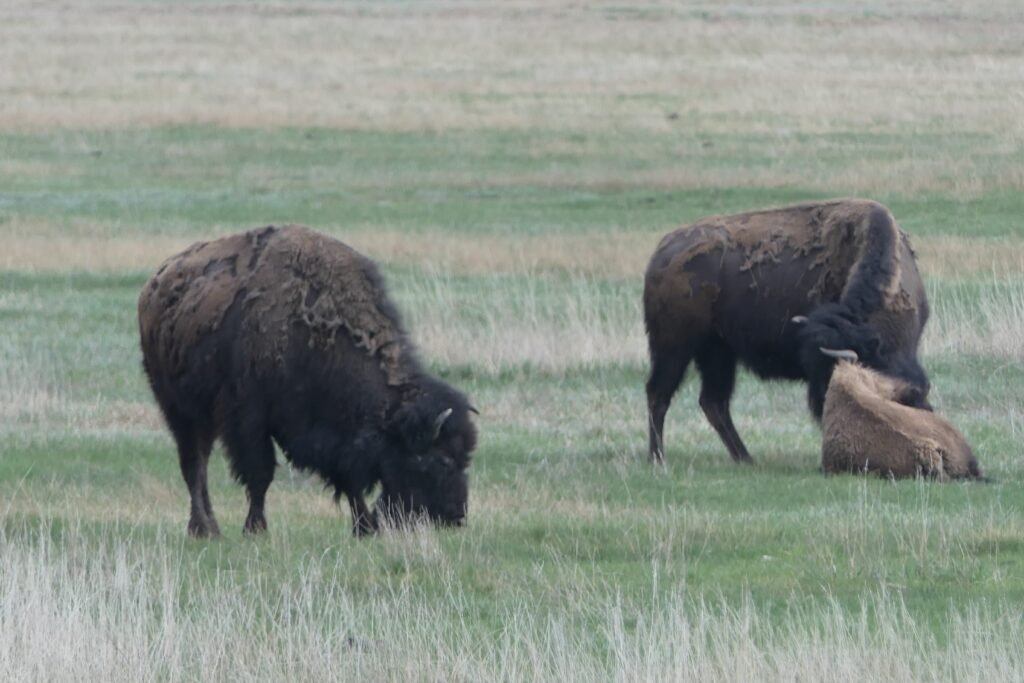
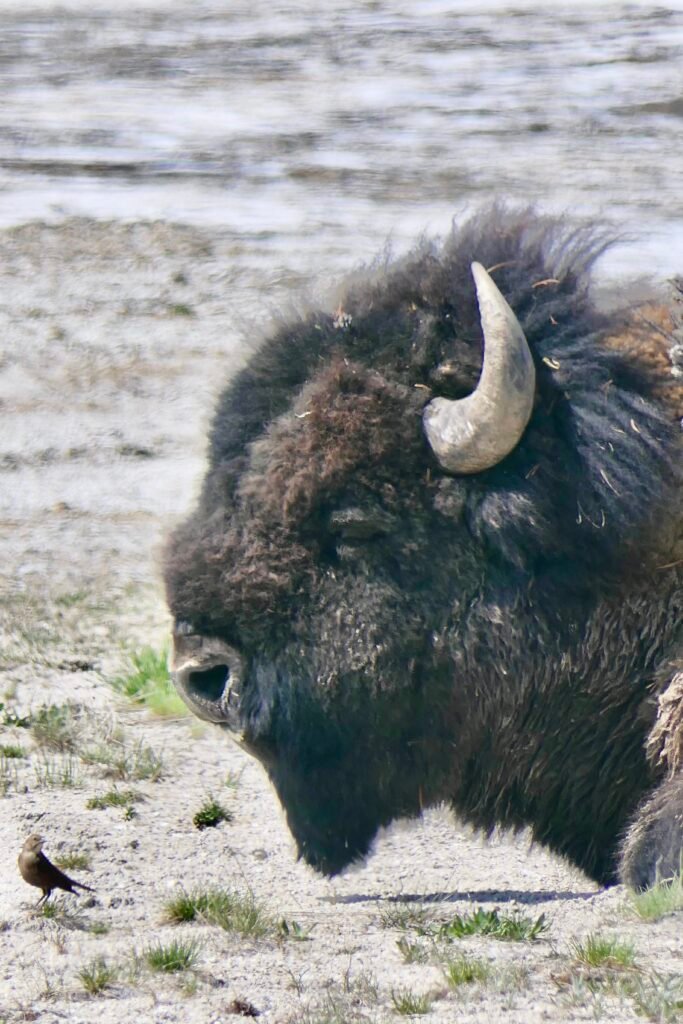
It is no surprise we find Old Faithful bustling with tourists patiently awaiting the big blow. Also waiting patiently, and with some dignity, are two bison sitting comfortably in front of the geyser offering up a classic photo opportunity. Moments later Old Faithful, true to its name, erupts with surprising force, a silver column roaring into a bright blue sky.  

The bison remain unmoved by this remarkable display of nature, no doubt having seen it show off many times before. As the great spout subsides, and knowing the show is over, the two great lumbering friends move on as the human audience drifts away, all of us with the common aim of foraging for food.

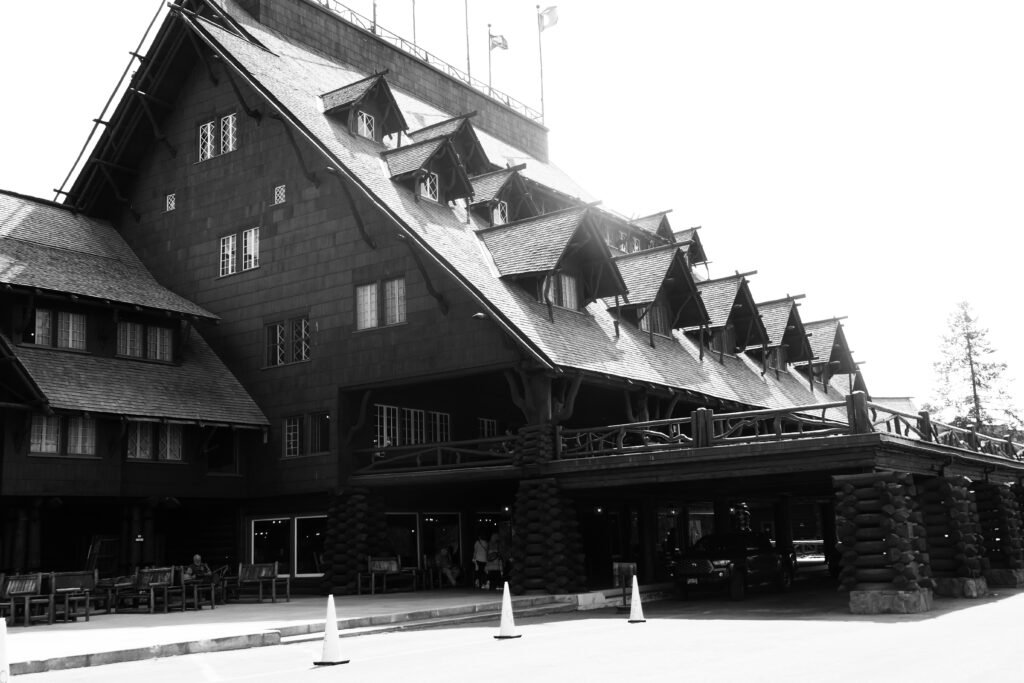
Our lunch is a little bit more accessible for us than our bison actors who graced the stage earlier as we move a few yards inside to the Old Faithful Inn to take refuge.  

This remarkable and very old hotel is seething with admirers as they gaze up at the vast timbered cathedral of a building. Beers in hand, we step onto the balcony to watch the geyser erupt again. What goes up must come down, so as the geyser goes up, our beers go down.   

Apparently only 2 per cent of visitors ever venture more than a mile from  the few roads that populate Yellowstone. That’s partly to do with available time, but there is also a sad lack of adventurous spirit around. Regrettably. time constraints put us firmly in the majority  We loop through Mid-Geyser Basin over the footbridge on the Snake River, then the two-mile one-way Firehole Canyon circle and its waterfall, through landscapes that change faster than you can process them. It advertises the opportunity for swimming, but with the snow run-off it’s hardly surprising there are no takers who are willing to experience hyperthermia as part of their tour.  

Our accommodation for the evening is Canyon Lodge, although we are delayed by a grumpy bison in the middle of the road who refuses to move, no doubt upset at losing his way to Old Faithful. In the distance a herd of elk are lifting their legs high and slow, carefully picking their way through a swamp like a marching band, so the hour-long drive seems to pass quickly.

Like all National Park hotels, the accommodation is expensive and underwhelming, the food forgettable with the sad looking chicken burger and a decidedly desperate feta pie served by the canteen, sorry – restaurant, doesn’t cut the mustard either. If only there actually was some mustard on offer to provide some bite to these bland dishes. 

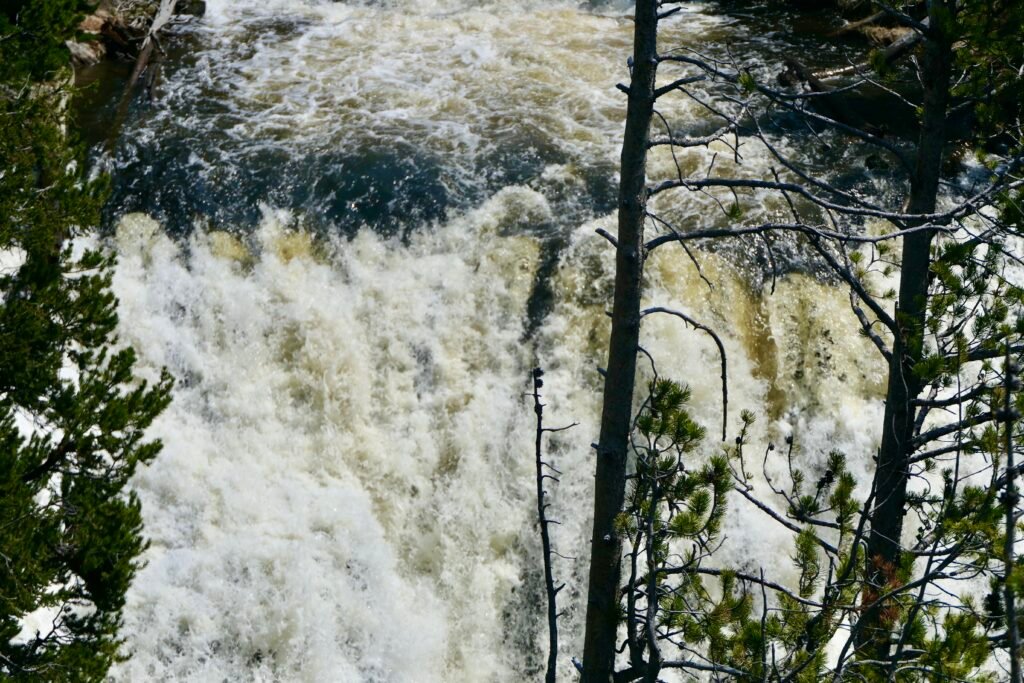
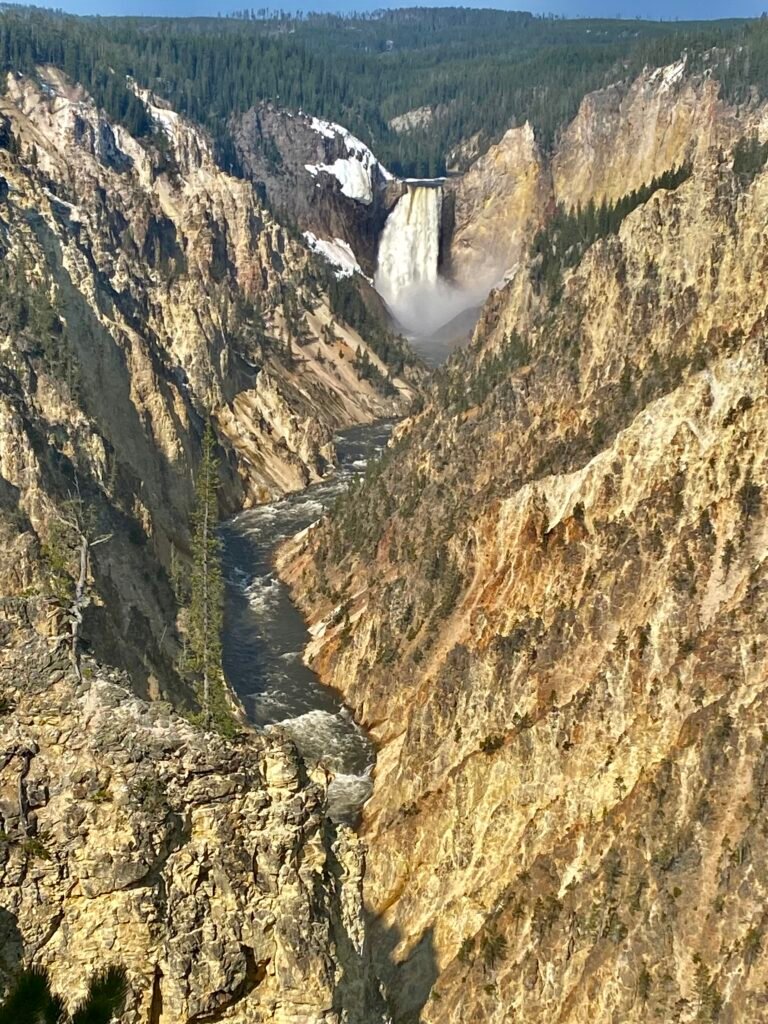
We escape quickly and drive to Artist Point. The view of the Lower Falls comes into view, and it’s a showstopper. Years of anticipation crystallise in an instant as water thunders into the canyon below. A rainbow forms at the base. First, a ghostly mirage of fused colours, then crystalising into sharp focus before being seemingly washed away by the sheer force of the water. Later at the Upper Falls overlook we look down on people standing precariously close to the edge. Sleep that night, despite the uncomfortable beds and banging doors, is serene and contented.  

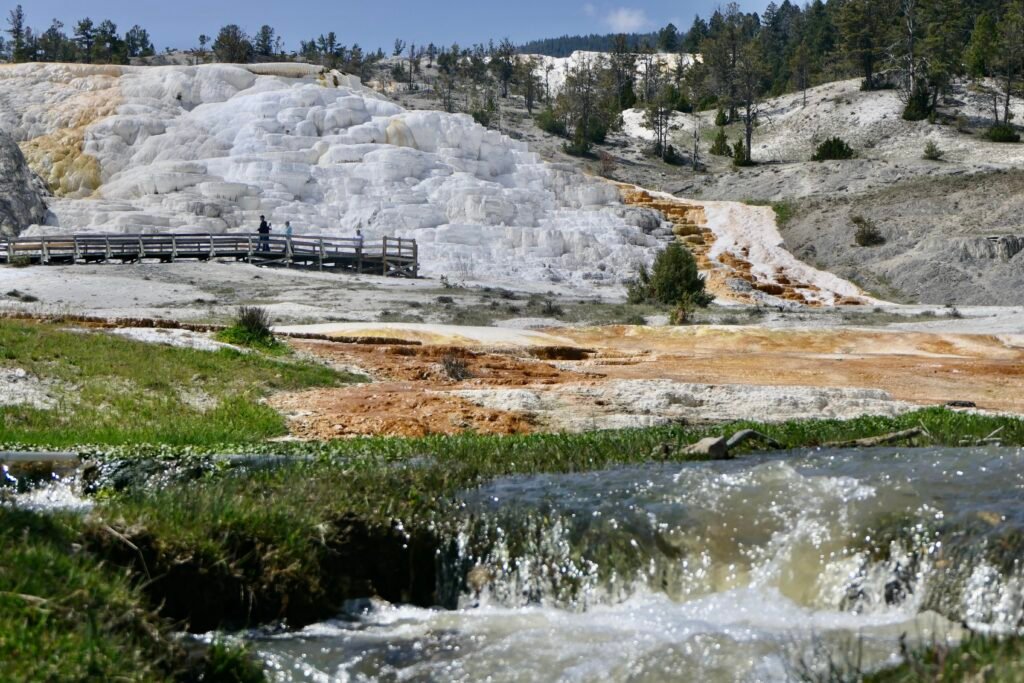
Skipping the delights of the canteen breakfast we drive north, past Roaring Mountain, under Grizzly Lake high up in the hills, alongside Obsidian and Sheepeater Cliffs, before falling into Mammoth Hot Springs.  The Terraces rise like a frozen cascade, white and immense shaped by heat and time. I guess the word Mammoth says it all. The 300 feet climb can be challenging, where the loop hike takes about an hour.

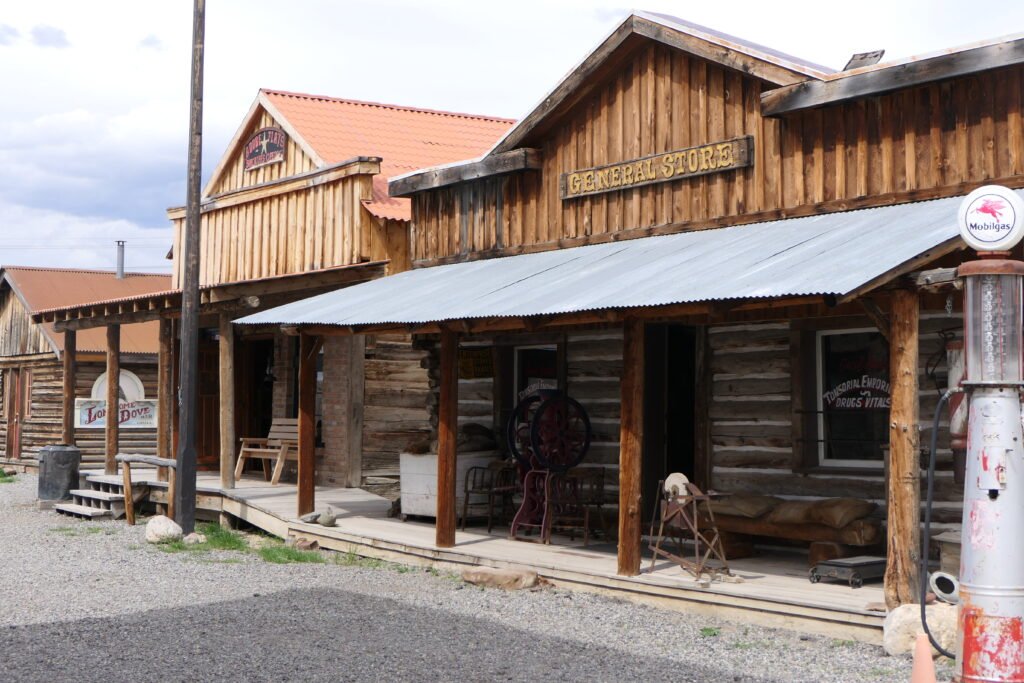
Our stomachs now rule again, so we invade the general store looking for lunch and are rewarded, if that’s the phrase, with Ritz Crackers, Philly Cheese and an Almond muffin. America’s National Parks are not known for their edible offerings, which I might have mentioned before. 

On the way to Tower-Roosevelt through the Blacktail Deer Plateau I’m expecting an interesting story behind the name. However, it turns out that Teddy Roosevelt merely holidayed here beside a large, tall, towering waterfall. Nothing more, nothing less. I suppose it does what it says on the tin.

As we stop at one of the numerous lookout points to enjoy the view, a van speeds into the parking area and u-turns rather quickly, stony dirt being thrown aimlessly from under the spinning tyres. The driver shouts one word – “bear” and speeds off. We follow and sure enough we spot a huge grizzly on the hillside. We use these precious minutes to take some photos before the big, bad Yellowstone ranger comes round the corner with flashing lights to moves us on so as not to create a queue.

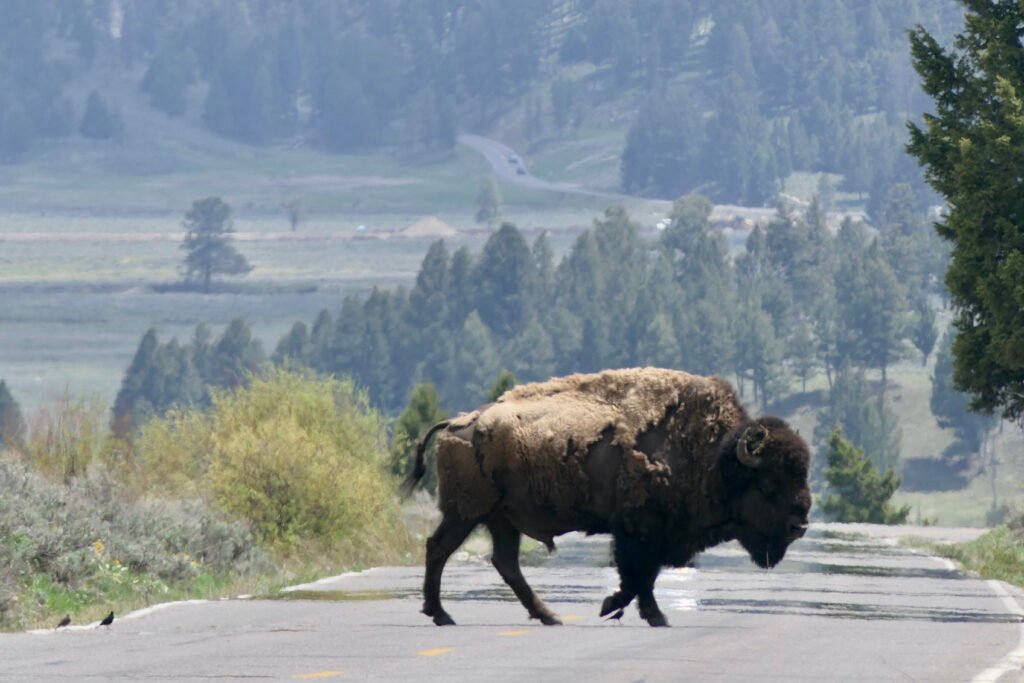
As it happens, just round the corner, a herd of bison decide to take 20 minutes to cross the road, stopping intermittently to stare at the queue of cars as if to say – this is our road, not yours. Not much further and we get stuck again, this time by a type of animal known all over the world – the road-worker, or as they call them here – the highway operative. I assume it doesn’t get you any more pay, just a more important job description so you don’t ask for a rise. There are dozens of them laying down new tarmac so the bison can walk on the road safely to hold up more traffic in the future. It’s one vicious circle in Yellowstone, but a beautiful one !  

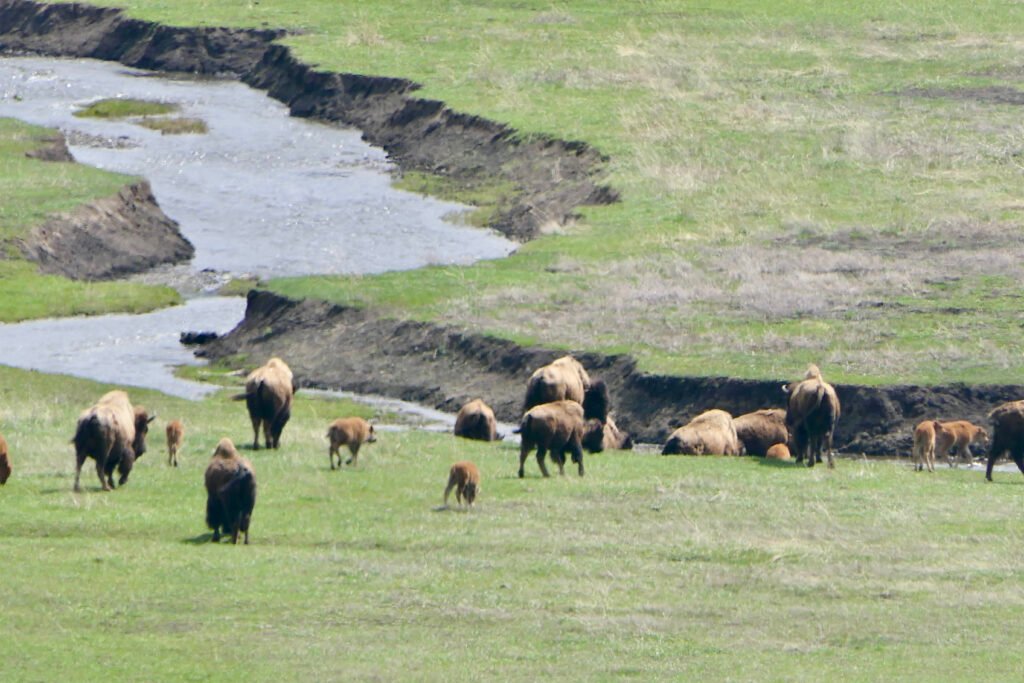
Entering the Lamar Valley is another truly uplifting experience. The valley stretches for miles with sweeping views of the meadows giving you a panoramic view of the wildlife on offer, filled with herds of bison and elk. 

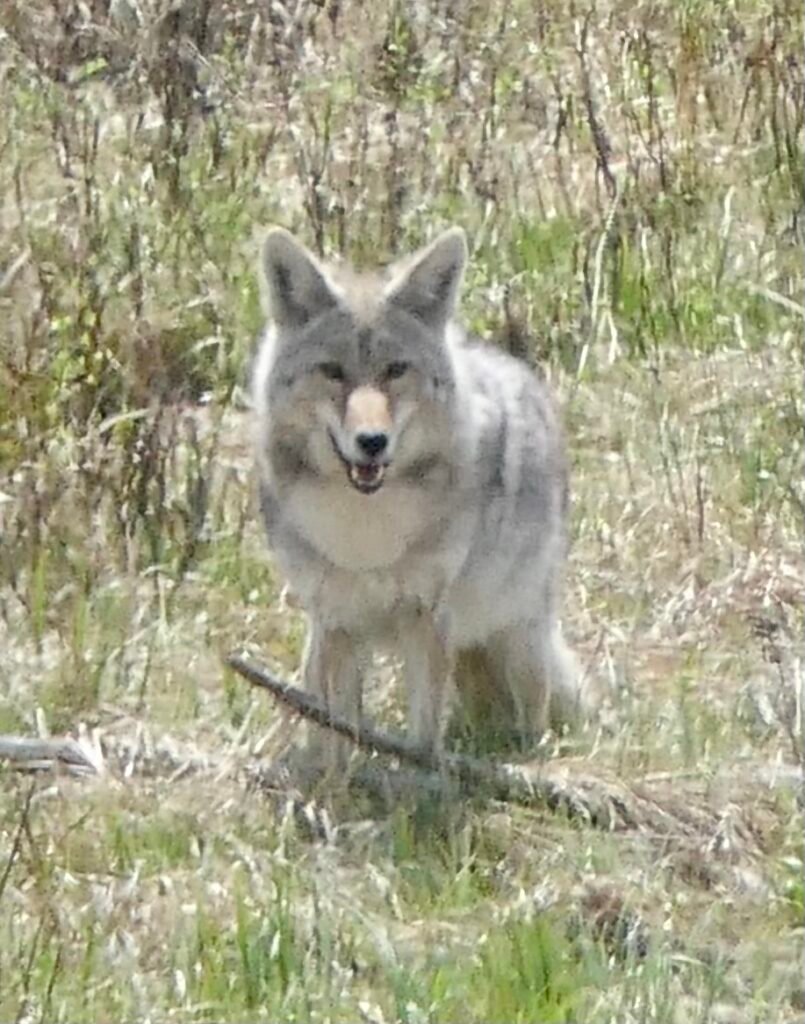
A girl pulls up, gets out of her car and swings a camera with an extraordinarily long lens on to her shoulder. Normally I would be impressed by this, but she is looking at something in the far-distance so I follow her gaze. Without skipping a beat, she says just one word – Coyote. Now, I’ve never seen a coyote before, and at the moment I still can’t see it, so I’m very impressed that she spotted it in the bushes from her car. Apparently, many people treat them with disdain because they’re scroungers, but I think we should admire them for their tenacity, if not their good looks. It looks like a wolf that failed the audition.  

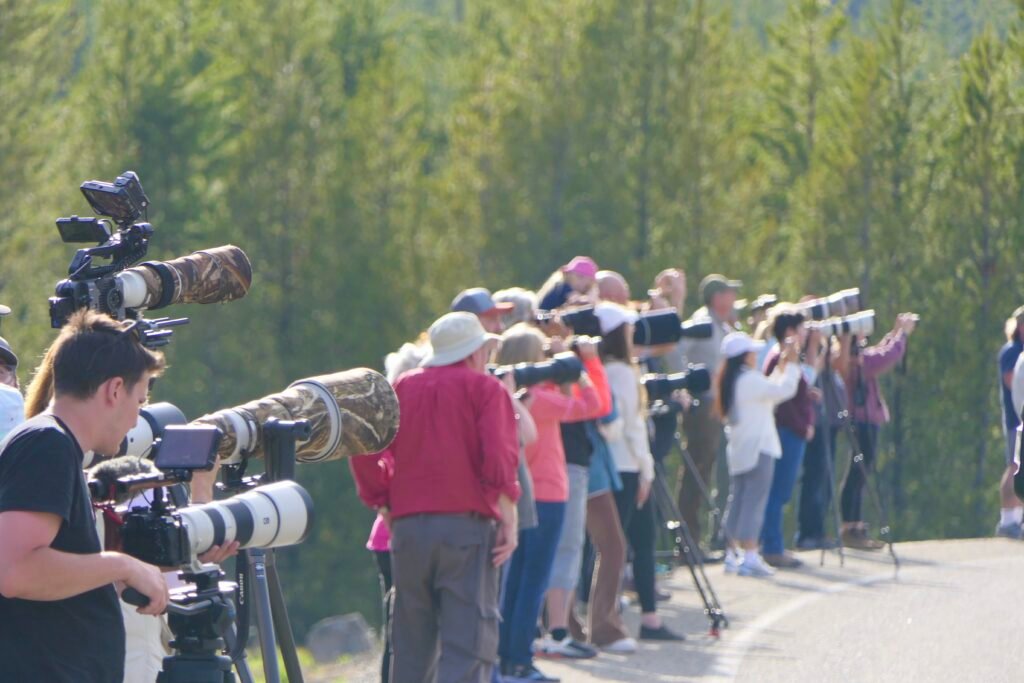
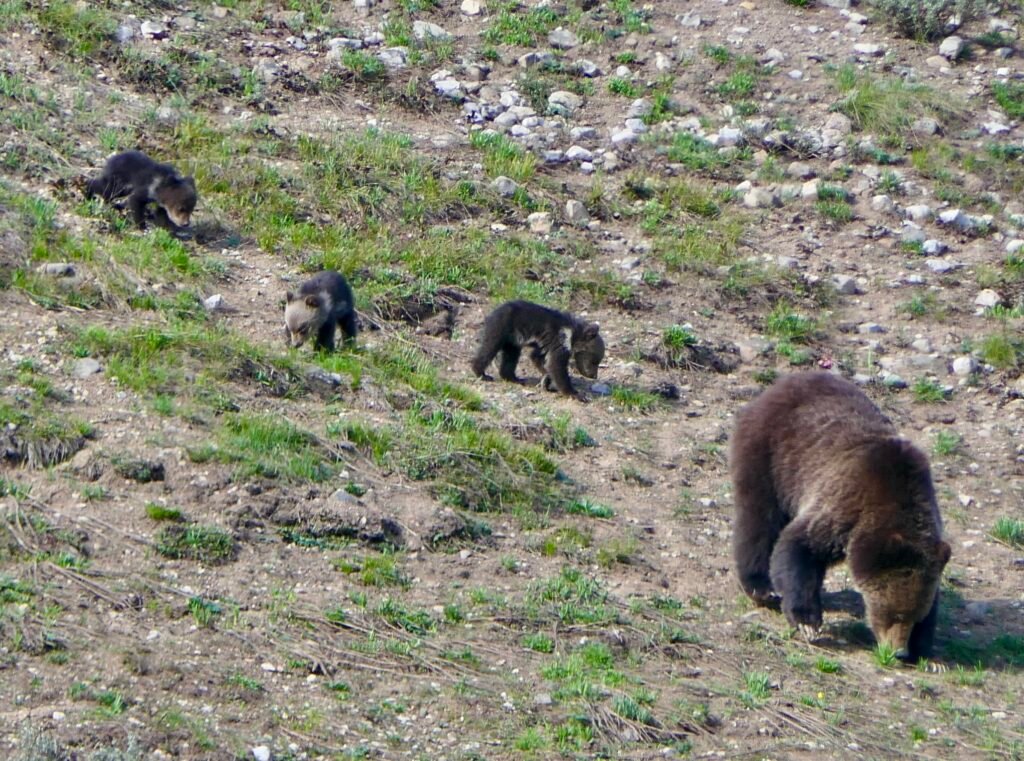
We turn at the end of the valley for the 30 minute drive back to Canyon Village and are confronted by a lRoad Closed sign. I groan as it’s 37 miles back the way we came, so no early dinner tonight. However, what’s for you, won’t go by you, as some Scottish sage once said. We come across a host of photographers standing along the side of the road staring up into a hillside, their huge telephoto lenses almost blocking the road. We find a parking space by chance amongst the dozens of cars abandoned at various angles on the grass verge, like they had been swept away in a flash flood.  Looking up at the hillside we spot what everybody is here for – a grizzly bear called “Obsidian” with her three cubs.

Watching a bear and her cubs in the wild is profoundly moving. Everyone, everywhere, should get the chance to see a bear in the wild. It’s one of life’s great experiences. We watch them for half an hour while they graze and forage along the hillside, and as they move southwards, the whole crowd moves as one. I’m not sure what a group of avid photographers is called – maybe a Frame of Photographers? A Focus of Photographers, or maybe it’s just a Negative of Photographers!

They said they had been waiting to see Obsidian with her newborn cubs in tow for a couple of weeks since she emerged from her winter slumbers. If it hadn’t been for the road closure, we wouldn’t have seen them. I’ll never shout at road-works again. As the bears disappear over the hillside, we all drift away silently, content that in the last hour or so we’ve witnessed a scene that, in reality, only the lucky few in this world get to see.   

Time was moving on and we had a reservation at Lake Yellowstone Hotel for dinner. We pass through spectacular scenery in the half-light giving the surrounding hills a mysterious and intriguing feel, as if an artist’s deft touch has added light and shade to create a moving tableau round every corner.

The evening descends into chaos. long waits, missing food, harassed waiters complaining guests and very weary staff. Nicole, the manager apologised. I told her to sit down as she looked as though she’d had just about had enough. You know it’s really bad when the tables start groaning. Those sitting at those tables were equally angry. The meal is comped and the total bill comes to $16, plus three hours of my life.

I feel sorry for the harassed waiter, so I give him a generous tip before turning round to see my partner and Nicole disappearing down the hotel corridor arm in arm, now best of pals. Nicole was very excited to learn we were from Scotland, apparently because she is a McDonald, and so the two of them swap emails. Never to be used of course. It has been an unforgettable day softened by exhaustion and shared stories.

Day three drops in and we’re all packed up at Canyon Lodge ready to leave. We return to Artist Point once more. There is no rainbow today as the sun is too low, but the emotional pull happens again, partly because we don’t want to leave. Driving East we pass ice-rimmed lakes, shimmering in the morning sun.

At Fishing Bridge, we stop to raid Pendletons General Store where once inside, we decide not to pillage but actually pay money for some snacks. 

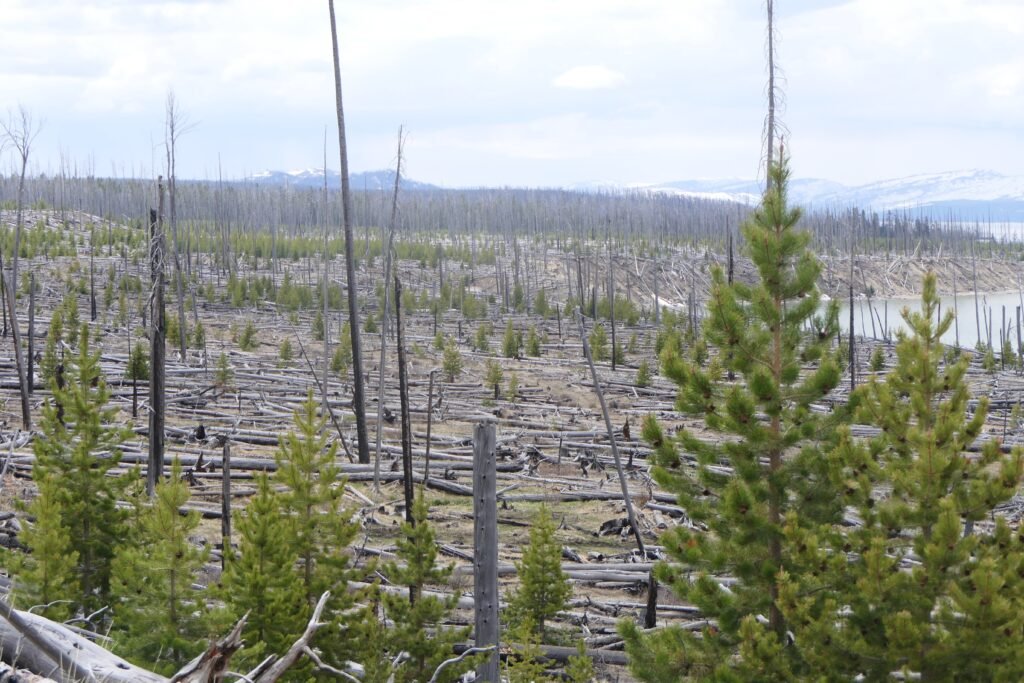
At Mary Bay near the exit, the storm damaged forest stands as a reminder how fragile even this vast wilderness is.

We exit Yellowstone at 12:45pm, and a little bit of my heart is left behind. I make a promise to myself that I will return. It may be the sad goodbye that plays a part, but some small sliver of my soul lives in these wild open spaces where the animals roam and the waters flow. Suddenly it starts to rain. Almost the only rain we’ve had on this month-long trip through the States. By coincidence a song starts playing on the car radio by the Scottish band Runrig. The beautiful and haunting “Going Home’’.

“In the distance day was dawning,
Comes to me the early morning,
Something tells me that I’m going home

The brand-new sun shining bright
From the darkness, fields of light
Something tells me that I’m going home”

From Grand Mormons to Grand Tetons

Salt Lake City’s Temple is covered in scaffolding when we visit, undergoing a four-year renovation scheduled to finish in 2026, so no doubt many other tourists will be disappointed as well by not getting the full visual impact in this magnificent square. I guess it’s a metaphor for ‘work in progress’ for both the building and the Mormon Church. Membership of the Latter-Day Saints is declining in the US but growing elsewhere. Half their 14 million members live outside the States, but the estimated net worth of the Church at over $250 billion is staggering. Members are encouraged to pay up to 10 per cent of their salary to the Church, so you have to be a big believer that the money is going to put to good use. Back home in the UK, the reader might be surprised to learn that the Mormon Church owns many thousands of acres of land in Norfolk and Suffolk.

Talking of movement, there is a lot less movement on Salt Lake’s massive freeways – six lanes of chaos. The local residents may stay true to their religion, but their choices of lane along the freeway change by the second. It’s difficult to believe there is this much traffic this far north of Los Angeles. I remember visiting Salt Lake City some 25 years ago, walking into a bar and being told we needed a sponsor before we could drink there. The only other person in the place was Sam, who was clearly a regular and – surprise, surprise he agreed to sponsor us in return for a beer. Or rather several beers as it turned out, but he was good company. Having dinner later at an upmarket restaurant in the city, we had to finish the first course white wine and the bottles removed, before we could open the red. There would be a riot if that happened in a Scottish restaurant.

Onward from Salt Lake City, we travel through Logan Valley, visiting ‘Aggies’ for ice cream in her retro cafe. We find out it is a very expensive retro café, paying for all that retro I suppose.

That sets us up nicely for our foray into the hills as the snow lies thick, and where, at a particular dramatic viewpoint we unexpectedly meet a young couple from Iran, called Payum and Myta. I love these unexpected chance meetings with people, although it is a long way from home for all of us, but we see them again later in a couple of places down the road. Meanwhile, as we’re talking, a cross country skier casually slides by us in the snow…..and this is nearly summer ! We drive on past Beirdneau Peak and through beautiful farmland into Garden City at Bear Lake. It’s very quiet and resembles a ghost town by the water.

We continue through little settlements like Fish Haven, Bloomington and Paris. The one without the Eiffel Tower obviously. There are dozens of beautiful summer homes here, but not occupied yet for the summer season and with few signs of life. 

We reach Montpellier where unfortunately, the tiny bank that Butch Cassidy robbed is sadly closed for the day. Maybe they only get robbed on four days of the week. Just because Butch and Sundance sang ‘Raindrops Keep Falling on my Head’ doesn’t make them good guys, but we get taken in by the romance of it all. Star Valley, Smoot and Afton with the antler arch over the street slip by, then Thayne, Alpine and Swan Valley disappear behind us.

We arrive in Victor at another Air BnB and step into Irma’s Place. This is a lovely house but there is no sign of Irma, although the door is unlocked and we had been told to settle ourselves in. A happy little dog runs up the stairs to greet us. Maybe the dog is in charge of check-ins? When Emma eventually arrives back from her day job, she keeps herself to herself and we go out and eat at the Knotty Pine Restaurant. We sit outside but as the weather gets noticeably chillier, we move indoors where the cosy atmosphere is countered by the noisy crowd and even louder waitresses. 

318 miles today

We are in Victor for two nights, so leave early in the morning to drive the 40mins to Jackson. I find out that my credit card has been charged twice, so we need to go back into the Knotty Pine to query it. After a language barrier of American English versus Scottish English, we resolve the problem and take the Teton Pass Highway round Taylor Mountain to Jackson Hole. An eagle swoops over us and disappears towards the lake, reappearing with a huge catch in his claws as he soars skywards.

As we arrive, Jackson is holding the Annual Antler Auction for the Boy Scouts of America in the main square. Scouts from the Jackson District hike the 25,000 acre National Elk Refuge to pick up antlers shed from the male of the species. They must have an extraordinarily sized boy scout membership in Jackson because there are hundreds and hundreds of antlers, stacked high on pallets roped together in bundled lots and stretching down three or four streets. The square is packed with people listening to the auction from small bleachers, and we learn that these antlers are surprisingly expensive, so I resist an impulse to make a bid. We wander off looking for coffee through the displays of discarded animal jewellery. 

An upmarket, trendy place called “Persephone” provides us with a breakfast of posh coffee and trendy muffins in the sunny garden.

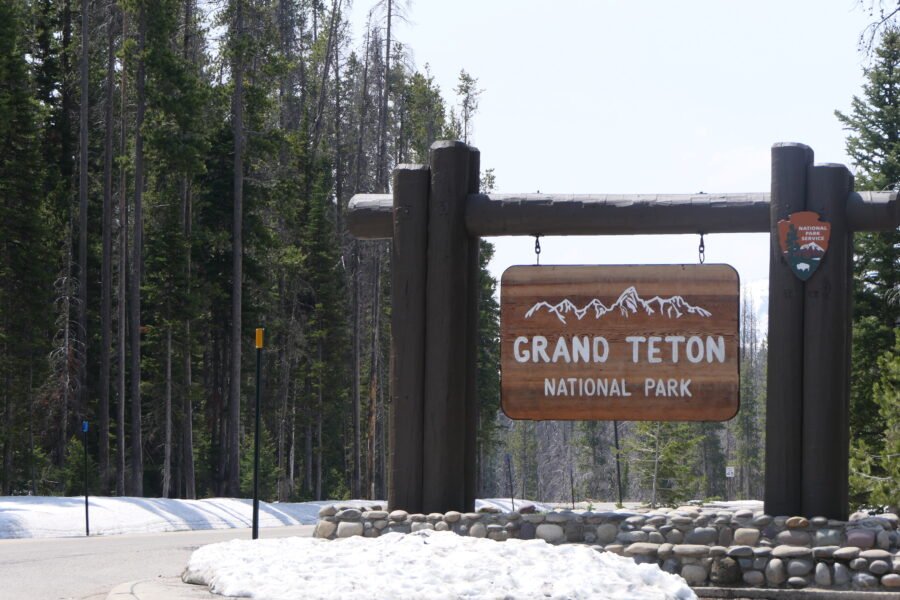
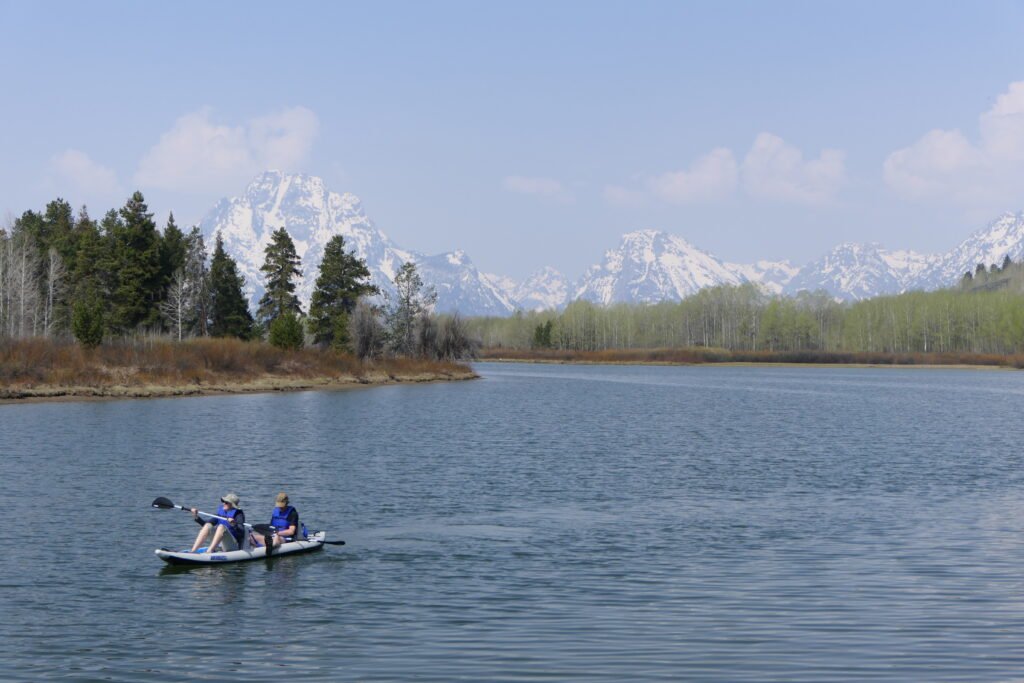
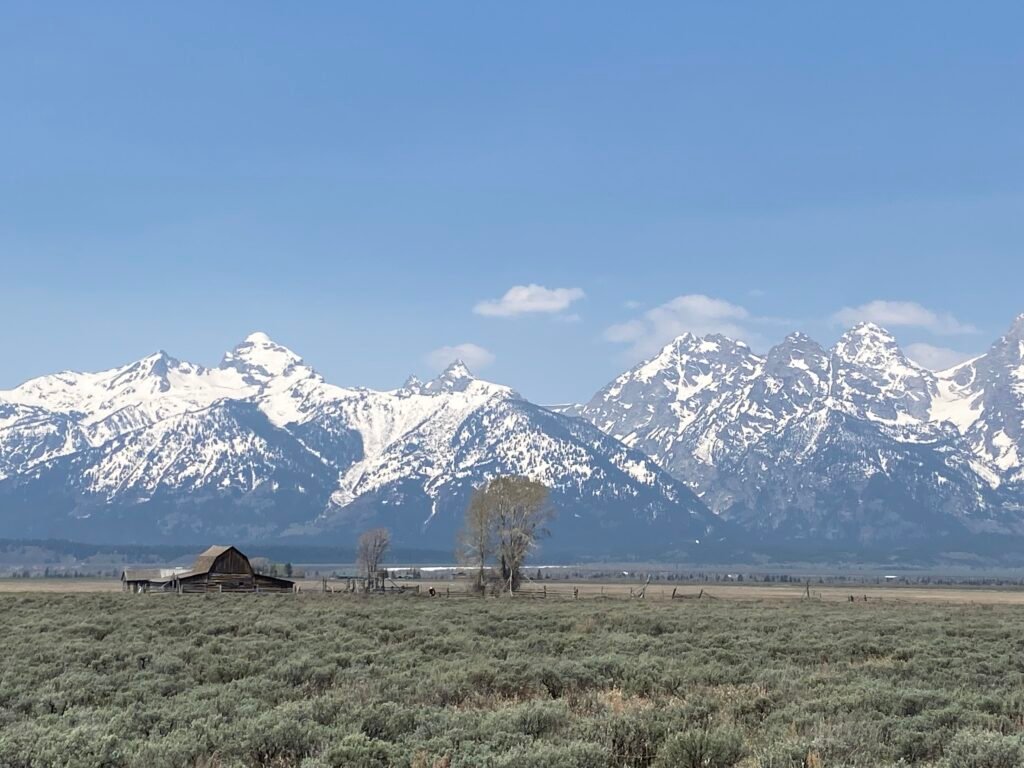
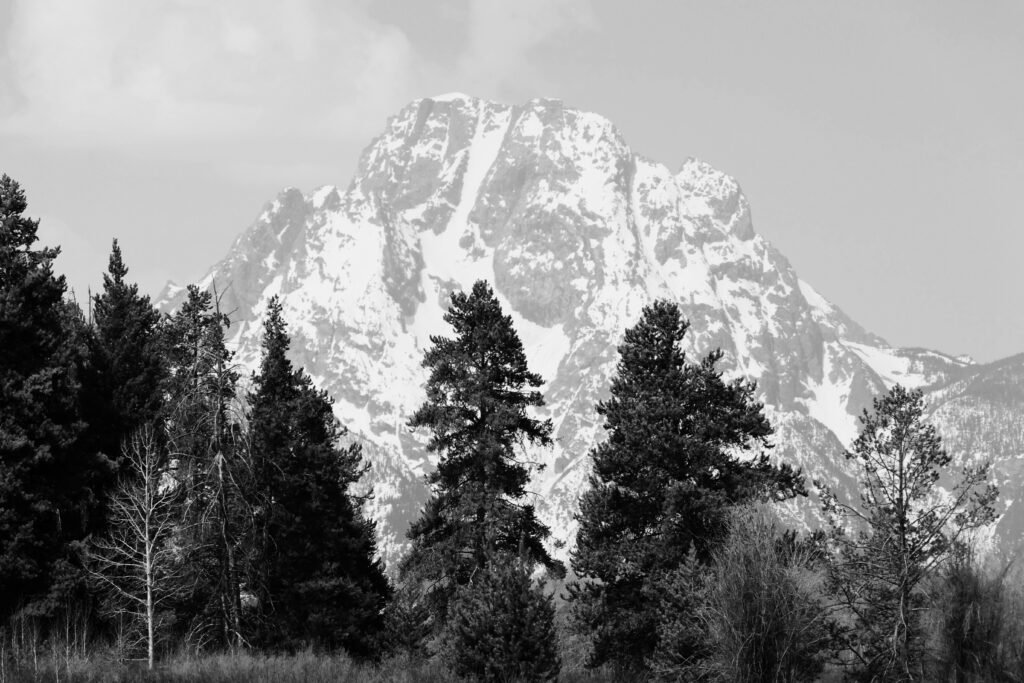
We leave Jackson behind and try to find the famous Mormon Barn against the backdrop of the Grand Teton’s, but Google Maps takes me down a track that says access is closed. A three-mile detour down a second dirt track gets us to the iconic view. There are quite a few people around and no wonder, as the scenery is stunning with the mountains in full majestic form and replicates the millions of images produced of this scene over the years.

An hour later we’re buying bagels at Jenny Lake in a typical American General Store, but with the added attraction of a photographic gallery where there are some stunning, and remarkable pictures of the local wildlife. I comment to the photographer my admiration on one particular picture but my interest wanes dramatically when she tells me the price. I could buy a small motorhome and still have change. Somewhere to load the antlers I suppose.

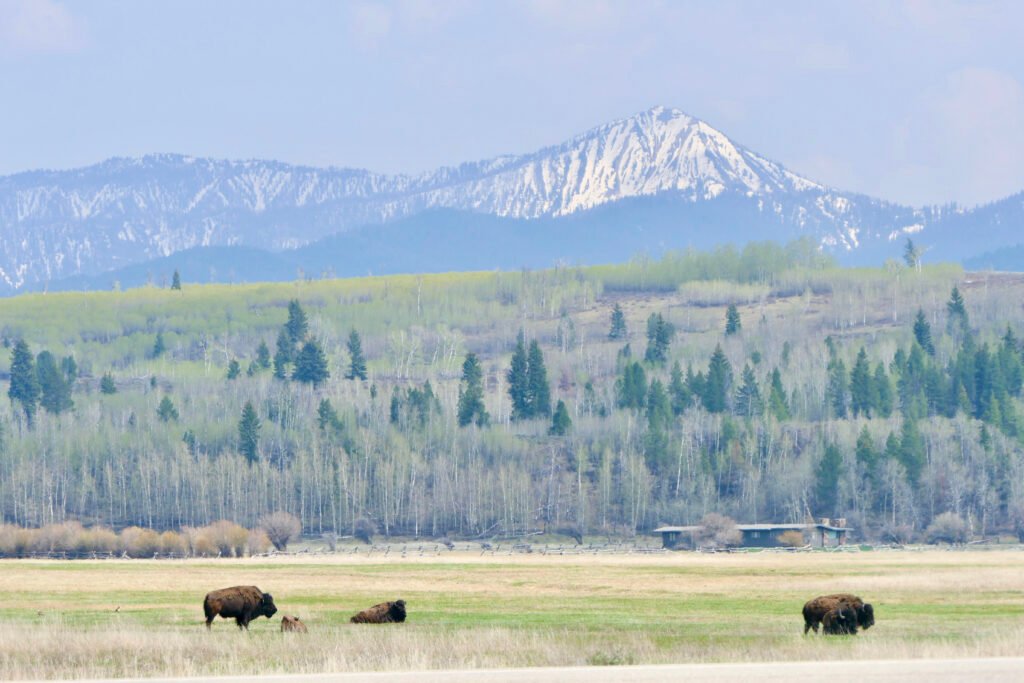
On the way back to Jackson, there are bison behind us, bison beside us and bison in front. Huge herds scatter around the vast fields as we roll down the road to do the tourist thing in Jackson by having a drink in the Millionaire Dollar Cowboy Bar, where the stools along the bar are made of saddles and for some reason are all mounted by girls.   

132 miles today

We left Irma’s in the morning, although we didn’t see her and never actually saw her husband at all. A perfectly lovely Air BnB, sadly lacking a personality in both the building and the hosts. We have to drive back through Jackson to get to our next destination of Yellowstone which is no hardship, so have breakfast in “Persephone” again – this time it is a cheese scone and then we’re on our way to visit a place that has been my dream for twenty-five years. Yellowstone.

Appointment with Puglia

Naples isn’t the obvious airport of choice when deciding on a road trip through Puglia. Bari or Brindisi are somewhat more convenient, but there is method in my madness. Renting a car one way from east to west is ruinously expensive, and besides we hadn’t seen Naples in a while. After a couple of thousand kilometres around Puglia, our plan was to finish with four days of peace and quiet on the island of Ischia. We got the island, just not the peace and quiet, but more of that later. 

Stavro, our taxi driver, meets us at Naples Airport. Kind and helpful he is an encouraging introduction to the city, though I conveniently forget that just because an Italian taxi driver is nice, that doesn’t always convert to driving skills. Luckily it is late at night, and we get to ‘Casa Valeria’ unscathed, apart from sitting on each other’s laps in turn as we sway from side to side negotiating the complexities of the Naples road network. We haven’t been so close, that often, for some time. 

Our hostess Valeria, turns out to be gloriously crazy, in the nicest way. She has a style that could be at the very least considered enthusiastic, edging towards hyper. We have a comfortable room for the next two nights at the back of her apartment, although breakfast the following morning doesn’t quite live up to Valeria’s effusive personality. Even the accompanying hand actions don’t improve the offering, but you can’t help but love her. I’m sure it’s a marketing ploy just so we can give her place five stars, and God loves a tryer. So why shouldn’t Trip Advisor?

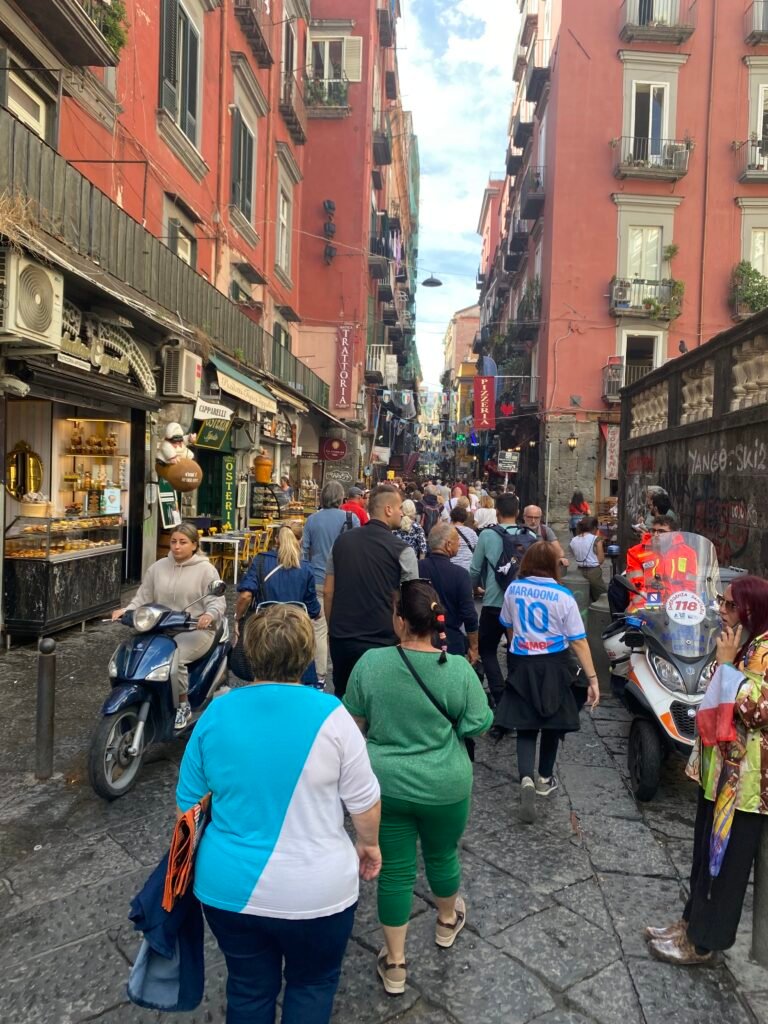
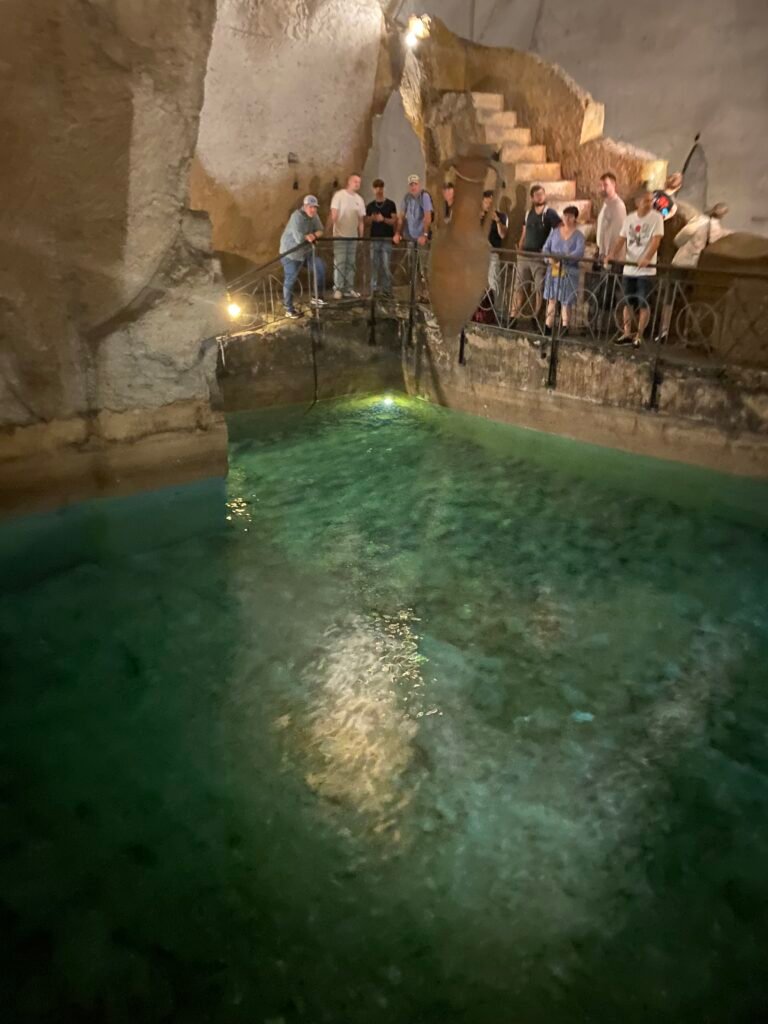
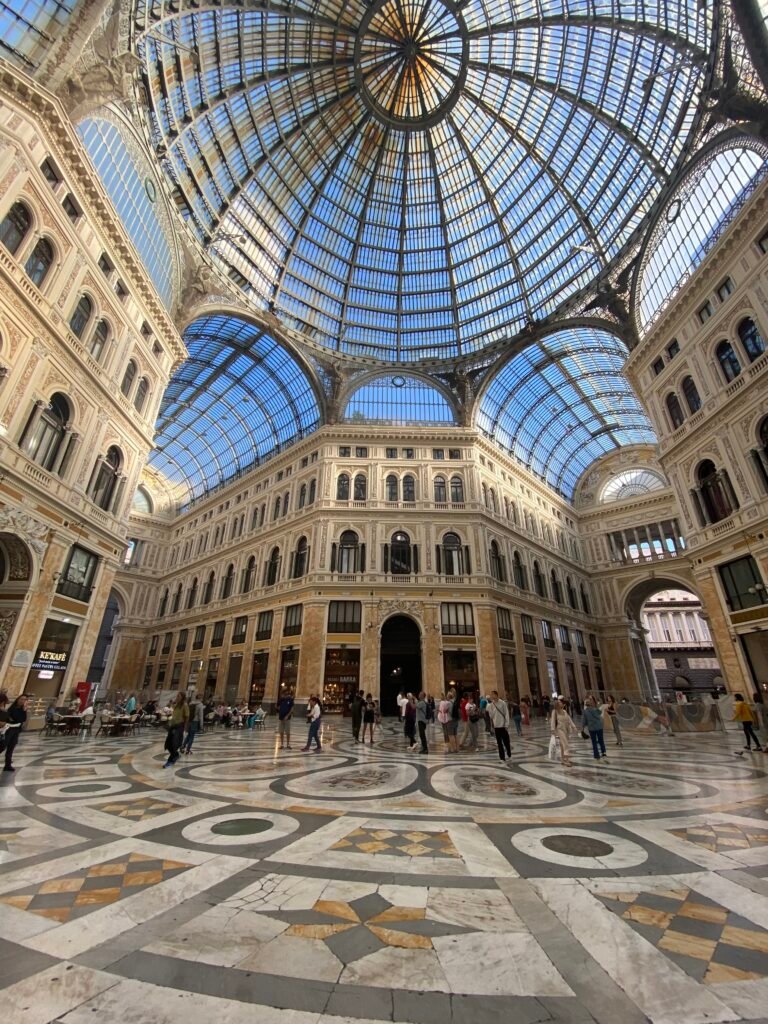
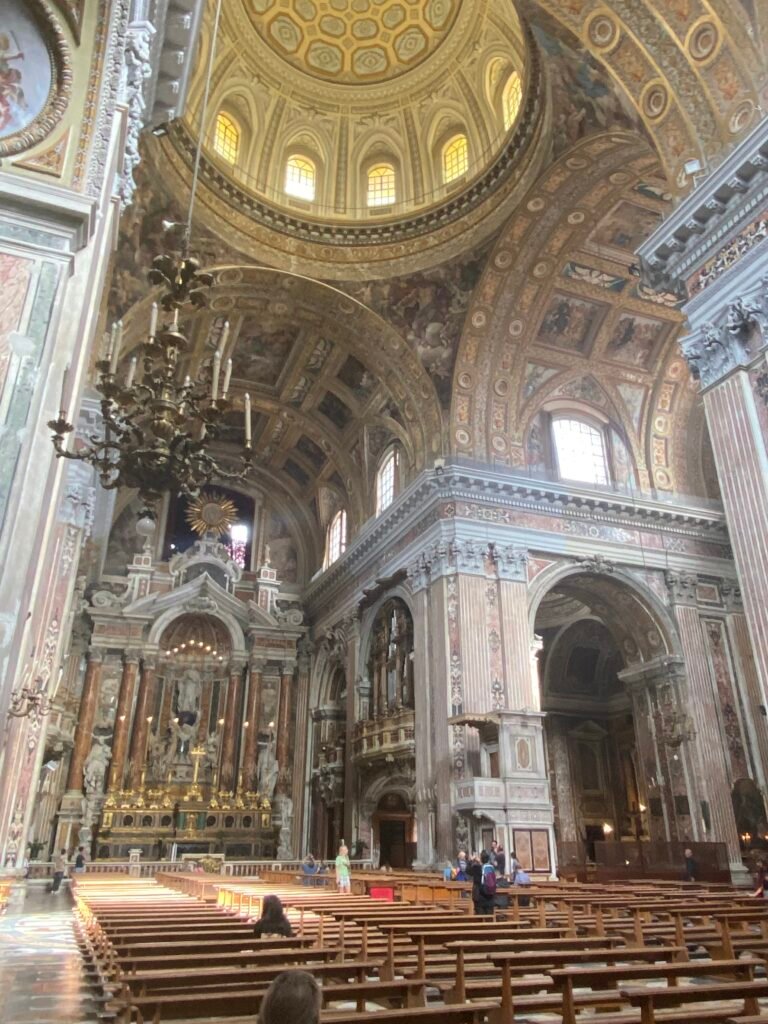
With so many coffee stops and eating places in Naples, we don’t really need breakfast. The apartment is in the upscale and leafy Vomero district on a hilltop dotted with gelaterias, alfresco cafes and refined restaurants, so we set out for a full day’s walk. This turns into a 12 hour day into a joyfully chaotic immersion, with too many people, but if you embrace the vibe, it’s an uplifting and fascinating experience. A funicular ride down to the old town, a trip underground to see Naples below the streets, a few coffee stops enroute, a dozen churches or so and the obligatory “I’ll just pop in here for a minute to have a look” shopping opportunities. Luckily my partner is more interested in street life in the actual street rather than the enticements that sit behind the façade of the numerous retail dens of iniquity.

Underground Naples offers an hour and more of fascinating look at the sheer scale of the construction and imagination of the people who created this subterranean world many thousands of years ago. The ingenuity in building this complex, situated some 40 metres below the streets is astonishing, makes it one of the top tourist attractions in Naples.  However, even that after all those years they still can’t fix the potholes that pepper the roads round the city! Progress is slow! 

We miss out on the catacombs further to the north, and since we had both visited Vesuvius and Pompei previously, they aren’t on our schedule. Despite a cool evening breeze during the long walk along the promenade by the bay, we are able to eat alfresco at Sobrillo’s which, although only pasta and pizza, is an insight into how good the food is going to be on this trip. 

The following morning, we have our ‘simple’ breakfast in the company of fellow guests, Carmen and her friend, visiting from Foggia which is on our route east tomorrow. They don’t offer a lot of encouragement to visit the town, so I strike it from my mental itinerary. 

We take a taxi to Naples train station to pick up our car for the trip, but as usual, despite being an Avis Preferred Member, the process takes 25 mins. We get our car with 65,000 miles on the clock, decorated with so many dents and scratches it looks as though it’s been attacked by a bear. I’m assured by the agent that there are no bears in this part of Italy before he insists that I take photos of all the scratches that are not on the damaged list in the rental agreement and it will all be ok in the end. Really? – so it’s my job to tell you what you didn’t notice the last time the car was returned? Ah well, it must be the Italian way. You do your job, and I’ll do your job as well. We both shrug our shoulders and move on.

We head out on the road, and I’m back in my happy place behind the wheel, taking in the scenery while keeping a third eye on the madcap activities of the local motorists as they hurtle down the autoroute assuming the laws of physics are merely a suggestion. A couple of hours later, Foggia is on the horizon, so we take a gamble to drop in, basically because its lunchtime. We don’t even get into the centre before we are distracted by an attractive looking deli in the suburbs. We gamble again, mainly because there is on-street parking and the one thing I know about Italy is that once you find a parking space – take it, they are like gold dust. ‘Oro Café’ turns out to be a little gem, with friendly staff and great food – our first of many serendipitous discoveries.

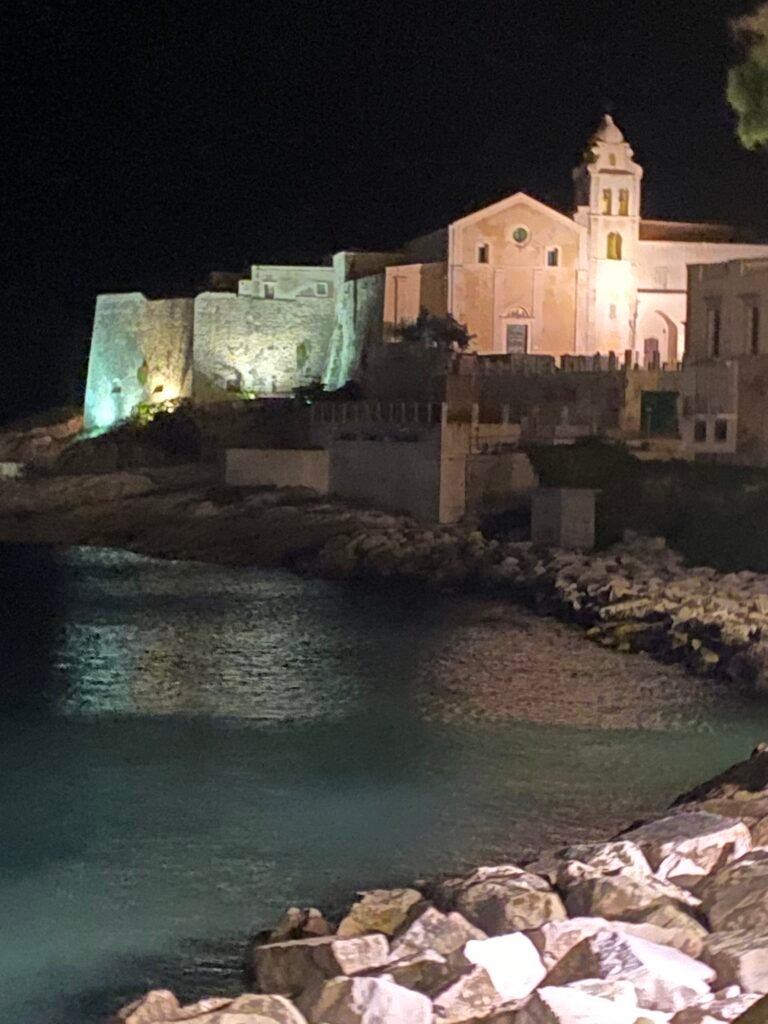
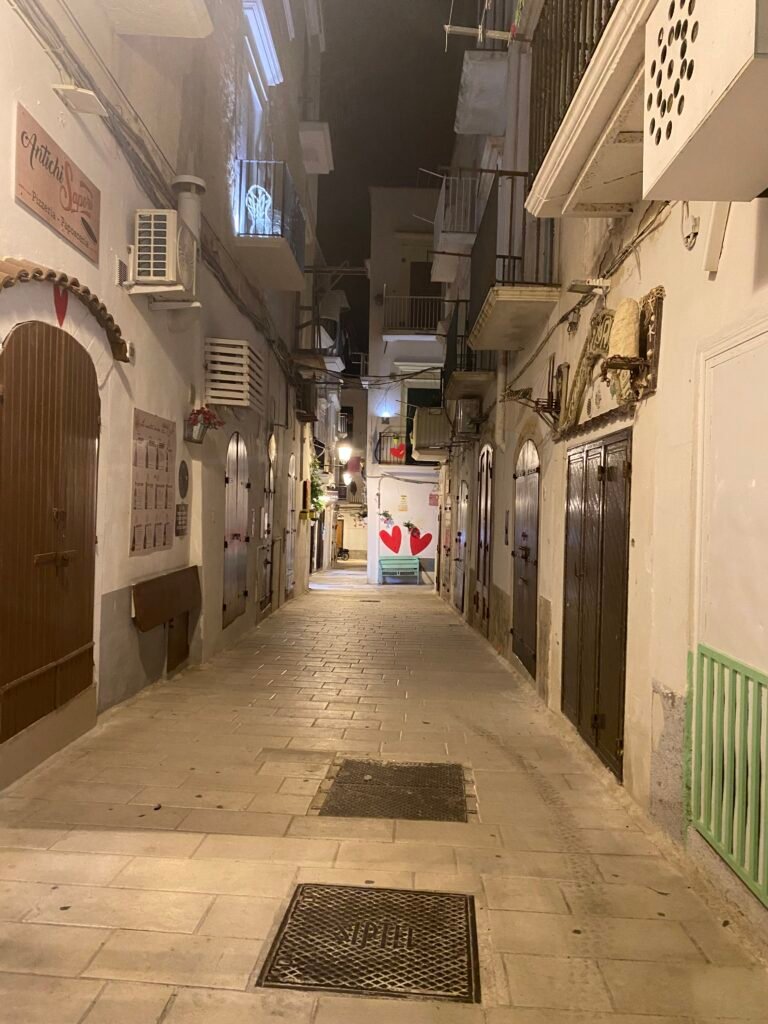
Back on the road we take the scenic route through the Gargano National Park to the pretty village of Peschici, via San Savero and Lago di Varano. We have little time in the town, but most bars and shops are closed anyway as it is late afternoon but we wander through the old narrow streets, then sit for a while with a beer in the square in the only bar open, watching the world go by. Or at least the villagers. The courtesy in Italy of providing nuts and crisps with every beer is a custom I like, and more countries should encourage it. We leave later than planned and it’s starting to get dark as we head to our overnight accommodation in Vieste. It’s only 20 kms away, but it takes nearly an hour along coastal cliffs, through pine filled woodlands and head-spinning twists and turns in the road.

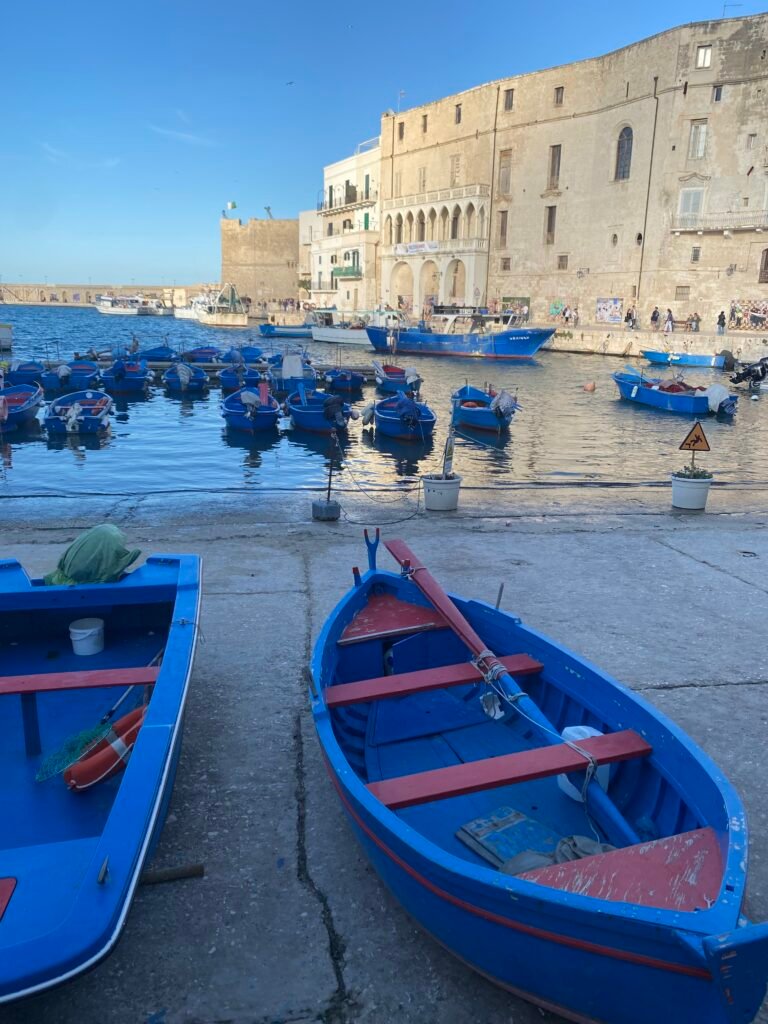
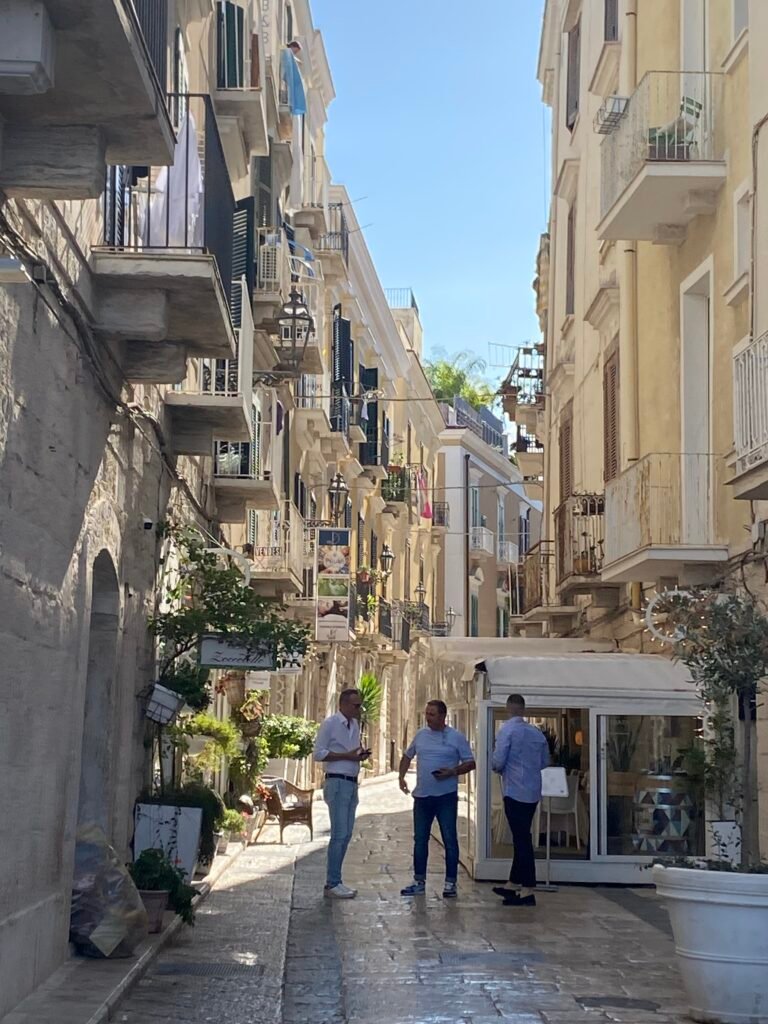
Trying to find booked accommodation in Puglia’s little coastal  towns is like trying to finish a jigsaw. You seemingly have all the pieces but when you get there, that one last piece is missing, either lost in translation or simply to test your resolve to see if you are a worthy guest. The streets and alleyways of these beautiful villages, like Vieste in the north, Trani and Monopoli further down the coast and Lecce in the south, test your navigational skills, especially when Google maps tries to squeeze your very normal-sized vehicle through an ever decreasing gap between buildings, as if extracting more juice from the grapes to make the very wine you’re going to drink later that evening to assist your recovery. However, it’s all worth the effort. Away from the coast the scenery might not be the most stunning, but the coastal routes, the villages, the people and the food most definitely are.

The instructions from our accommodation for parking in Vieste, a pedestrian only cliffside town, seem concise enough, so we park in a large space with a big P at the entrance. Only one other car is here. It turns out the correct parking is another big P twenty yards further up the hill towards the castle with the exact same sign, but out of sight. I only find this out when we check in. Our room at ‘Dimora del Dragone’ turns out to be a beautiful property with a large terrace overlooking this ancient village and beyond out to sea. A delicious Puglian potato pie at a little restaurant in the alleyway next door in the warm evening air soon brings the good times back. The wine also helps. 

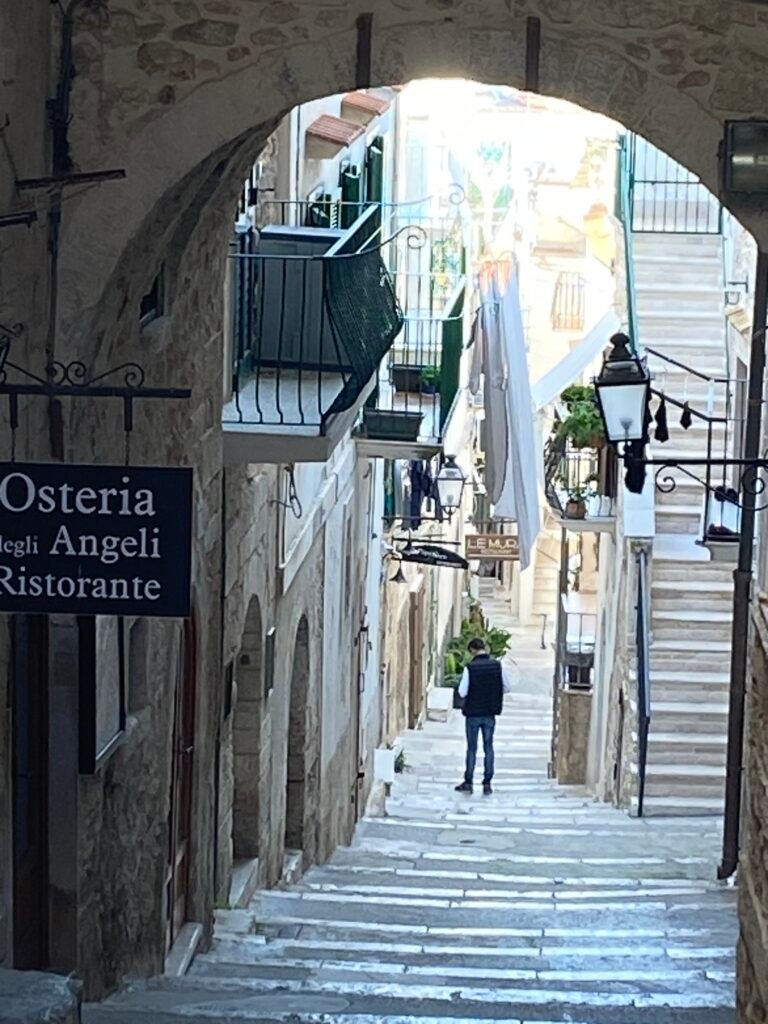
Vieste isn’t the easiest of places to reach from afar, but it’s worthwhile if you care to stay for a couple of nights. With miles of limestone cliffs and hidden beaches all along the coast it’s a very attractive town with little alleyways hiding some lovely restaurants and tiny unique shops. In the outlet beneath our apartment, a smiling octogenarian is making leather belts on his machine, giving an old-fashioned feel to everyday life. And then there are steps. Lots of steps. I watch several ageing residents climb relentlessly towards their chosen destination. I realise they adopt a particular method, with a slight side to side motion, keeping their rhythm of one step in front of the other and seem to disappear faster than expected. It’s October and many places are closed but we find a café open beside the harbour, order wine and eat delicious bruschetta, while watching a man fall off his boat onto the harbourside. I felt I could have been a local hero had he fallen into the water, but luckily the wine stops me reacting with too much haste. 

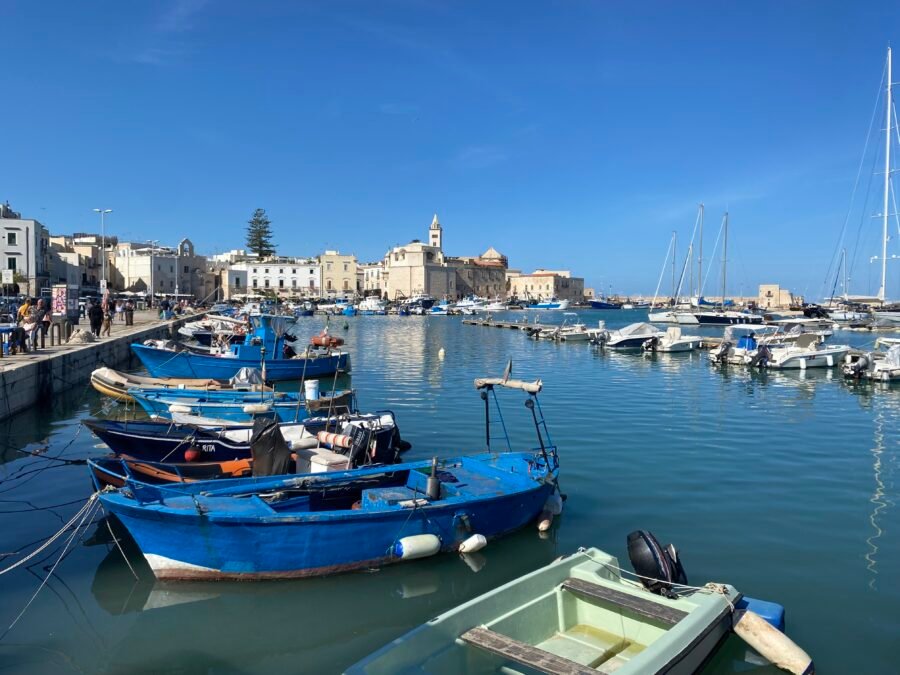
As we work our way down the coastline, we stop in Trani, a delightful little historic harbour town, and once again food beckons. We lunch on octopus, mussels and rice. Not our normal diet but when in Trani, be a Trani, although that could be taken the wrong way, so perhaps we’ll leave it there. By this time, we are recognising how good even the simplest of food is here in Puglia. 

Monopoli the town, not the board game, is next on the list, and is really just a bigger version of Trani and just as attractive. It would be easy to spend some considerable time here, but we have a long run today – mainly because our chosen accommodation can only take us for the next two nights, and the reason for making all this effort turns out to be one of our better decisions. 

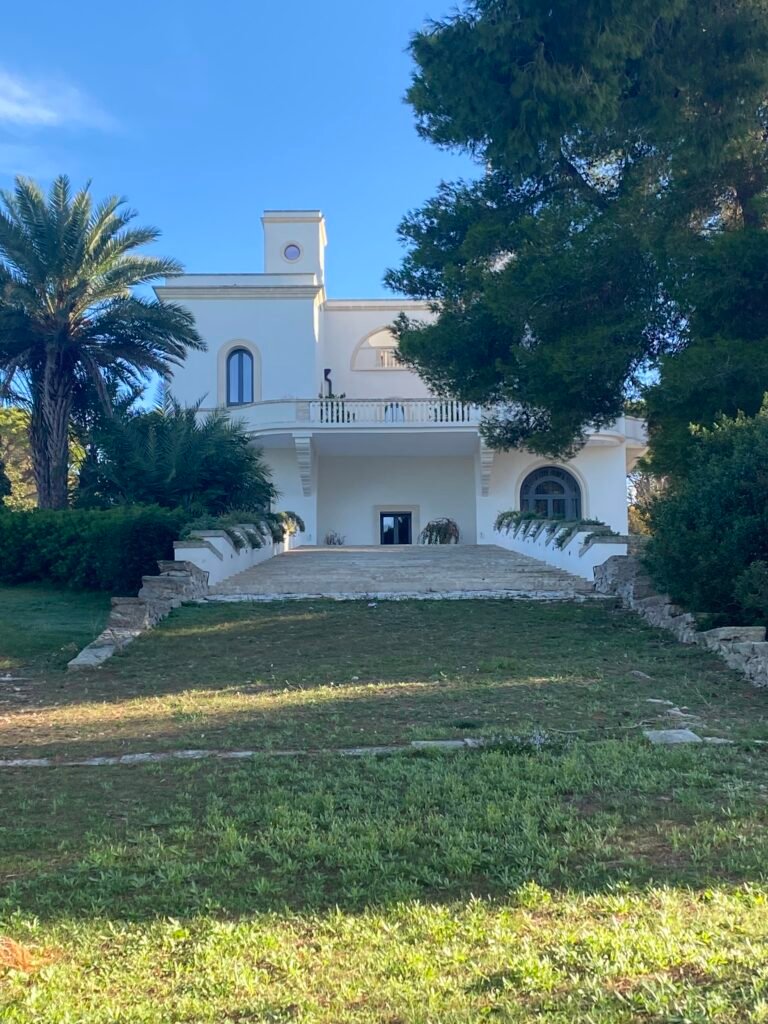
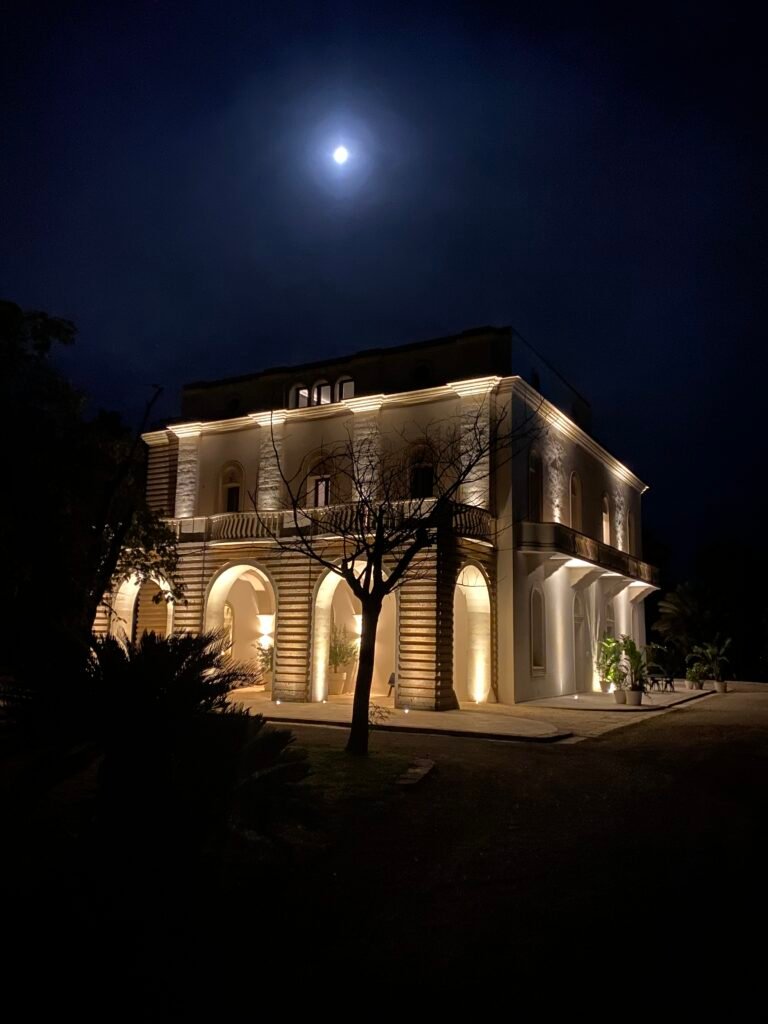
Before we left the UK we had pinpointed ‘Sa Suites’, just outside Trepuzzi, as our chosen place for sleeping tonight. Set amid a plethora of abandoned little olive farms, it’s an incongruous place to locate a hotel. Well, it’s not a hotel really, nor is it, by definition a Bed and Breakfast. It could be classed as an Inn, but Inn’s will never be as classy as the 8 roomed ‘Sa Suites’. It is an extraordinary place. Olive groves and lemon trees are in abundance on an estate that boasts a floodlit tennis court, large outdoor swimming pool and views over the surrounding area. The rooms are stunning, with huge beds and outstanding fittings. The diverse art scattered round the walls of this large building look magnificent in a seemingly effortless way. Owners Rick and Anja take us through their persistent and remarkable journey in converting this building to the magnificent oasis it now represents, and which only opened in 2023 a few miles from the historic town of Lecce. 

We arrive a bit late at the property and are now being asked if we would like to eat just as the other four guests are sitting down for dinner. I say no because I don’t want them to go to any trouble, but that is the last thing on their mind as they desperately want to please us. So, a beautiful dinner appears not twenty minutes later, and we devour it quickly. The terraces and balconies attached to each room bathed in the autumn sunshine defy you to leave this place of quiet solitude. Rick and Anja know a few things about food and especially how to serve up breakfast the following day. It’s a feast of Puglian cheeses, cold meats, pastries and fresh fruit. Personally, if I owned this place, I wouldn’t want anyone to stay here and just keep it for myself. It’s that good. But they need to recoup their outlay which must run into millions, so I guess they have to suffer people like us aspiring to luxury living but only having two nights to spare. In the great scheme of things, it wasn’t expensive. 

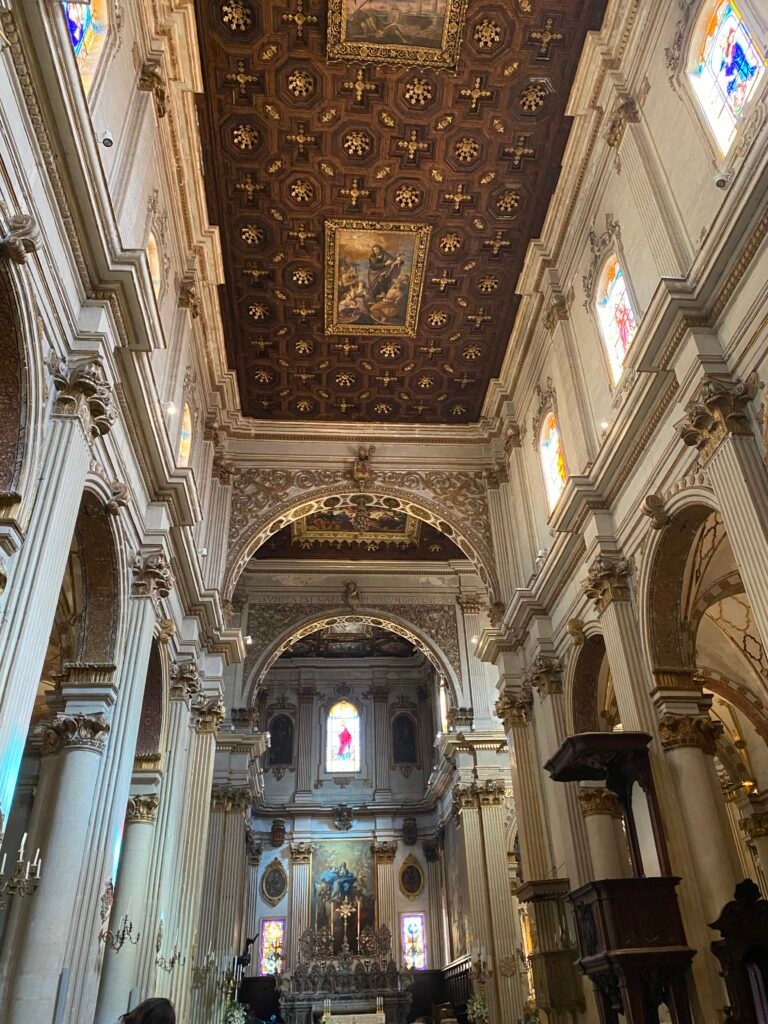
Lecce is a beautiful, if busy town with a stunning and extensive historic district. The Romans have a lot to answer for, and that includes Lecce. With a story that goes back to the 3rd century BC, the town known as the Florence of the South has added many countless treasures to its culture and architecture over the years. However, what its hasn’t added is car parks. It is probably the worst place to find a parking space, not only in the whole of Italy, but probably in the entire Roman Empire. 

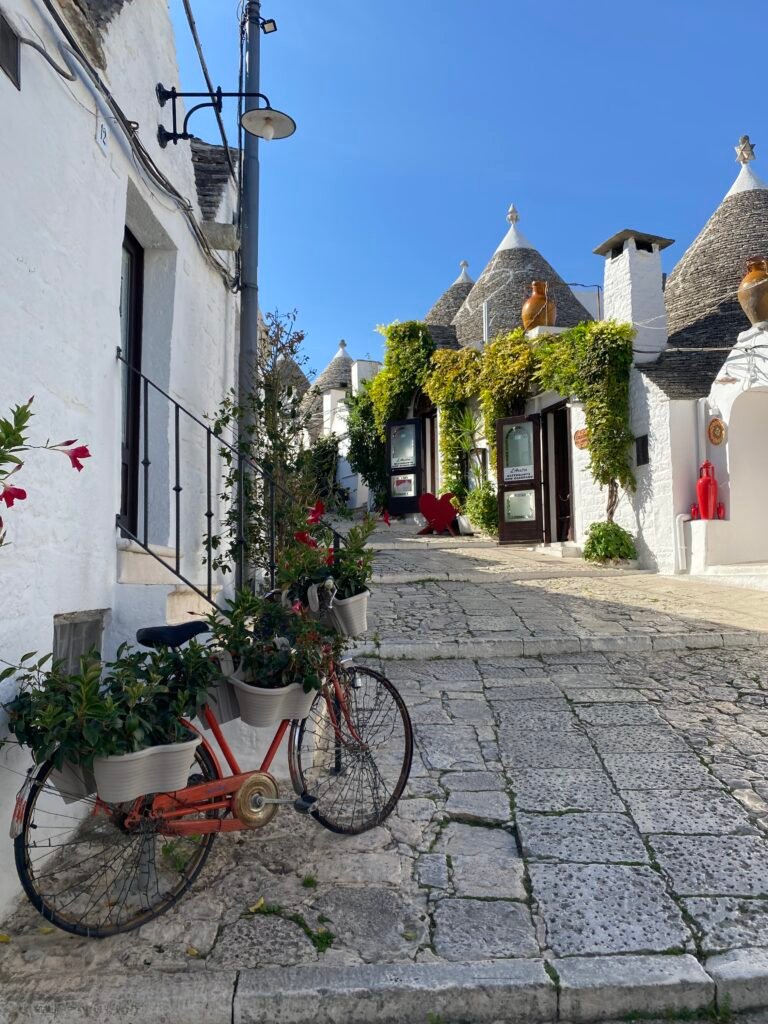
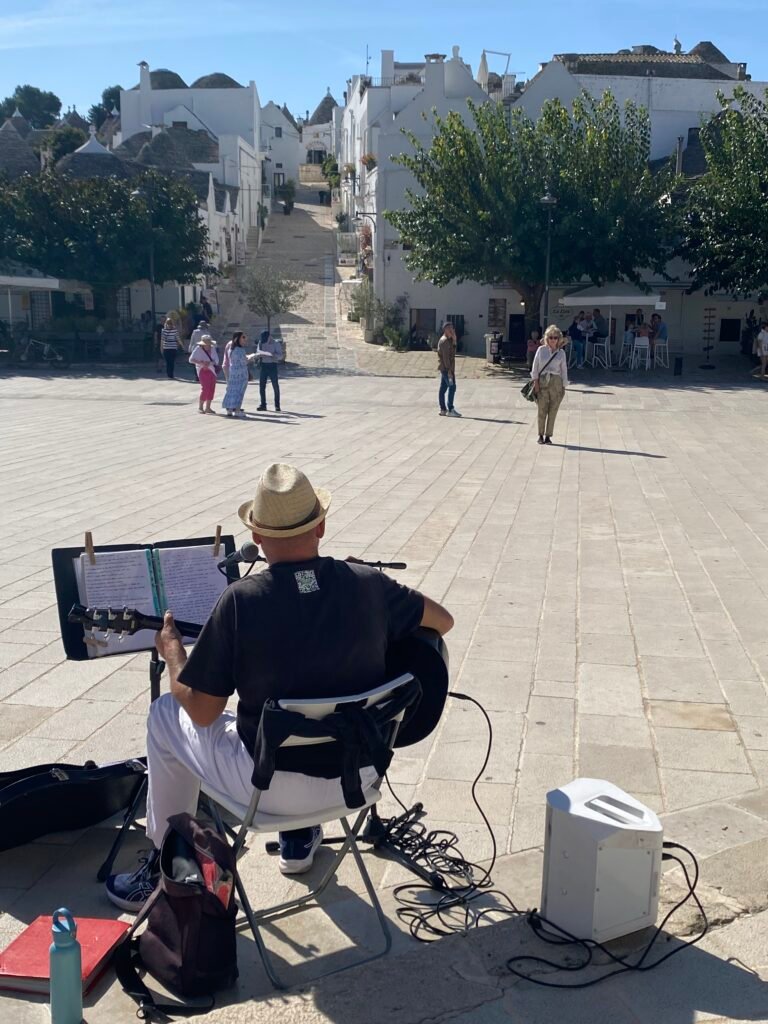
After two days of utter luxury, we reluctantly leave Trepuzzi and the wonderful ‘Sa Suites’. Admittedly it’s not for everyone but it’s now firmly on my list of favourite accommodation. We drive for only an hour to the touristy town of Alberobello, home of the Trulli’s. Put like that it sounds like an ancient disease passed down from generation to generation. He’s got a dose of the Trulli’s. You can immediately see the attraction in these toytown streets of conical shaped dwarf houses. I do have a thought that this is where the Hobbit came from, as they provide the perfect residence for one so small. Residents do live in them, or rather people do. How many are residents and how many are for rentals is debatable. Booking.com and Air BnB websites are full of them but too many visitors passing the door wouldn’t be to my liking. However, there is no denying it is pretty, and the most visited destination in Puglia. Our accommodation is somewhat dull in comparison, but clean and only fifty yards from the action. Trulli close if you will. I spot a restaurant which seems like the most sophisticated in town conveniently set amidst the little houses. Disappointingly, the only table left is in a corner facing two walls. They’re very attractive walls but walls none the less. Gianni the waiter arrives, and our wall view is forgotten. He learns we are from Glasgow in Scotland and unbelievably we find out he worked in ‘Est Est Est’, a well- known Glasgow eatery for 25 years. Of all the places in all the world ………well you know the rest. The dinner and wine turn out to be somewhat better than his former restaurant back home. 

In the morning, after a healthy breakfast in the village at the aptly named ‘Cosi’ we drive an hour or so to Matera, the stone city.

I love Matera. It is an extraordinary town with a very old historic district, as well as a newer historic area, or historic 2 – the sequel, I guess. We splash out, and join a small guided tour with some very quiet people, and one loud American who wanders off at every opportunity. His two colleagues pay attention at least. Gaetan our guide is clearly passionate about his hometown, and rattles off facts and figures like a machine gun. Trust me he says, for the hundredth time as he drops another little gem of information. He is great fun up to a point. You could never go on a pub crawl with him as he would start telling you about how many bricks it took to build them, or how, underneath the stone floor is another house, and another, then another. The two hours go quickly but he is very keen to show us the animal bones acting as supports for roofs of the little homes that seem tiny but stretch back into deep caves. I won’t forget Matera. It made a big impression.

As I succumb to the vagaries of old age, most things I used to complain about pass me by without troubling my thought process. However, one form of exasperation that continues to annoy me still, is other drivers. Particularly Italian drivers, and more specifically, Italian drivers on Autoroutes in Italy. I can then break it down further into the mere madmen who defy logic by pulling out inches in front of you, or the lunatic, clearly desperate to get to the asylum by hugging your rear bumper as we are both doing 80 mph, where getting a pubic hair between the two of us would be a miracle. The temptation to switch one’s rear sidelights on is almost too much to bear. I don’t want to kill him, just rattle his head a bit until he comes to his senses, and he understands I’m no pushover.

From Matera we’re heading for some sophistication on the Amalfi coast. Consternation might be a better word. It may be October but the change in pace and chaos increases exponentially in this part of the world. We’re basing ourselves for two nights in Pontone, directly above Amalfi, not so much as the crow flies, more like as the goat climbs. We’re in the nosebleed area of the coast, and while spectacular, the weather is not playing our game, so it’s difficult to see much of the sea between the two peaks in the distance below. If we thought Puglia was bad for drivers, then Amalfi is gold medal country. The famous hairpin bends are an art in driving skills. Surely there is an extra test you can take to get an Amalfi Coast Approved licence. The following day, the weather improves, and we head up to Ravello, a mere 3.7 km away. However, it takes us half an hour after a combination of long traffic lights and drivers who try to outsmart those same lights and then meet a vehicle coming the opposite direction. 

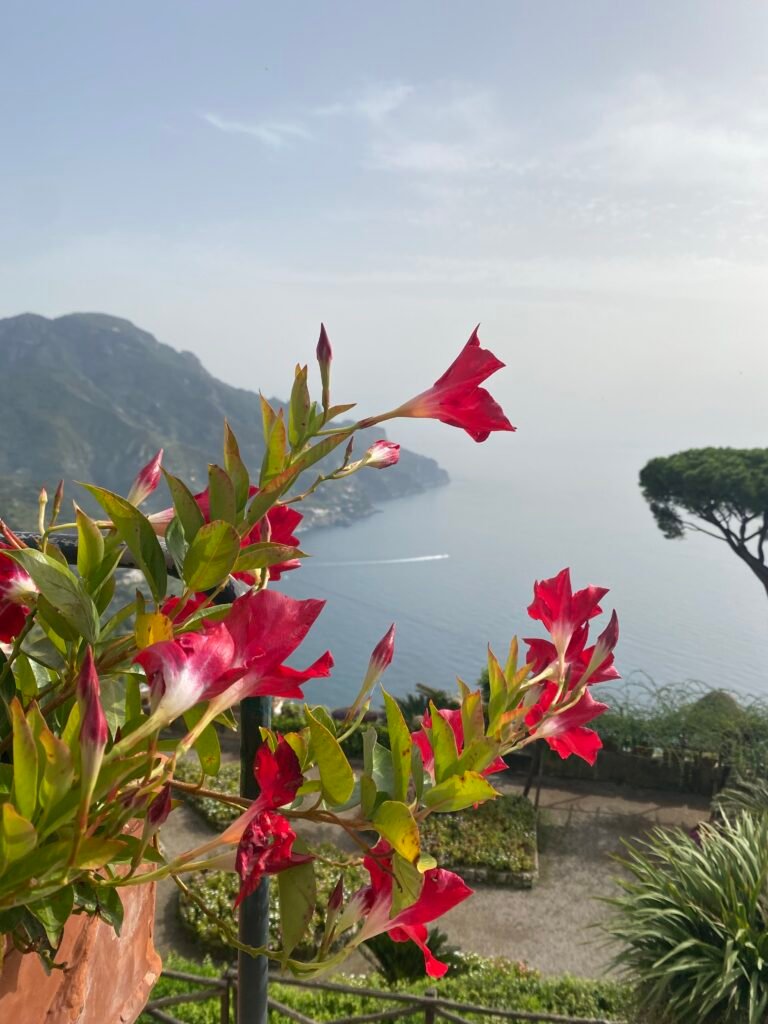
Ravello is a revelation. Not so much for the pretty square and surrounds, but it turns out that the famous Villa Rufolo and Gardens were saved and renovated by a Scotsman called Neville Reid. He suffered from “afflictions of the chest” so in 1851 decided the air in Italy was much better for the soul. Little did he know that millions of Scots would follow him, not so much for afflictions of the chest, but more for the sun, the sea and cheaper holidays. Reid spent years and a family fortune to renovate and create the extensive and stunning gardens overlooking the Adriatic.   

After an ice cream it’s back to Pontone. There are only two restaurants in the village that are open. In fact, there only two restaurants in town in total. We ate in San ‘Giovanni’s’ last night, which was great but tonight is the turn of ‘Antico Borgo’ which after a poll of all the diners, the result suggests that this is the better of the two. The poll consisted of two diners. Same as the number of restaurants which is only fair.

Well, the previous 24hrs have been interesting. Last night the gods were angry and offered up a smorgasbord of thunder, lightning, and torrential rain on an epic scale, followed by a partly flooded apartment, a car shunt from behind, a parking fine, a mobile phone left on top of our vehicle in a car park for two hours, and a one-legged pigeon who took a fancy to my nuts. No wonder I’ve not had time to write.

Over a hundred lightning strikes and hours of thunderclaps gives me a new appreciation of the grey, dull skies of the UK. Bad weather is different here, but quite exciting in a kind of masochistic way. It keeps you awake but also you are somehow disappointed if another roll of thunder doesn’t assault your senses within the next five minutes. Our flooded apartment requires the help of the owners to get mops and brushes out, but with a shrug of the shoulders it seems as though this isn’t any great drama. Life should be so easy-going ! 

Luckily the car shunt from behind, although turning our necks round like a scene from the Exorcist, didn’t seem to do any physical damage to the car either. Standing in the road trying to discuss a solution with the two older Italian occupants of the attack car who couldn’t speak a word of English is challenging. Gesticulating between the four of us must have looked like street theatre to the many passing drivers. Our new colleagues were reasonable, so we parted maybe not the best of friends, but amicably. 

Our one-footed pigeon is the most persistent and bold feathered friend you could imagine. We only had crisps and nut’s and so told him the salt content wasn’t good for him. Of course, he only understands Italian, so he isn’t deterred. 

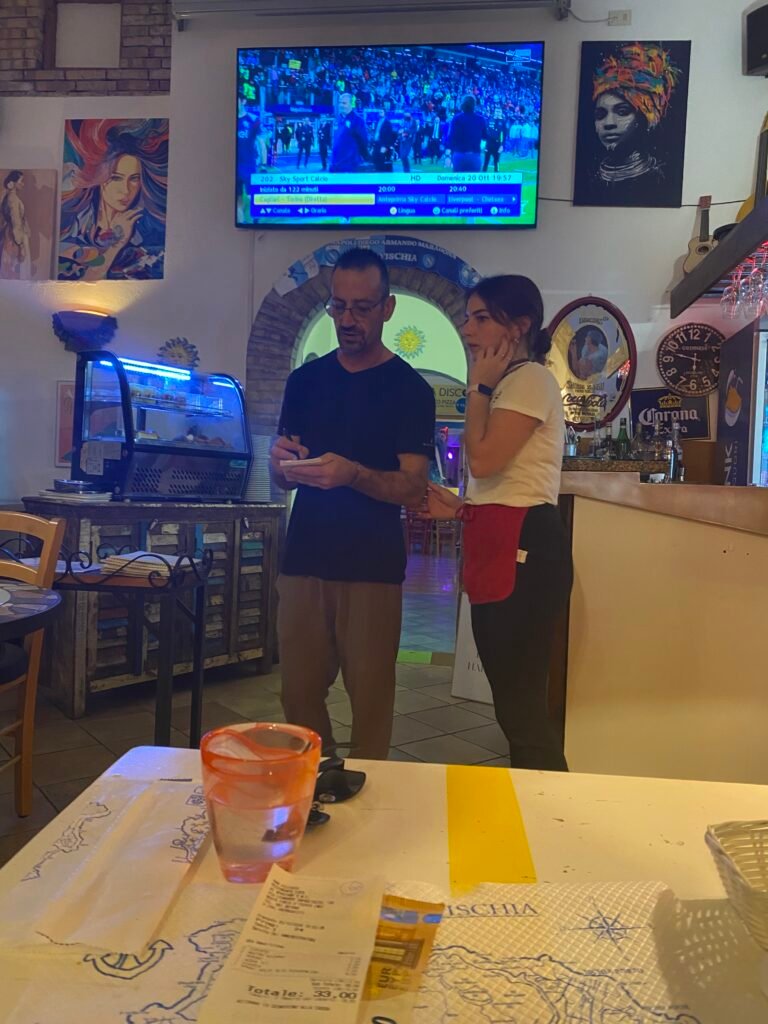
All faith in human nature is restored that evening by Luca and Danielle in their roadside pizzeria, with added Sky Sports. At first we are refused entry as it is an hour before opening time. However, as soon as I mention we want to watch football, we are ushered in, tables and chairs are moved, and then they spend ages looking for the right Sky channel despite us apologising and being prepared to skip out. A cast of several come to help, and they won’t let us leave. The chef, with just the right touch twist of the controls, eventually found the game. We’re made comfortable before Daniela brings us complimentary bruschetta as a comfort snack with the beer. Now we know we HAVE to stay for dinner, which turns out to be as good as any we’ve eaten on this trip. A great end to an eventful day. And I refuse to mention the mobile phone incident.

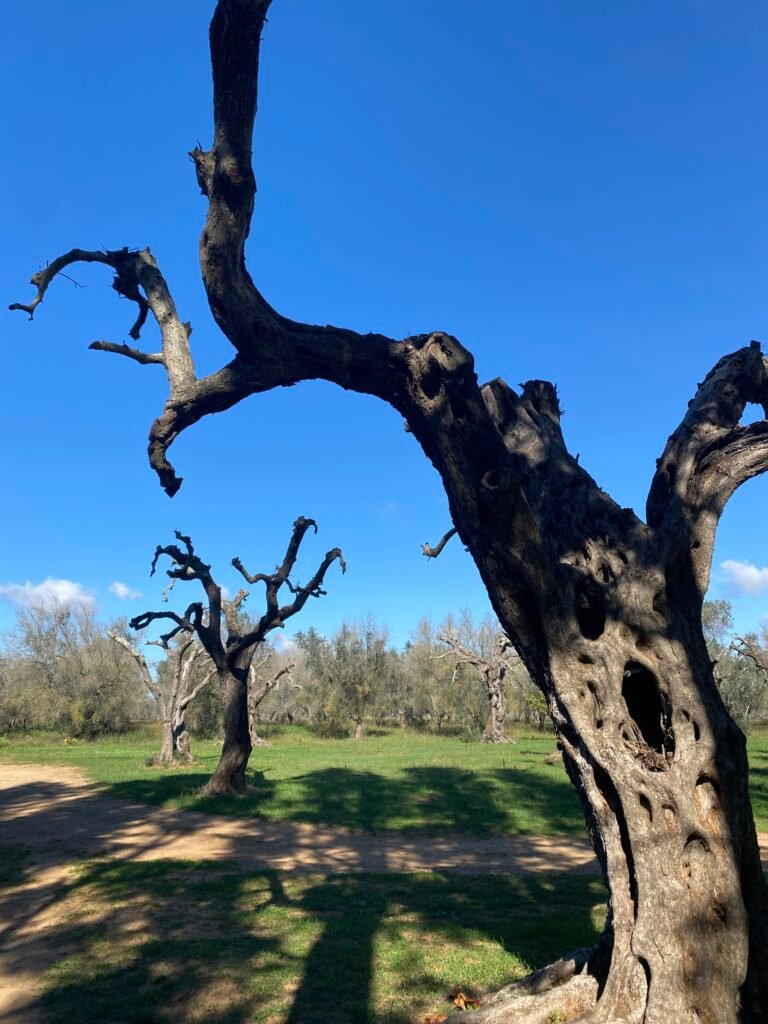
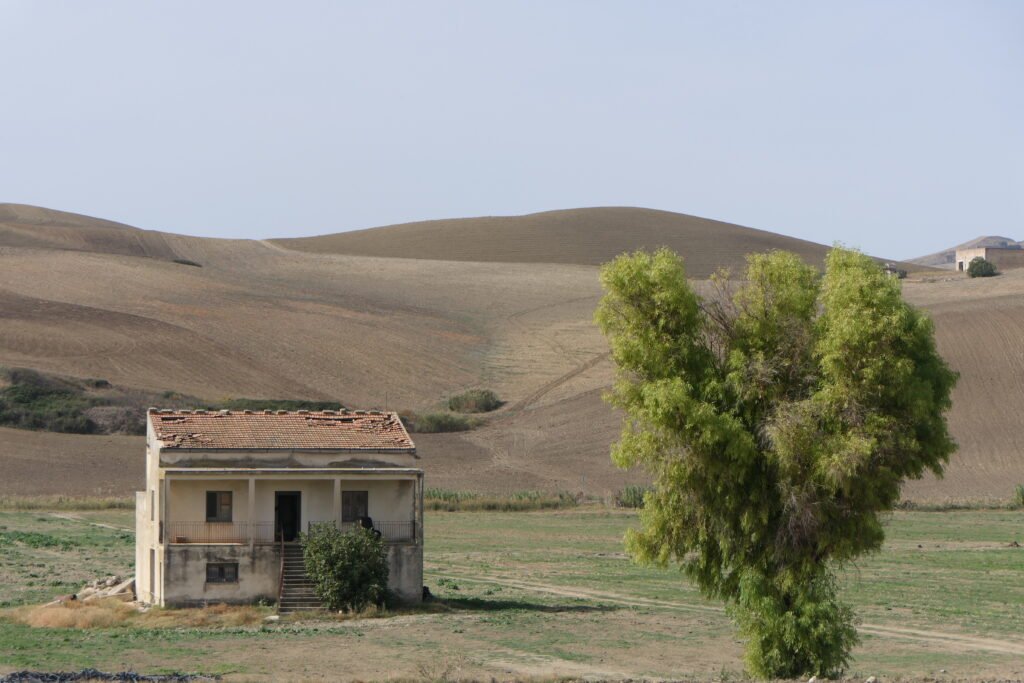
Home time comes too soon. Puglia not only stole our hearts, but mostly our stomachs. The coastline, tiny villages and blue sea are a delight and although inland the countryside is relatively flat and unexciting, it is always interesting. You can see the remains of how life was like here not all that long ago, but of a different era. It’s seen in the unkempt small farms, untilled soil and empty hillsides. It’s a timeline that is hanging on to its past by its fingernails, all too soon to be forgotten as modern-day windfarms creep slowly across the countryside like alien tripods from War of the Worlds. HG Wells was right in a way. A war of the worlds it is, separated only by time. 

Grand Canyon to Salt Lake City

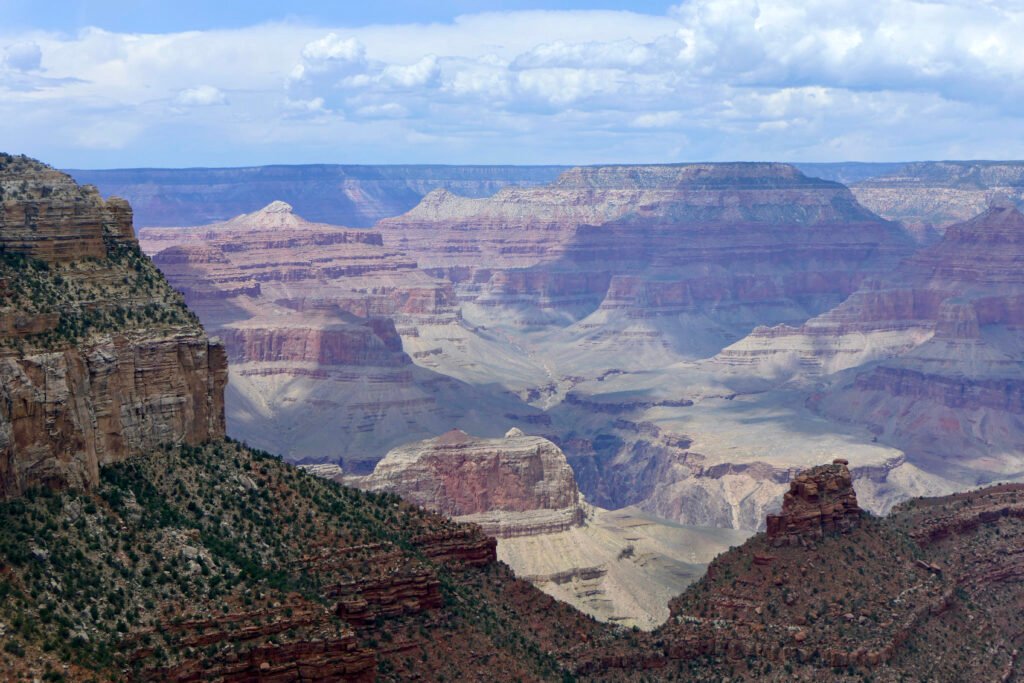
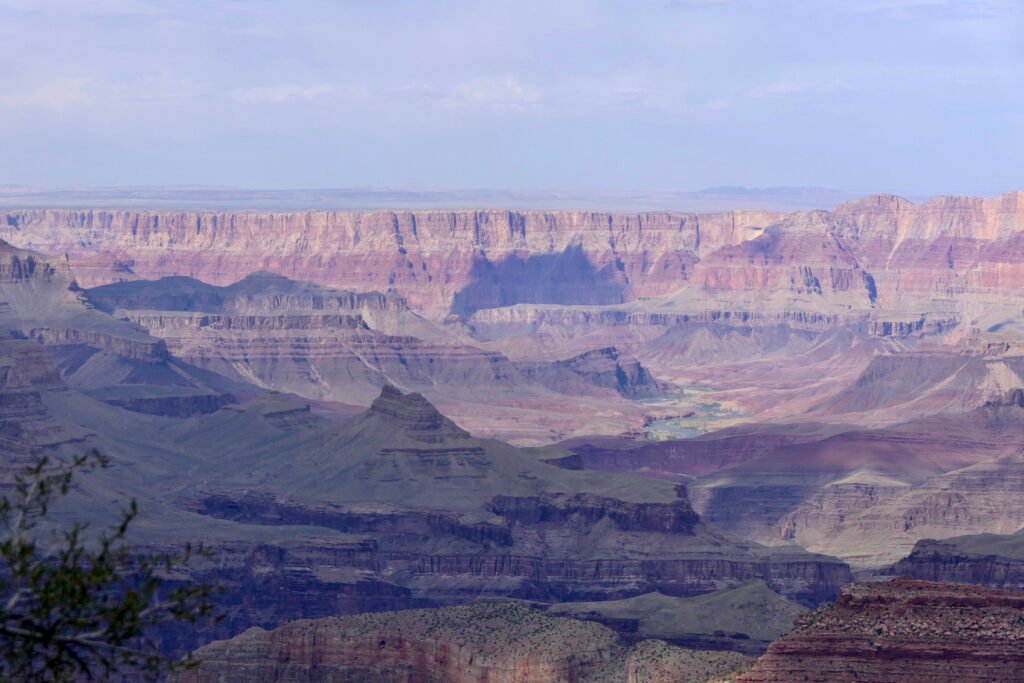
Arriving at the Grand Canyon is like no other arrival. When I was first here in 1991 we jumped on a helicopter – I must have had money in those days – and set off about hundred feet above the trees of the Kaibab National Forest. I thought it would easy to the see the Canyon once we were airborne, but the fascination of skimming the tree-tops left me totally unprepared for the sudden lack of tops, never mind trees, being replaced by a huge chasm of nothingness. The experience was breathtaking, awe-inspiring and not a little scary all at the same time. I may have screamed a little bit but the pilot was polite enough just to offer a knowing smile. The flight was short, fast, and tested my nerves as well as my bank balance, but each second was a gift from God, albeit with a little help from Airbus.

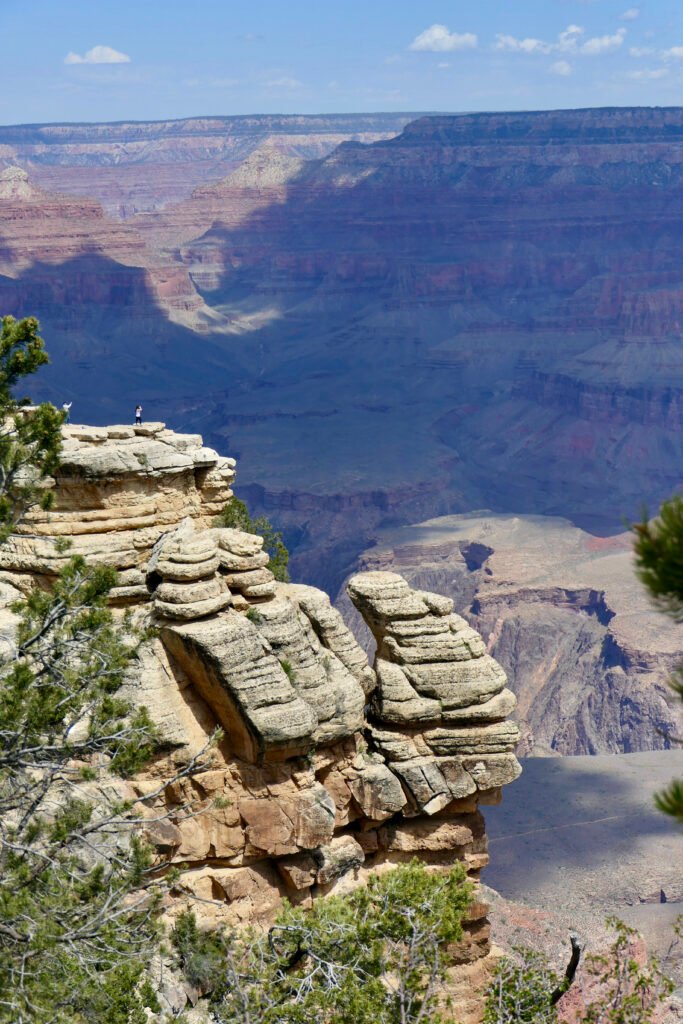
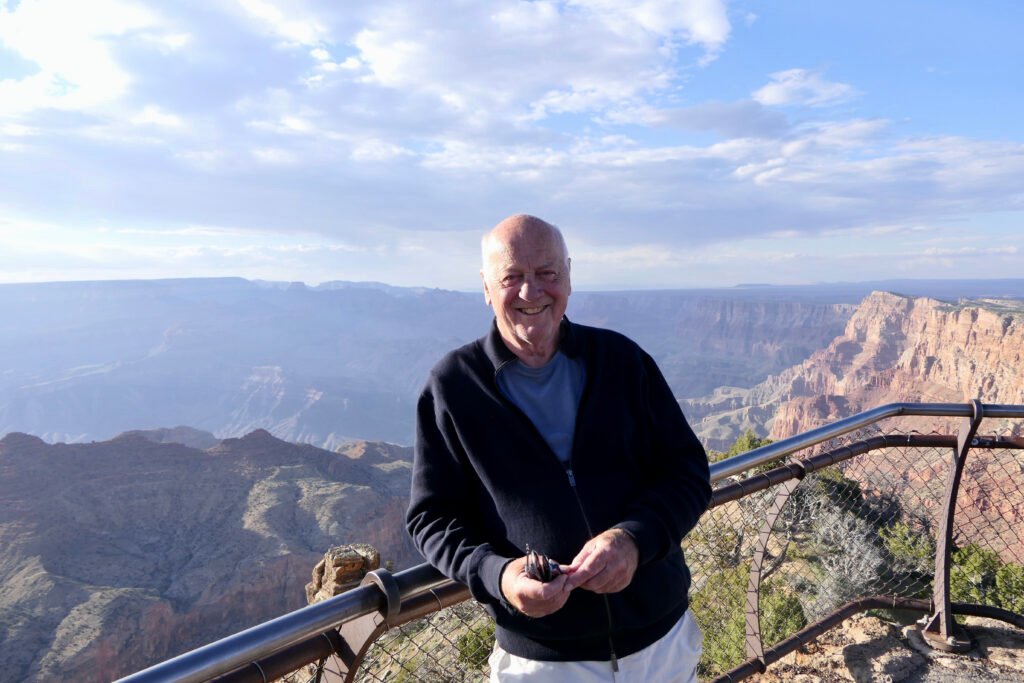
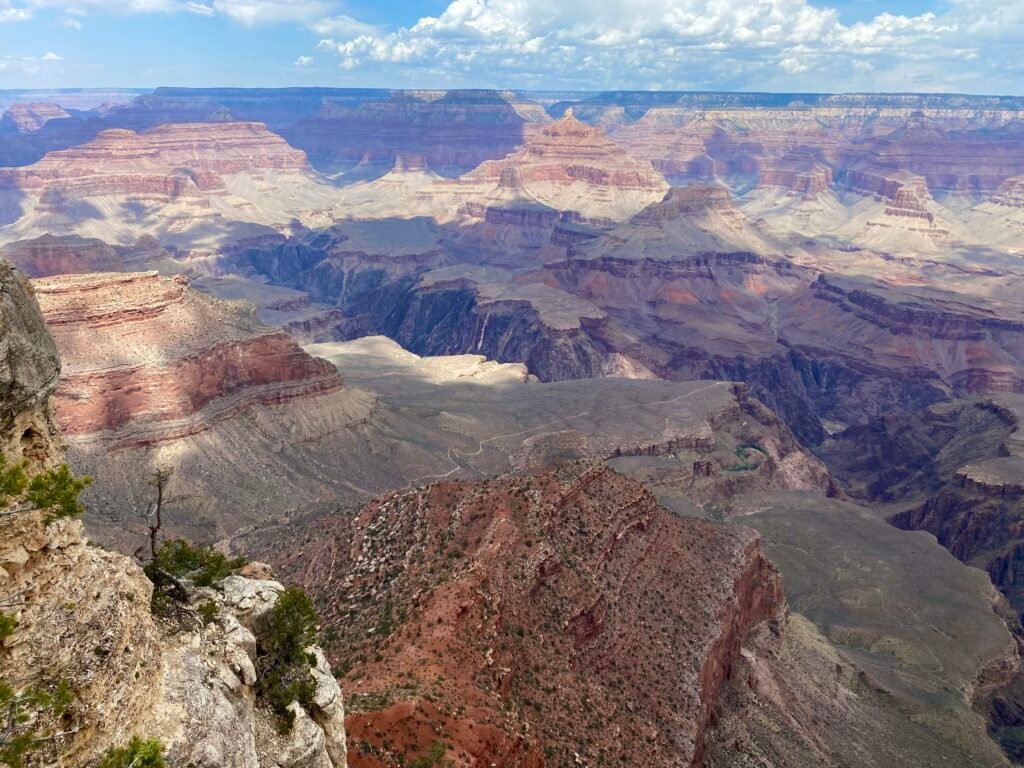
I love being able to see the reaction of friends and family when I show them the sights and sounds where I’ve been moved by the numerous majestic views I’ve experienced. I knew this latest visit was going to be no exception, and as I walk my partner Nicky up to the viewing point looking out over the abyss, the expanse of this wonderful place showing itself bit by bit, little by little, until the sheer scale of the Canyon bares its soul. Our eyes mist over.

We walk for a couple of hours along the South Rim and experience numerous moments of wonder, eventually getting the bus back via Back End Grand Canyon Complex. 

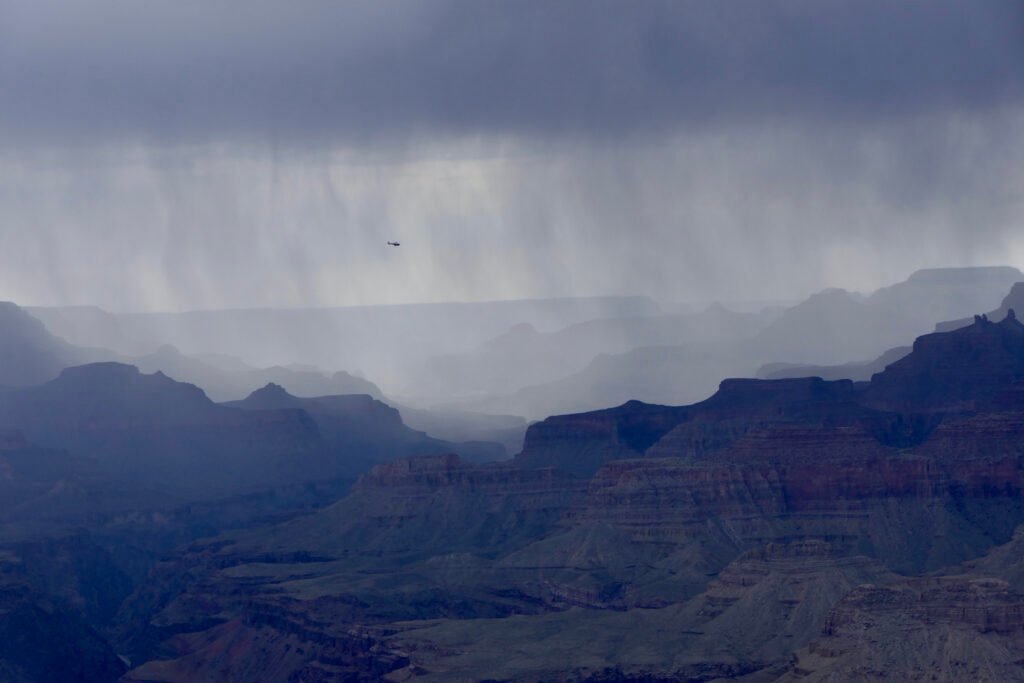
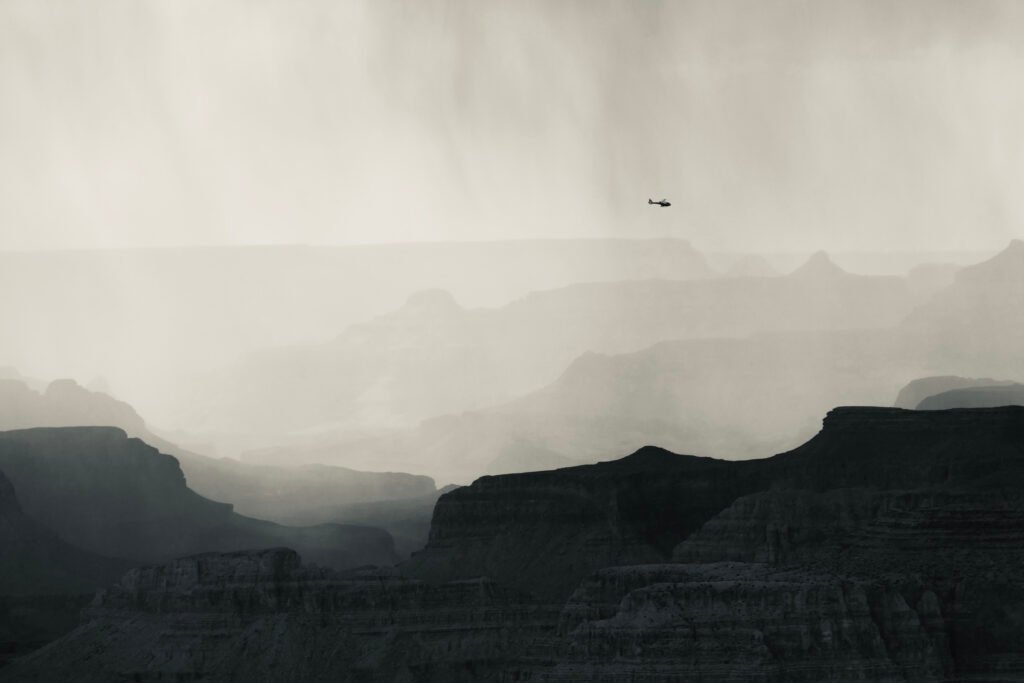
At the car park, Elk are walking around nonchalantly between the vehicles and we steer carefully onto the road, before heading off down Desert View Drive towards Cameron. The Canyon takes on a continuing kaleidoscope of magical shapes and sounds, while in the distance black clouds roll round the North Rim, the rain cascading into the valleys and chasms. The speck of a tour helicopter in the far distance seemingly flies through the downpour with the ease of the hawks that soar and swoop in this vast bowl. 

We tear ourselves away and head to Page, some two hours away, although in truth it seems somewhat longer as we sit in silent thought, now understanding fully what the Grand in Grand Canyon means. As the night draws in, the light fades and we pass little settlements seemingly sinking into the prairie grass, lit only by one or two street-lamps. It’s quite strange and eery in the gloom.

But never fear, we are saved by the great food God in the sky as the bright and gaudy arches of Macdonalds appear on the outskirts of Page. We’re back in fast food civilisation. As we queue there are only two other people in the restaurant, a man and a woman. I hear the lady talking with a Scottish accent, so I interrupt her in mid-flow as she’s ordering a couple of Sweet Chilli Chicken wraps with full sides and a Double Cheeseburger for dessert. It turns out they come from a town only fifteen minutes from where we live in Scotland. I call Nicky over, and we sit down together for what you could euphemistically call “dinner”. We all agree that we’ll not talk of this when we get home to our respective friends and family, just in case we are run out of town or ex-communicated for having a sneaky Big Mac. I bet our new best friends were mortified at being found. I decided not to tell them about our monthly pass for Subway……..

We ultimately find our accommodation at the “Suites on 10th Street”, set in a strange area beside a commercial estate. It looks as though they were formerly offices, but the accommodation is good, clean and comfortable. I search for the washing-machine which was part of the deal, however I don’t find it until the following day. It turns out it was at the rear of the building in a storeroom. Of course it was. Silly me, why did I not think of that ? In a rash decision, I decide to keep the clothes on that I arrived with. 

201 miles today.

We leave Page at 11am even though I thought it was an hour earlier. Apparently, we’d crossed some invisible mid-western time-zone, so we drive all of four minutes to Starbucks to have a coffee to get over it. By now the sun is hot, I’m bald and Nicky’s hair goes curly in the heat, so we bravely enter Safeway and buy two hats, which I regret to say we never wore. A bargain though at ten dollars each.

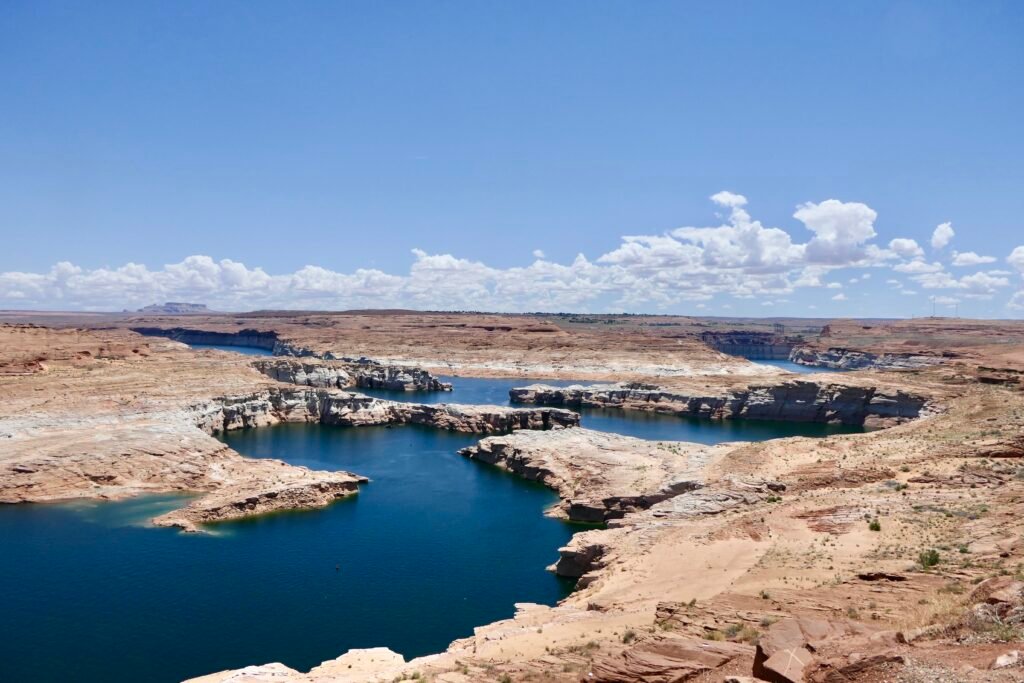
We head to Lake Powell and the boat ramp at the conveniently named Lake Powell Resort and end up having a disagreement over a photograph, so I take more pictures of Nicky just to be really irritating. Turns out they are really good pictures !  

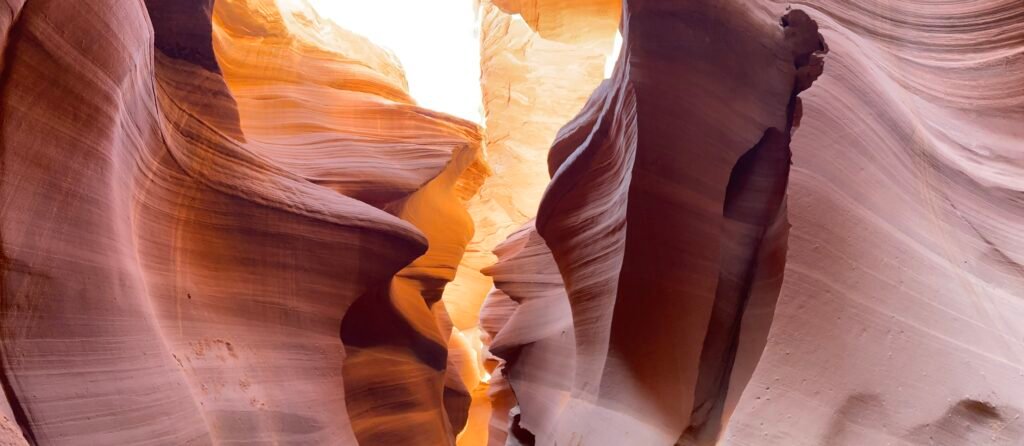
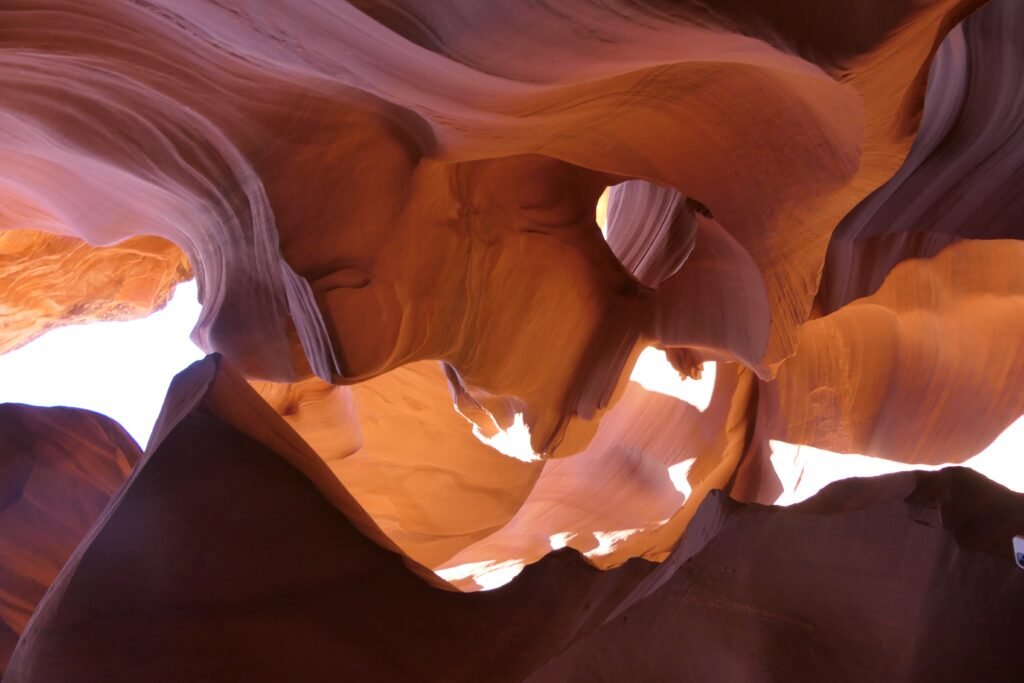
At Dixies, the guided tour company at Lower Antelope Canyon just outside town, we get the time wrong again and turn up an hour too early. The tour of the slot canyon is a revelation. We walk down some steep stairs into a fantasy world of colour. Photographs will never do it justice, but these remarkable canyons are extraordinary and one of the highlights of our trip. The experience of walking through these coloured stone walls so tightly wrapped around us is like being in a Disney movie, marvelling at how many shades of brown, yellow and gold there are in the world. Nature at its most inventive.  Our guide, whose name escapes me, mainly because I can’t pronounce it, is a Native American but seemingly has a side-line promoting Apple iPhones. He shows us how to take incredible photos with our cellphones and I learn a lot. We spend nearly an hour in the canyon, and it is spectacular. I will remember this walk for a long time. One of America’s unique and fascinating experiences.

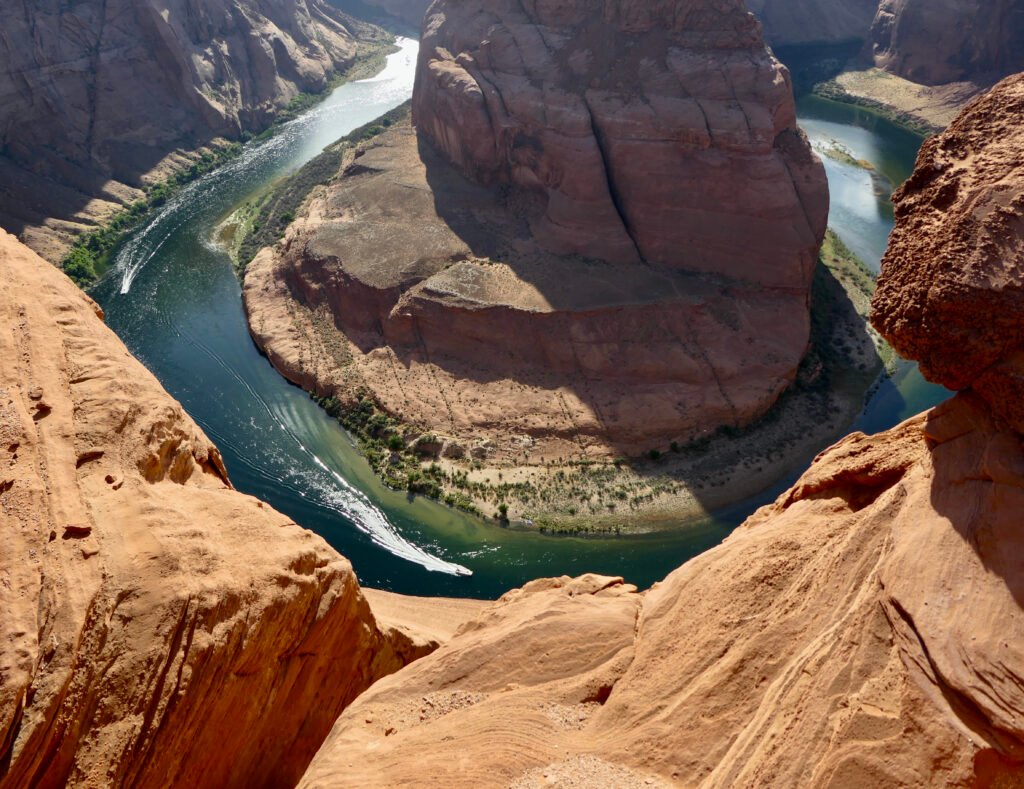
Horseshoe Bend is next via a quick trip to Subway and Safeway once again for provisions. We walk nearly a mile in 80 degree heat to the viewing point. It’s very busy but many others are here for the sunset due in a couple of hours. There are also one or two who have left their sensible hats at home because we watch them getting very close to the cliff edge including a girl with a baby. For those who have been here and looked down at Horseshoe Bend you’ll know that the fall is not a short one. I take pictures of them just in case their family want a memento of their idiot son or daughter’s last few seconds. Luckily, none oblige, and they live to die another day. The view down to the river is dazzling, and as the tiny speck of a speedboat heads northward, its wake spreads out across the river like an arrow slicing through butter.

Another 70 miles of road disappears underneath us as spectacular rain clouds unload over the gold-coloured wheat fields, and later, a sunset sets fire to those same fields. Quail Park Lodge is one of those anonymous lodgings so beloved of the American roadside but quickly contradicts the image by being comfortable, clean and with surprisingly welcoming hosts in Austrian’s Robin and Vins. How they found themselves here from the stunning valleys and mountains of Austria was a little beyond my understanding, but they are nice people. The property is quirky rather than Quail but breakfast is great with bagels, cream cheese and coffee.

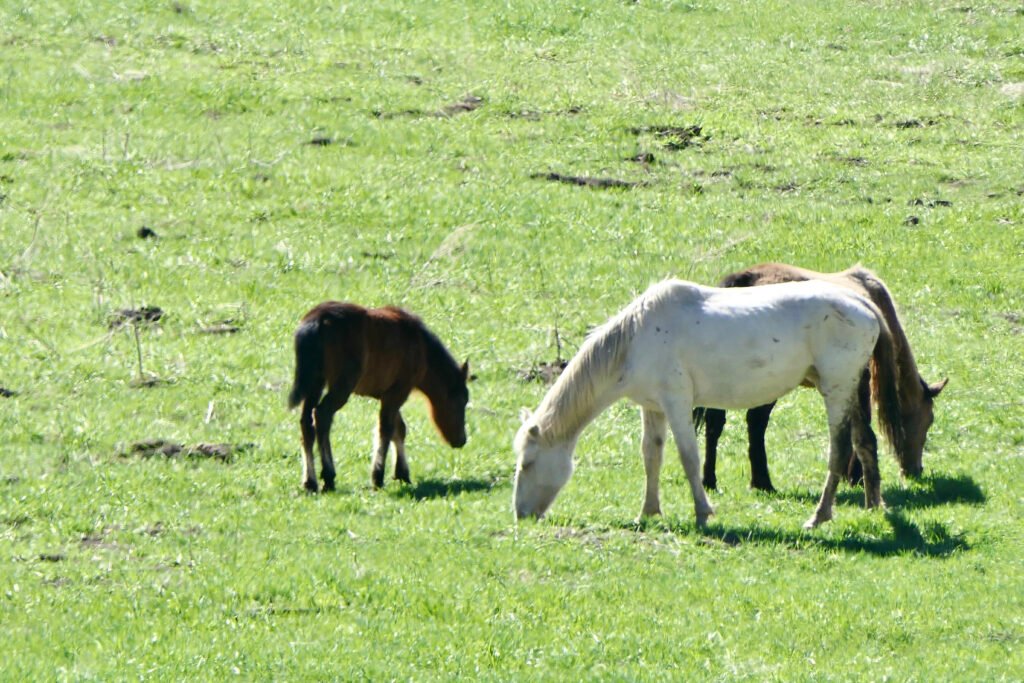
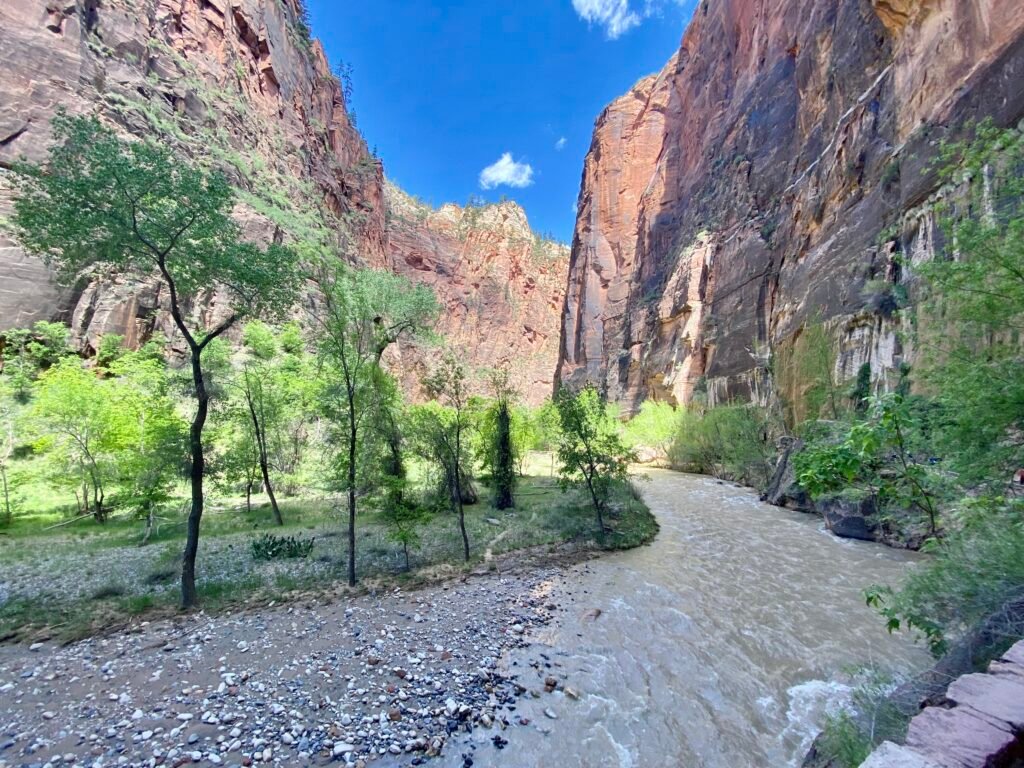
Zion National Park comes next, through the East entrance and the mile long tunnel, where we stop to make acquaintance with a group of Utah’s wild horses. They weren’t exactly wild to see us, but at least gave us a flick of their manes to acknowledge our existence.  To get to Zion, we have to park in Springdale, before boarding a shuttle to the park, which at 20 dollars a day is pretty expensive. We ride up to where the Narrows Trail starts and walk for a couple of miles along the track in the company of hundreds of others on the same mission. It turns out the river has very high water and the Narrows are disappointedly closed. This time of year, with a lot of water run-off from the mountains, it dictates what we can and can’t do, which we knew before we got here. Hiking up to Angels Landing is also off, which is probably just as well considering it’s not for the faint-hearted. 

We walk back the few miles to the visitor centre along the Virgin River and watch climbers attempt a sky-high cliff, seemingly hanging by a thread. Lunch is taken in town at Oscars Café in their covered patio, before hitting the road again along route 1-70 to Panguitch and checking into the Lamplighter Hotel, another Bates Motel look-a-like and I get horrified looks from my travelling companion. Luckily, we are given the “luxury option”.  It’s basically the same motel room, but separated from the rest of the complex, sparing us the thin wall syndrome of noisy neighbours. I pass the accommodation test again. 

585 miles over the last two days 

Leave at 8am and stop for coffee at a little roadside hut beside a fuel station, and chat to an Italian couple who were going to Goblin Valley. The fact he is stuffing his face with a pastry, their choice of destination doesn’t come as too much of a surprise. 

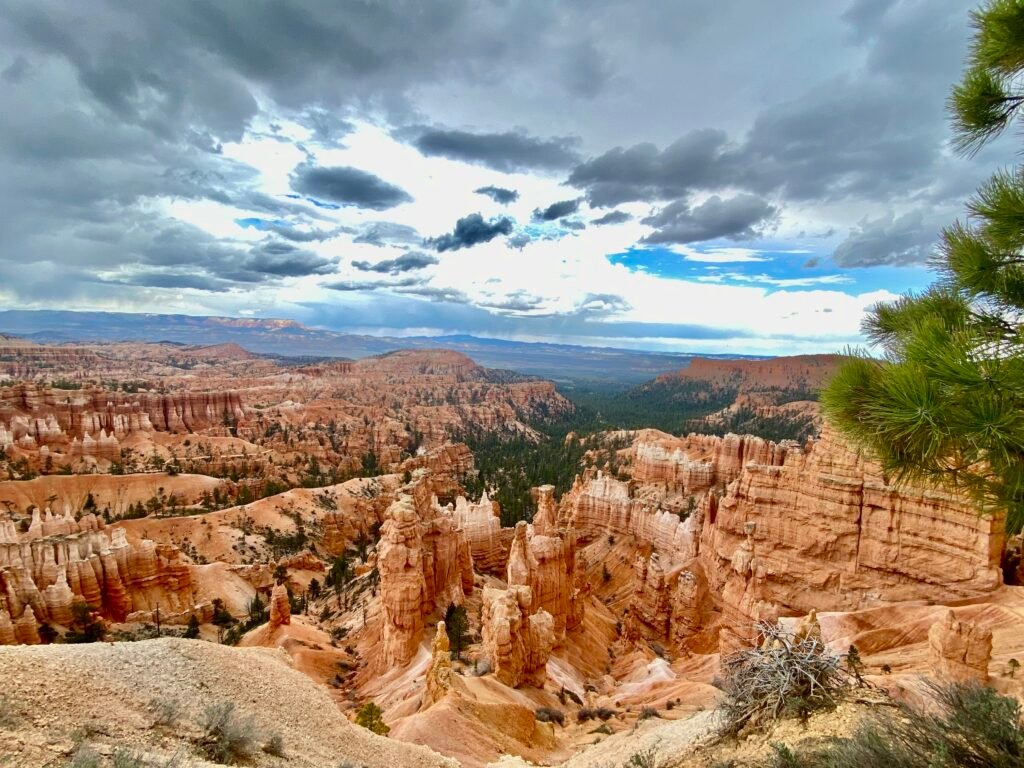
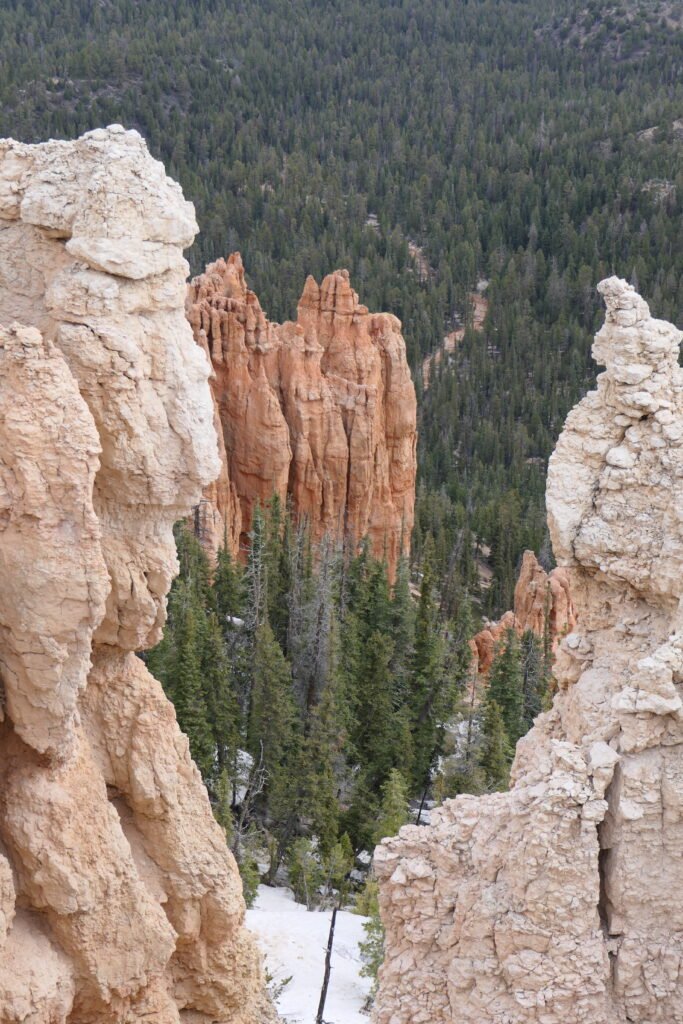
The entrance to the greatly anticipated Bryce Canyon comes into view. We were encouraged by others to drive to the far end of the park and work our way back stopping at the various viewing points. Rainbow Point and Yovimpa Point overlooks, then Poderosa Canyon Overlook and Agua Canyon, which has some of the best colours in the park. Natural Bridge is next, spanning 85ft and cut by the wind and rain then from Farview Viewpoint, you can see the Grand Canyon North Rim. Bryce Point has the largest amphitheater of hoodoo’s, while Inspiration Point has the best view of the silent city, the massive gold coloured edifices weathering gracefully in the wind and rain.  The combination of rain and thunder is getting serious now, and we have a moment regretting that we have to leave and not able to hike the trail far below us, wending it’s dusty way through the hoodoo’s. We walked over to the General Store, buy chilli soup and sandwiches, and sit on the porch commiserating about our basic lack of understanding about what the weather was going to do. 

We leave the park reluctantly as we have a three-hour journey in front of us, which ultimately takes four and a half hours due to the unbelievable views along Scenic Byway 12, otherwise known as The Million Dollar Road, through Capitol Reef Park. We stop twenty times or more to gawp at our surroundings. 

At Green River, we find an absolute gem of a hotel at the “River Terrace Inn” which turns out to be one of our more comfortable accommodations on the trip. It overlooks the overflowing Green River just below our window. The Tamarisk restaurant is literally twenty yards away, and as it turns out, serves pretty good food. It wasn’t a long walk home. With a great night’s sleep behind us and the sun shining on the river in the morning we could have stayed much longer.

286 miles today

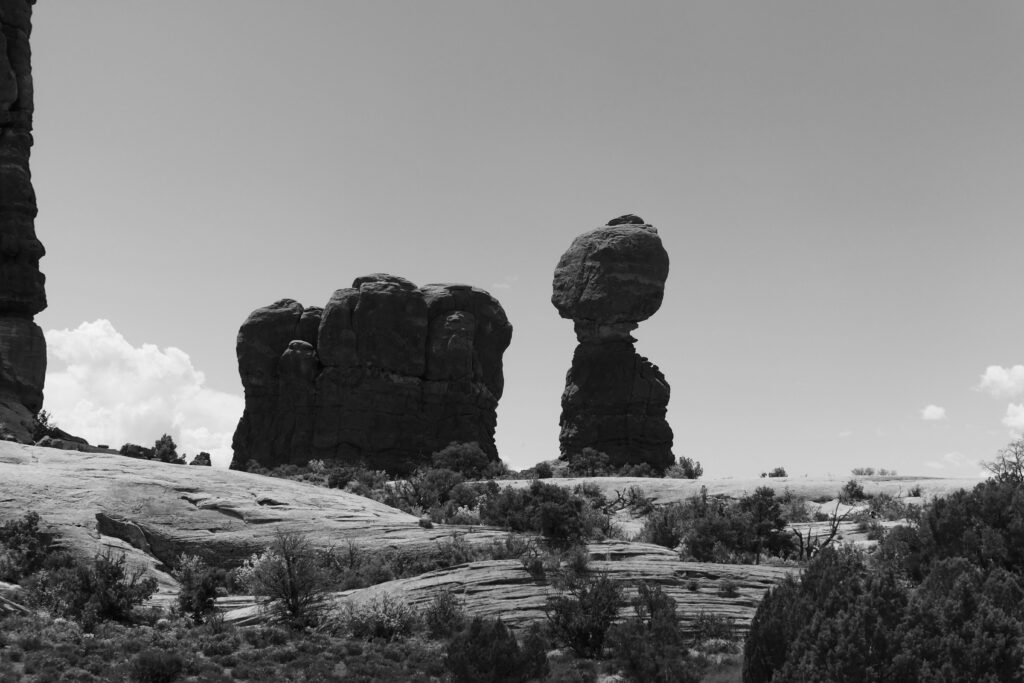
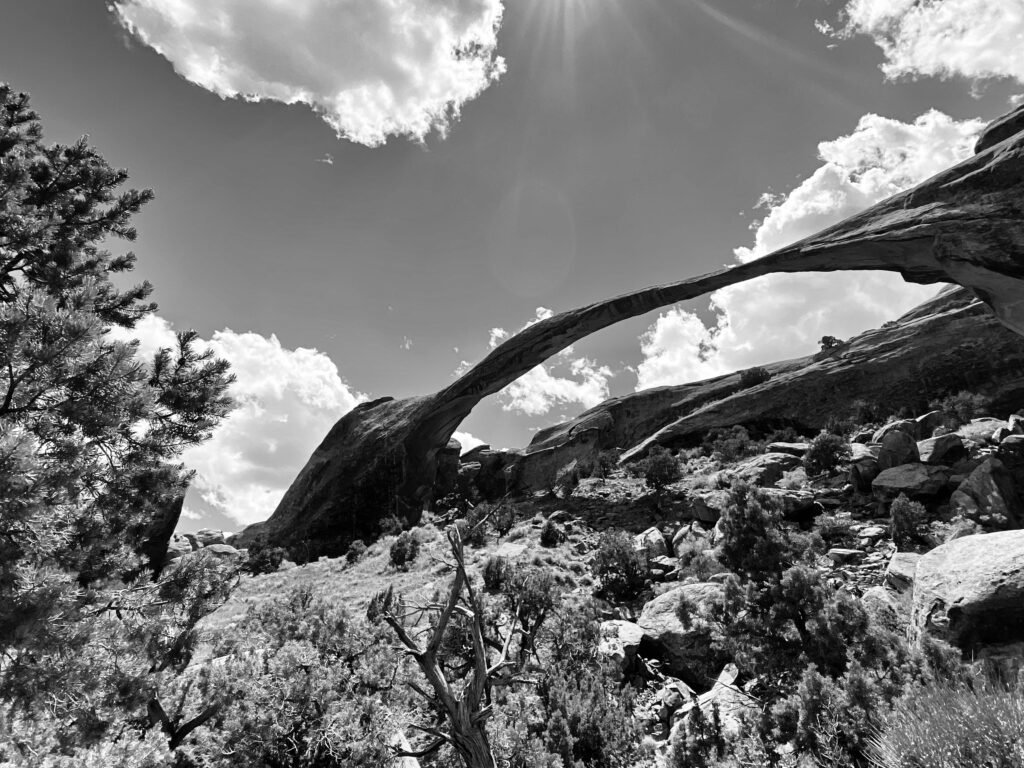
A 50 minute drive towards Moab is ahead of us, and the route through prairie and mountain scenery is simple fabulous. 18 miles into the park, we ditch the car and hike to “Devil’s Garden Arch” in 84 degree heat, compensated by some awesome views. After spending a few hours in the park, we miss out Moab town, shimmering in the heat haze in the distance, which is a shame, but we have another long four hours on the tarmac to tackle.

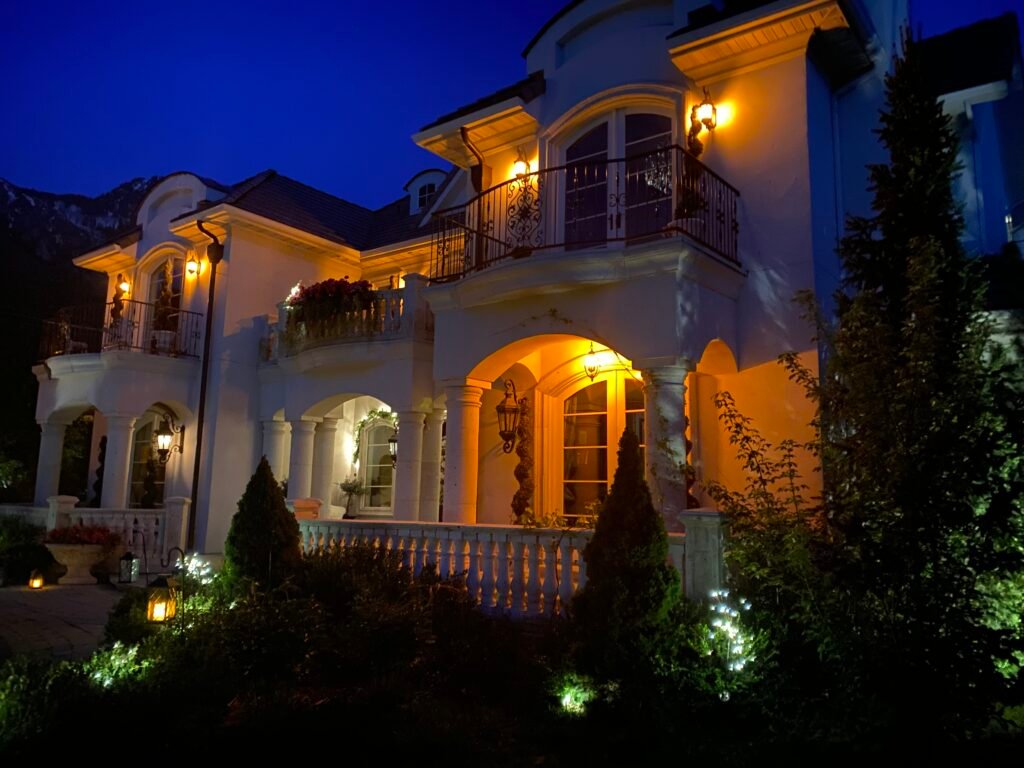
We backtrack to Green River for fuel and eats with our friends in Subway, then head towards Salt Lake City and our ultimate destination of Sandy. I was looking forward to seeing Nicky’s face when we drew up at this Air BnB. I knew it was nice, but I didn’t know it was $12 million nice. This was a huge mansion set in the wonderful sounding Dimple Dell Road and owned by the lovely Jeannie. The super luxurious accommodation was divine, and the home, or retreat, call it what you will, has a large range of artefacts, a couple of horses in the corral and a little lake to provide some calm. It was exactly the kind of place you dream about after a long few days on the road. We are shown to a large luxurious suite with an accompanying office although I have no intention of working during our stay !

We sit on the terrace for a couple of hours enjoying the peace and quiet of our beautiful surroundings, contemplating the amazing sights and sounds of the previous few days, before falling into a deep sleep.

Red Rocks, Canyons and Forests

Sedona to the Grand Canyon

We had hardly left our accommodation in Sedona before we stop at Firecreek Coffee house for sustenance. Out on the deck I meet 77 year-old Joseph, kitted out in his cowboy trench-coat, leather hat and walking rod, even though it’s already sweltering. He looks out of place in a coffee shop but is obviously a regular which makes for an interesting conversation. We talk a lot about Sedona and Scotland before he wanders off, no doubt to tend to his sheep somewhere in the hills. He’s probably an ex-accountant for all I know, but it’s nice to speculate about what he actually does in life.  

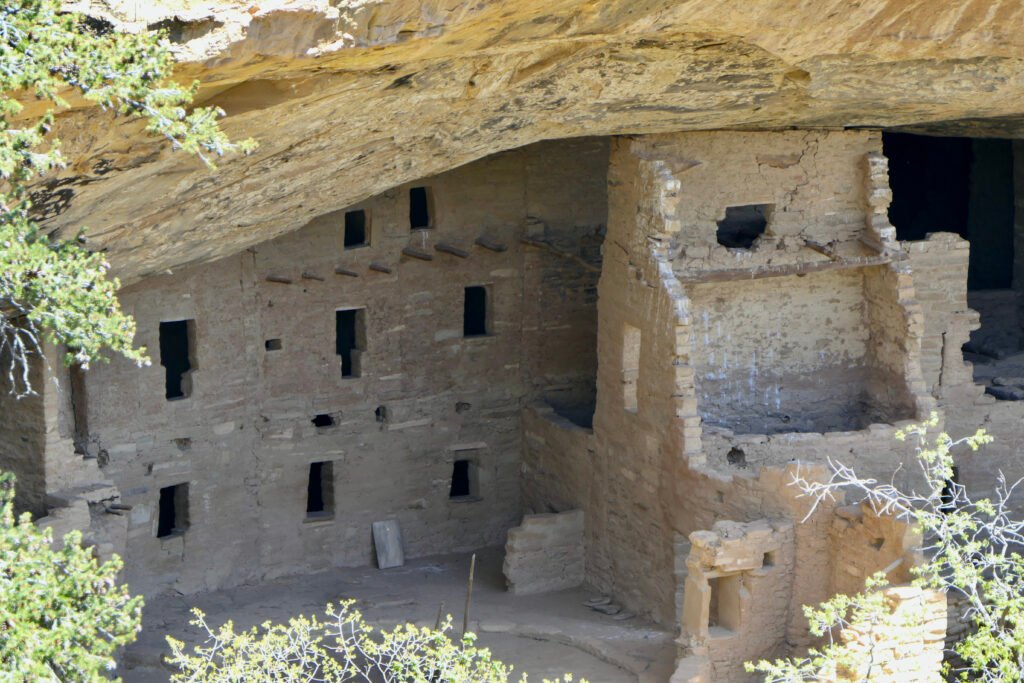
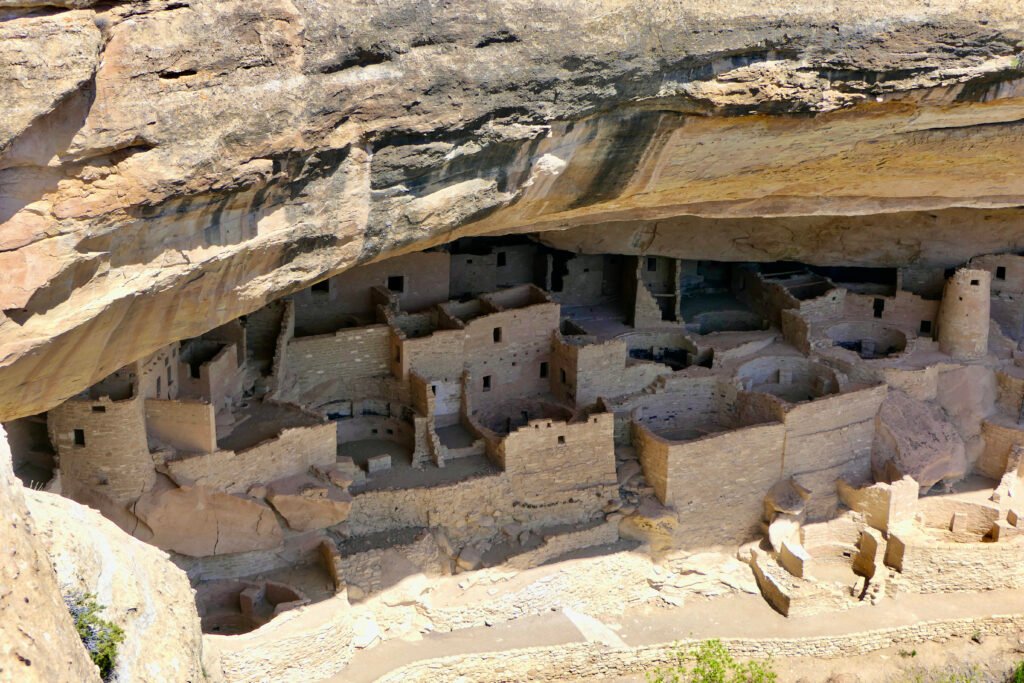
Our first stop of the day is Montezuma’s Castle for a taste of some Pueblo cliff dwellings, which turns out to have a very peaceful and pretty riverside setting, apart from a couple of noisy families. A couple of nights in the dwellings would sort them out. The Castle was carved into the cliff somewhere around the 1100’s and is five storeys high with an astonishing 45 rooms protected from the rain above and the creek below.

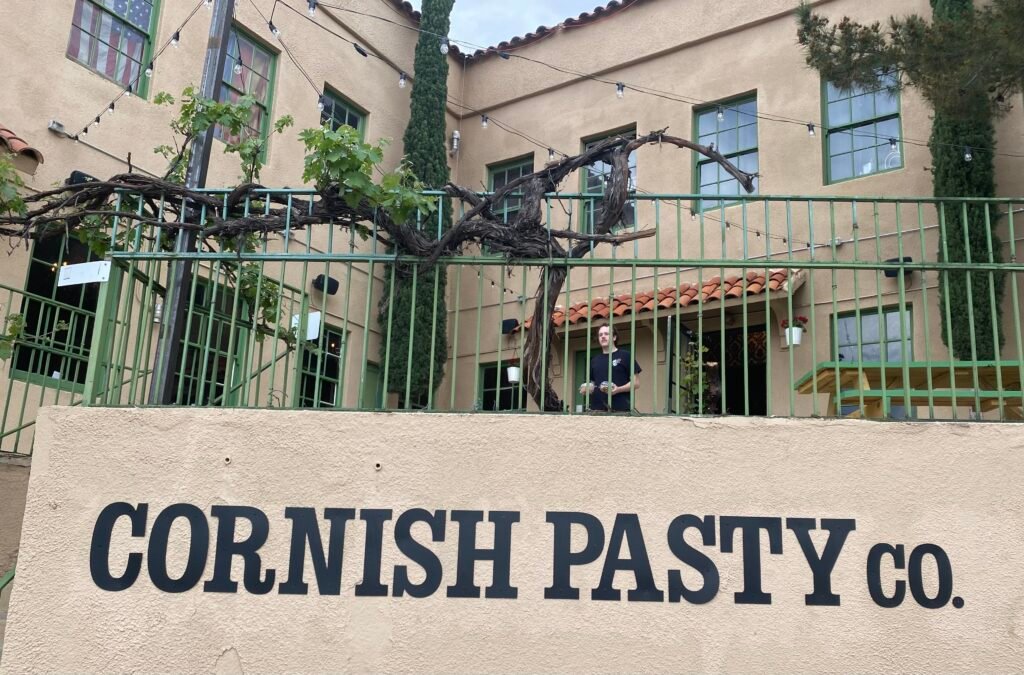
On towards Cleopatra Hill situated between Prescott and Flagstaff and the historic copper mining town of Jerome. This town is impossible to describe. I can only offer the suggestion that it’s a haunted ghost-ridden ex mining village with an arty, touristy feel about it ? Founded in 1876 with a settlement of tents in a roaring mining community, known in its heyday as the wickedest city in the west, it once had over 15,000 residents. When the mine closed it had 46 people remaining in town. Back then it also just happened to be the murder capital of the State, which is nice. As we walk up and down the many stairs and slanted sidewalks, we come across some curiously named stores, such as Wicked City Brew, Haunted Hamburger, the Bordello of Jerome (a restaurant, no less), Ghost City Inn, and the oddest of them all – The Cornish Pasty Co. This place is packed with customers. 20 minutes and 23 dollars later I leave with my Cornish pasty. That’s a bit steep even for a good pasty. To be fair, it IS large but needs a little more bite to it. 

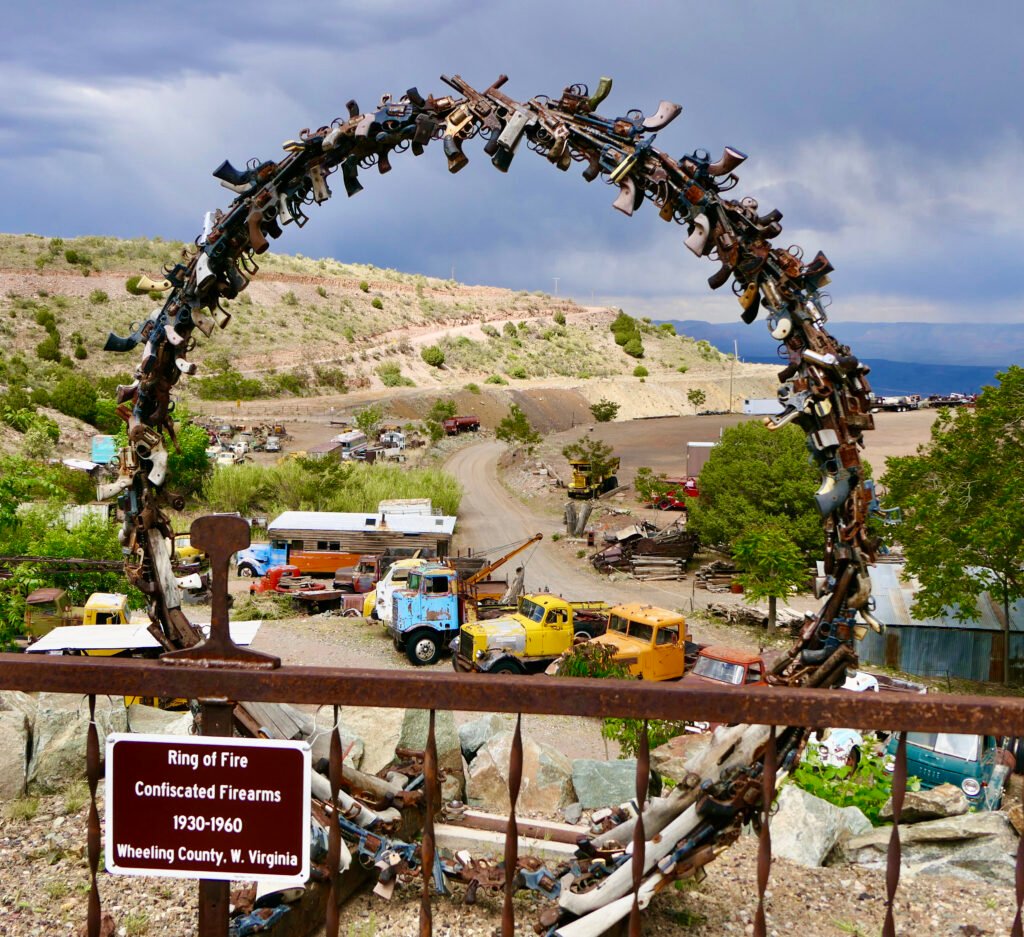
One of the reasons we’re in Jerome is to visit the Gold King Mine and Ghost Town, which sits a mile further out of town in the hills. We carry on up through Jerome onto a dirt track into what looks like a quarry and arrive at a ramshackle set of old buildings surrounded by an array of broken down, rusting vehicles. There are nearly 200 cars, trucks, motorcycles and even fire engines here. It is an astonishing place.

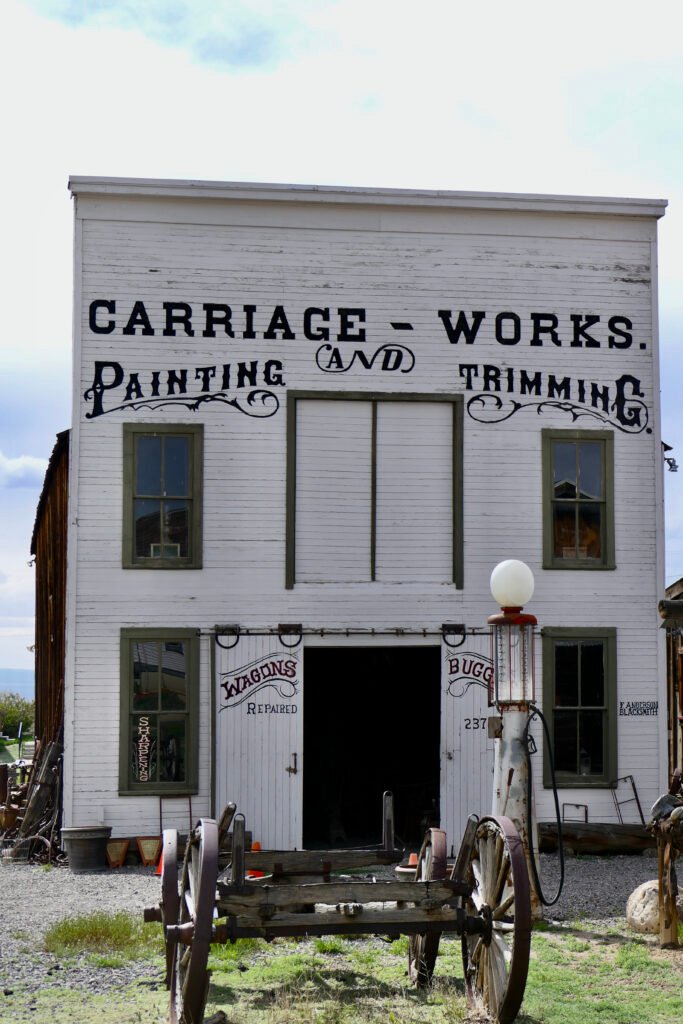
We wander round a variety of buildings carrying signs for dentists, plumbers, blacksmiths and so on with thousands of pieces of machinery scattered around in addition to a working sawmill.

Somewhere among this melange of vehicle heaven, we turn a corner, and are suddenly attacked by little fluffy baby chicks who, it turns out, are part of a petting zoo on the property. You couldn’t get two more wildly differing attractions – a petting zoo and a ghost town.

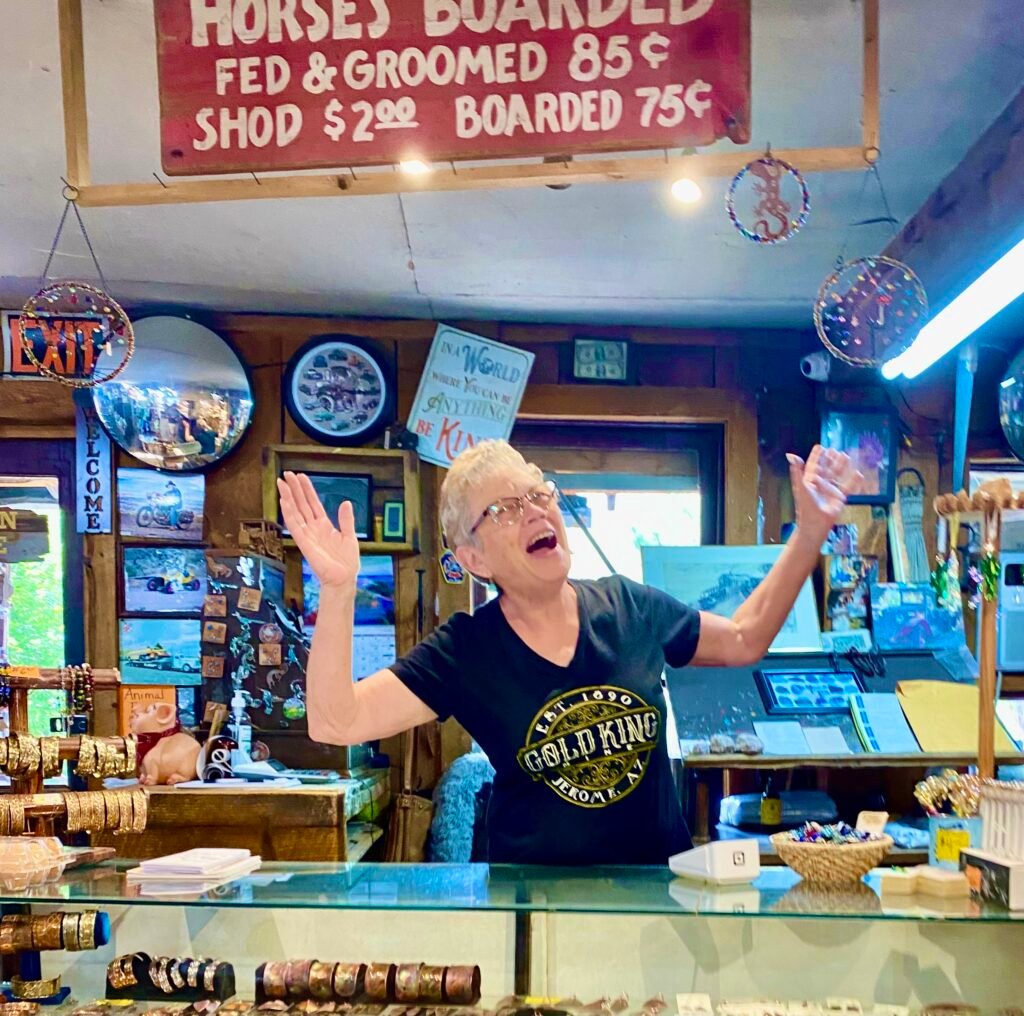
With gold panning as a side-line, the Gold King Mine keeps coming up with surprises. And there’s more. The lady in the little gift shop is a cheery, happy go lucky soul who, after asking where we are from tells me she been to our home town and knows it well. This place continues to astonish me. I love it. 

Our ultimate destination for the end of the day is Williams, a hop, skip and jump from the Grand Canyon but I decide to take a little detour to Prescott as I’d been there many years ago – at that time in three feet of snow ! We arrive just in time to see the Arts and Craft Fair in the main square packing up, so we take solace in Frannies Ice Cream shop for a couple of large cones. Disappointingly, Frannie wasn’t in. How come these people are never in their actual shop when you visit ? I try and find the beautiful mansion that I stayed in last time, however without the snow as a backdrop I couldn’t get my bearings. 

I’d travelled through Williams before many years ago, but it’s changed somewhat. It turns out to be a little like Blackpool in the UK on a quiet night. We’re booked into the very last motel on the strip called El Rancho with very comfortable rooms and decide to take a walk down Main Street – actually the only street – looking for somewhere to eat. Nowhere looks too enticing so we end up back in the room with a tin of soup and collapse into bed. This is what the high life is all about !  239 miles today.

The sun is up early and so are we.  It’s not my first trip to the Grand Canyon. That was in 1996 when my first look at this amazing place was from a helicopter. We had flown over the treetops for about five minutes before the forest disappeared and over the cliff edge, where there was nothing between us and the bottom of the Canyon nearly 6,000 feet below, one of the most awe-inspiring things I have ever experienced. This time after reaching Grand Canyon Village, it’s a gentle walk up the slope from the car park to the Canyon edge. The experience is no less exciting and inspiring than before. It is still one of the world’s most incredible views no matter how many times you visit.

When I was here all those years ago, Instagram wasn’t a thing, so this time there are a lot more idiots trying to get that unique photograph that they think no-one else has got. I fall into the trap of taking photos now of a series of those idiots clambering onto rocks strictly forbidden by the park authorities, just so they can have their “close to God” moment. Not so much spiritual, more like dicing with death. I’m merely trying to record their last moments so they can have a fitting finale for their Instagram account.
Disappointingly they all decide to live another day, so we move on to Devils View Watchtower to see the sun get lower in the sky. There are so many different spectacular views to discover along this trail, it’s the land of a thousand photographs. Leaving the Canyon is hard. It is a most wondrous place.

Old Durango to New Sedona

135 miles

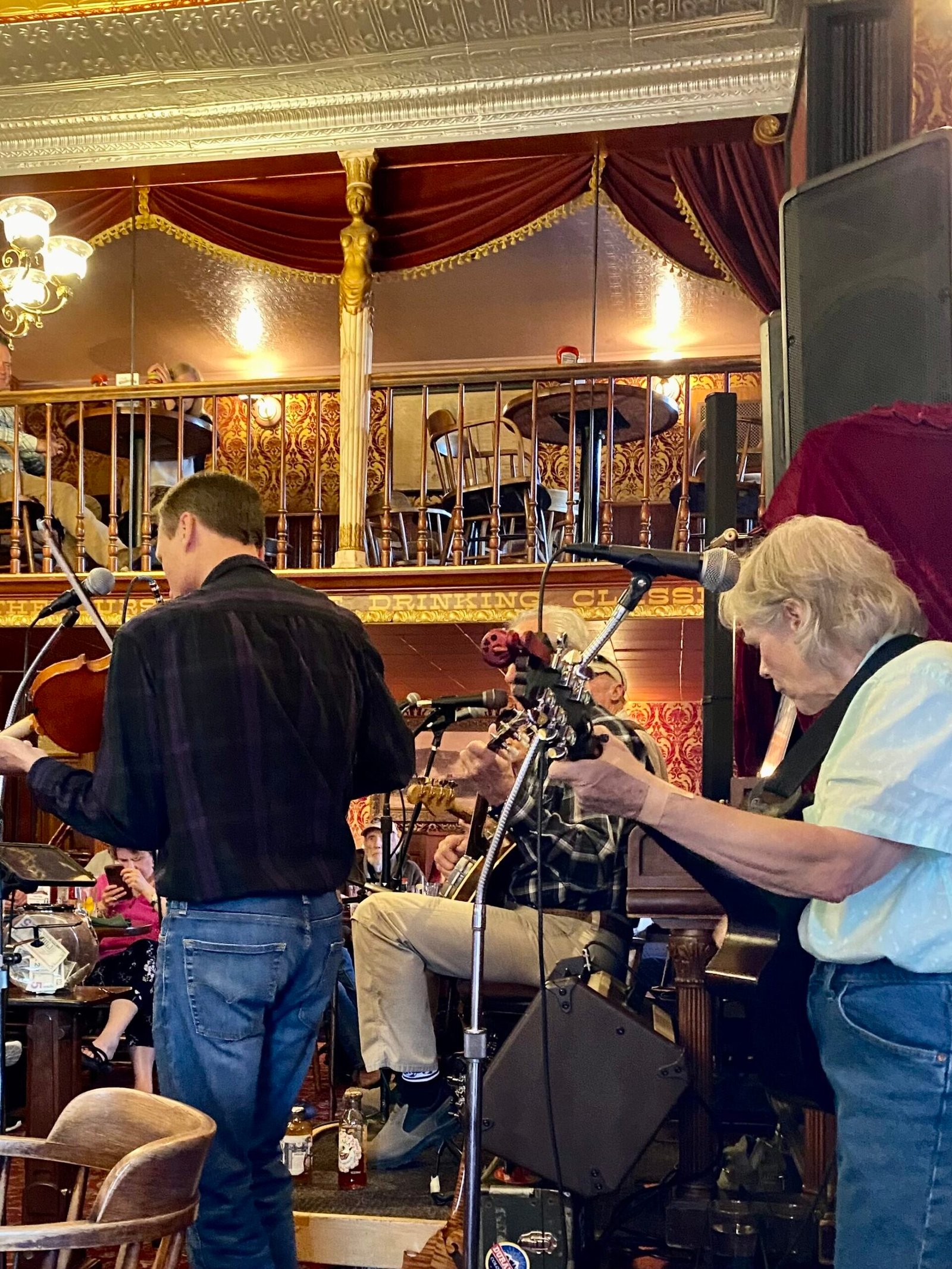
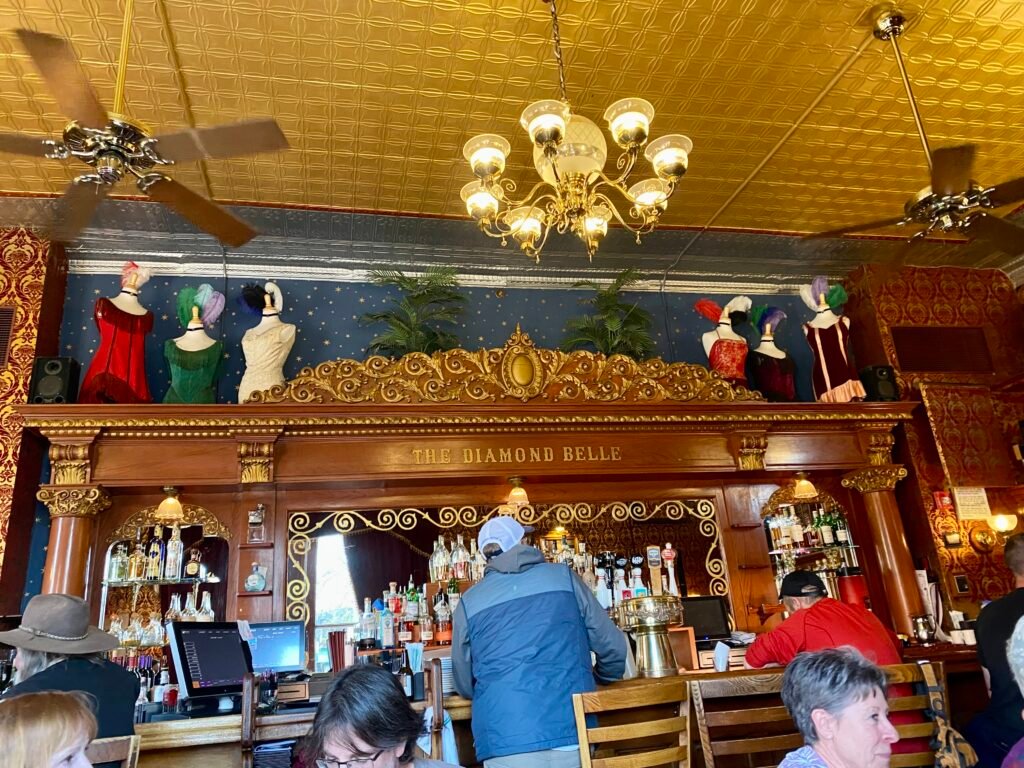
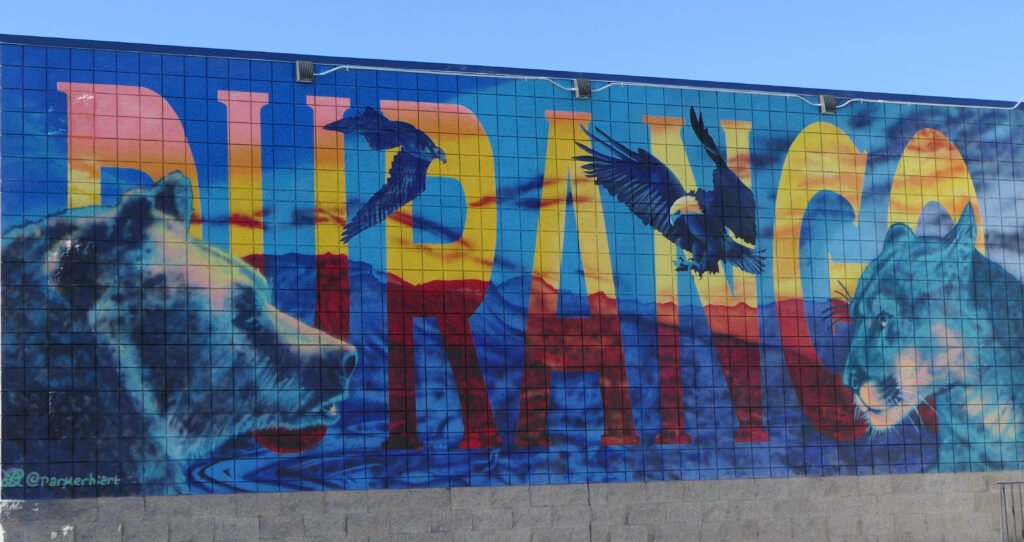
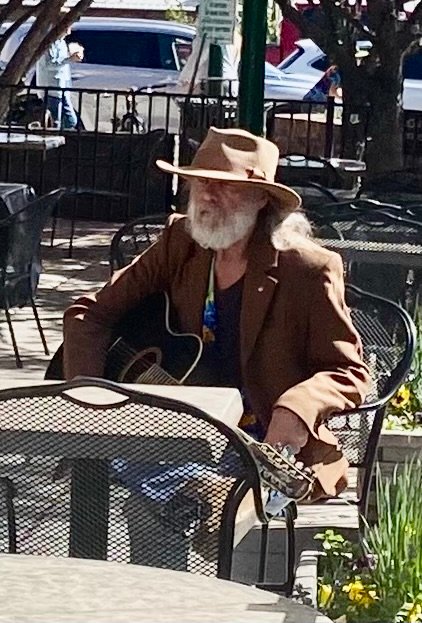
The previous night had been a late one – that’s if you call 1130pm late in Durango. We’d managed to grab the last two seats in the bar at the Strater Hotel just as a local Country and Western band took to the stage. I say stage, but it was more like a raised pallet, just enough to give some height to the musicians so those at the back of the room who weren’t paying much attention, could hopefully see them perform. 

Strater Hotel Bar, Durango

Built in 1881 at the peak of the silver and gold mining era, the hotel retains many of its artifacts and indeed some of the characters still seem to be caught in a time warp. However, everyone is having fun as the band stomps out another country tune, and the one doing the most stomping is the sole lady musician, clearly the leader as she is dictating which songs are sung. When they take a break we get served by a cheerful young waitress dressed as an old-time saloon girl, but she fails the test as her sparkly black tights are torn. She apologises for her carelessness, having caught them on one of the bar stools earlier. She takes our order and wanders off. Two minutes later a young cowboy is trying to unhook her tights from another pesky bar stool that attacked her. This gallant act takes some time, much to the amusement of the locals and as the band plays on, there is a surreal look to the scene as the young lad is leaning over the girl, her leg pointing towards the balcony, and pints of beer being passed over the two of them from the bar. Maybe this is exactly what it was like in the 1800’s? That is, apart from the two Ford mustangs, three Chevvies and a bunch of trucks lined up outside. Horsepower is some-what different these days. 

Country Sunshine AirBNB, Durango

With heads still sore the following morning, daylight arrives with a crash or so it seems, and we leave our accommodation reluctantly despite the birds out in force, begging us to stay. Heading back into town for the day, we pass by a forest fire cloud billowing its way skywards from one of the high hills beside the main road. We decide not to alert the fire services, as we assume there are better qualified people than us to determine whether this is a serious matter or not. In the centre of Durango, we spot a branch of Subway. Now, I’ve never entered a Subway before – ever, but it’s a quick and easy meal for us adventurers on a road trip……..and expensive – with a unwarranted tip on top. We take our hard-earned sandwiches to Santa Rita Park beside the river to eat. It happens not to be the best park to lunch in. A vagrant turns up and asks us for a spliff, which I had to decline as I wouldn’t know one if the smoke went up my nose. Not knowing what to else to offer him, other than a half-eaten Subway which he would no doubt turn his nose up at anyway, we are interrupted.

His mother and father have arrived. Having driven up to the grass verge in their car, they make no attempt to get out of the vehicle to greet their son. I’m now wondering if they know something we don’t. Now they’re talking through the car door window. At least they’re on speaking terms which relaxes me a little. His father passes over a pair of pants to him through the open window, and he promptly takes off his own trousers and throws them into the trunk, noticeably not handing them to Ma and Pa. My sandwich is hanging out of my mouth as I gawp at the state of undress this unfortunate is in. He steps into his newly starched Levi’s, and with a quick wave from Mum and Dad, the car speeds off while the lad walks lazily into the distance down the river path, admittedly with a slightly easier and more definitive spring in his step. You can always rely on Mum and Dad. Only up to a point though. They clothed him, they fed him, but obviously weren’t going to go the whole nine yards and invite him home for the night.    

We leave our newly clothed riverside resident so our own adventures can continue, and we move further downstream to the white-water rafting area, a cool facility in the middle of town offering canoeing, rafting and boarding. It’s great to watch for a while, the highlight of which is the confident “expert” participants then falling into the frothing waters on a regular basis. We all admire skill, but what we really like are moments of incompetence because that brings it down to our level where we feel much more comfortable, instead of trying to impress the many onlookers on the riverbank.

Lions Den lookout over Animas City Mountain

I want to get a better overview of Durango, so we head up past the University and find a look out area called Lions Den, more by chance than design. Here we meet Derek, the manager of the local Ranger Station who seems to be just hanging around. It turns out he’s keeping a close eye on the hillside opposite where the fire we saw earlier today is still burning. I feel some disappointment when he tells me it’s a controlled burn and he has a team making sure it doesn’t spread. I had hoped for something more dramatic like a raging, untamed inferno chasing some wild animals and furious residents out of the forest. However, I put that thought away quickly, half wondering whether I have tendencies for being an arsonist. That’s how it all starts I suppose. Scary. This thought is interrupted by a scream from my partner, who is sitting on a wall and finds a snake squeezing its way out of a gap in the concrete between her legs. It’s harmless of course, but for a Brit it’s a surprising experience. For our fellow hillside gazers, it’s a big laugh although to be fair, Derek takes the situation seriously and explains what it is and how to deal with it. Like walk away.

Derek the Ranger’s snake

We thank our Ranger friend who has spent a good deal of time with us explaining about how a Ranger’s work is never done. He obviously hasn’t heard about painting the Forth Rail Bridge back home in Scotland. We say our goodbye’s as we head back to our hosts, Walter and Jodi for a rest and re-pack again. 157 miles today

Morning breaks, and we’re on the road again, via a little trip to our new friends at Subway just so I can check out that they really are asking for a 20 per cent tip for doing not a lot. Yes they are, but I still buy a foot long tuna sandwich as they’re actually quite good. It’s only a half hour drive to the Mesa Verde Visitor Centre along route 160, but we need to drive a further 20 miles into this huge park to get to the first vantage point. We chat to a nice lady from Florida who is pulling a relatively large SUV and trailer. She seems to be on her own and having driven from the Sunshine State I offer my admiration at the long-distance excursion she’s taking. This immediately sounds patronising, but she laughs it off and said “that’s why I have a trailer”. That’s me told. Florida Lady kindly takes our picture with the spectacular view, and as we part I see a weasel sitting on the rocks, which I thought was rather appropriate in the circumstances.

Mesa Verde

As we approach the cliff houses of the Pueblo people, carved out of the rock somewhere around 1190, the view of these dwellings is incredible. We work our way from Spruce Tree house to Balcony House and on to Cliff Palace which originally had a mind blowing 150 rooms.

Mesa Verde

As we walk back up the steps, someone shouts snake ! However now being experts in this kind of animal environment, we hardly flinch. When I eventually see it, I flinch several times. It was large, striped and extremely…..well, snakey. Photos snapped, both us and the snake slide off in opposite directions.

Mexican Hat

With Mesa Verde ticked off, we move on to Monument Valley, passing through wonderful the exquisite Mexican Hat. Well, the name is wonderful, the town less so. However, the Hat itself is wondrous. Just for a minute, I’m minded to climb up and tip it over. It was only a fleeting thought……….

Forrest Gump Highway or Route 163

I’ve been in the States over 50 times, but for a variety of reasons I’ve never made it to Monument Valley, so this is a truly exciting part of the trip. So exciting, I had rashly splurged out a fortune to stay two nights at the world famous (in America) Goulding’s Lodge so we could rest within sight of the huge rocky monuments themselves. As we came over a rise in the road, the late afternoon sun was creating a raft of colours across the landscape, with rustic reds and deep purple patches sitting against the backdrop of a misty pink sky. Laid out before us lies Forrest Gump’s highway disappearing into the far distance, with one or two headlights shining like little lonely stars in the vastness beyond. Our room has the most iconic view we could wish for, and I sit on the balcony drinking beer and munching on a sandwich. We savour the setting sun and the changing shades colouring the magnificent monuments, with names like Mittens, Elephant Butte, Totem Pole and North Window. I go to bed very happy, but only when it’s pitch black and I can’t see them anymore. 212 miles today.

Woke up at 602am this morning somehow sensing I’m missing something. I am, and when I open the curtain I can see why. The magnificent sunrise over Monument Valley has to be one of the great views in the world with the pink and purple hues embracing the desert sand, then up onto the already red rocks. We sit and watch until it’s time for breakfast. Yes, food wins again.

Monument Valley

Unusually for America, we get cold coffee in the breakfast room, send it back and get tepid coffee in return. At least it’s improving. Maybe tomorrow it’ll be hot. In full daylight, the view from the hotel towards Monument Valley is only spoiled slightly by a gas station strategically placed in the middle of the desert. We have a couple hundred miles of space around us, so I’m curious why the planning person thought this was a suitable place for their monstrosity. Maybe they felt the view was compensation for the poor cashiers stranded in the middle of nowhere. Who knows ? My curiosity wasn’t curious enough to ask anyone the question. We had better things to do.

A dust storm rolls in …

By midday the weather turns, and a huge dust storm rolls in from afar, obliterating our precious view of the valley. Nonetheless it looks spectacular, and as it quickly as it comes, it goes. We had booked a shuttle tour rather than drive round the valley, and they suggested we would be driving 17 miles around the reservation, however we probably only do about half of that. The guide is pleasant, but pretty useless. Either that or they think there isn’t much to talk about around here. I’m sure John Wayne would have something more definitive to growl about. I would even sacrifice the air conditioned shuttle bus for a rattling old stagecoach. To be fair it didn’t distract from the sensational, and I have to say, emotional feel about the place. Dwarfed by the monolithic rock formations, you can just see all those iconic scenes from just the dozens of famous movies filmed here. Stagecoach (of course), Easy Rider, Back to the Future, Westworld and Mission Impossible to name just a very few. 

Earlier in the day we had visited John Wayne’s Cabin and the museum on Goulding’s property. It’s so small you’d be hard pressed to get John Wayne’s leg in there, never mind the rest of his body. But the museum is fascinating.

The following morning Sedona was calling, so again we reluctantly leave another iconic scene behind us and drive off through the run-down communities of Tonalea and Tsigi. Scattered with broken buildings and graffiti ridden abandoned motels, they exude a bizarrely attractive quality in their desperate and derelict state, highlighting the dying breed of small community America.

Tuba City, Cameron and Gray Mountain follow, before we arrive in Flagstaff, where the town website proudly suggests there are 21 “must do’s” in the area. Since eight of them involved bars and coffee shops it’s not difficult to see the attraction. There are a couple of could-do’s though, including Lowell Observatory, Walnut Canyon and the Flagstaff Brewery Trail which takes care of all those bars they mention. In reality though, Flagstaff is just a stop off point for the Grand Canyon some 80 odd miles away. After refreshing ourselves with a couple of local beers, waiting in vain for an old timer to strum his guitar, and the obligatory trek round the limited number of shops, it was back on the road for the 30 mile drive south to Sedona.

Our AirBNB in Sedona had been described as a “Million Dollar View” which to be fair, pretty much described the extraordinary Red Rocks of Sedona seen from the property. Our room was lovely with some nice extra touches, a cool-water dispenser, milk in the fridge and so on. The hosts, Lou-Anne and Thomas, were very hospitable but kept themselves to themselves, probably because they couldn’t understand my Scottish accent. Och well…… We were too tired to go looking for a decent restaurant, so it was tacos and salad at some forgettable eatery in town before an early night.

Red Rocks of Sedona

135 miles today 

The Mighty Million Dollar Highway

Ouray to Durango – 135 miles

It’s early morning in Ouray, Colorado and we’re preparing to head south, up into the mountains to tackle the Million Dollar Highway. Classed as one of America’s most spectacular roads, there are a few theories as to where the name for the highway came from. It could be that the spectacular views looked a million dollars, or the fact that locals used to joke that they would only attempt the journey if paid a million dollars to do so. The steep grades, winding turns, snow and ice for half the year, and a distinct lack of guard rails makes this mountain pass a challenging drive. Almost no guard rails seems madness, but with up to 300 inches of snow falling annually, it allows the ploughs to push the snow off the side of the road down into the gorges. Anyway there are few places either enough room to build barriers. It also means drivers take more care and negotiate the hairpins as if their life depended on it – which it does.

Though the entire stretch from Ouray to Silverton is called the Million Dollar Highway, it is actually just the twelve miles south of Ouray that carry the name, through the Uncompahgre Gorge, which is an incomprehensible name to pronounce anyway, to the summit of Red Mountain Pass.  The name most likely came from the fact that each mile on the Million Dollar Highway cost around a million dollars to build.

Million Dollar Highway

The snow starts to fall just as we are leaving Ouray. I am somewhat apprehensive about starting the journey. If it’s falling heavily here, what is it like at 11,000 feet, coupled with the difficulty of the drive even in good weather. Like all good adventurers we ignore the warnings and carry on. As usual Americans tend to overdo the hype. Yes – the snow is thick, the drive spectacular, the guard rails absent and the climb awesome, but it was no more difficult than driving a one-track road in the north of Scotland. Just a lot fewer highland cows to avoid. 

Two Lonely Skiers

Just past the summit we watch two skiers sliding to a halt after a steep run down one of the many slopes. With no ski lift, it must have been a helluva climb to get up the mountain to the point where it made sense coming here to ski in the first place! I admire their tenacity, if not their reasoning.

Old Mine, Ironton

We’re still at 9,800 ft when an old abandoned mine comes into view as we run into Ironton, described by Wikipedia as an “extinct” town. I would never describe a settlement where buildings still stand erect and proud, if somewhat dilapidated, as extinct. Communities like this which were once thriving, communicate a vision of what has gone before, like memories of a distant relative who has passed on. This little enclave may have passed, but somehow the soul remains in the wooden timbers still resisting the elements, but as each winter passes more abandoned shacks topple in the winter gales.   

This is part of the Red Mountain Mining district where up to 40 mines operated at its peak. There is a good deal of snow today, and apparently not an easy track to encourage us to investigate, so we leave it for another trip, and carry on down the mountainside into the larger and non-extinct popular old mining town of Silverton. 

Silverton

I love the place immediately. It’s uncompromising, with a seemingly haphazard layout, but still has a classic wild west style Main St – long and wide enough for a Jumbo jet to land with room to spare. We walk around the few streets taking in the film-set like buildings. With exotic names such as Bent Elbow, presumably a saloon, Shady Lady Saloon most definitely a bar, and Natalia’s Restaurant. The latter advertises itself in the window as the former brothel in days gone by, pointing out that this service is no longer available, but the food is good. Shame really.

In July 1882 the Denver & Rio Grande Railroad rolled into Silverton from Durango for the first time. Apparently, the growth was dramatic as by the following year, Silverton boasted of having a population of 2,000 people with 400 buildings, including 2 banks, 5 laundries, 29 saloons, several hotels and a red-light district situated on Blair Street which would ultimately assume great notoriety. 

Natalia’s Restaurant

Eight years earlier, men were bringing their wives and families to live in Silverton. This influx of families provided an incentive for citizens to keep at least part of the town respectable. An imaginary line apparently ran down Greene Street dividing the town between the law-abiding, church-going residents and the gamblers, bordello’s, variety theatres, dance halls and saloons. Gambling and prostitution were generally accepted so long as the practice didn’t upset the more respectable areas of town and indeed the fines imposed for scandalous or drunken behaviour were put to good use to improve Silverton facilities. Bordellos flourished. Saloons stayed open round the clock. Silverton was wild, wicked and sinful. Then came the crash of 1893 and the exodus began. Saloon keepers closed their doors. Dance halls were boarded up, and the bordello’s went quiet.

Today for miles around, the ghostly remains of the bonanza days are visible, boarded-up mines and windowless cabins recalling a time when Silverton roared. Now the town has nothing but tourism to keep it afloat.

We head into a shop entitled Railroad Art where we meet the owner Scotty, a fascinating character who tells me his wife has only just come back from her home country of Thailand. Apparently, she doesn’t do winters in Silverton which at -15 degrees centigrade on an average day, I’m with her on that. Scotty stays behind to mind the store. He regales me with tales of the railways in the UK. He knows them all and I appreciate his knowledge but by the time we get down to talking about the size of track gauges, it’s time to depart. I buy a poster out of a desire to make Scotty’s day, and he informs us that the steam train is due in town in a few minutes.

Original Silverton Station

We rush down to the yellow clapboard station just at the edge of town as a high-pitched whistle in the distance heralds the arrival of the Durango and Silverton steam train, lumbering through the valley into town. As we stand expectantly beside the track, the train puffs into the station, then through it and keeps on going with steam hissing like a dragon. It disappears up a side street where the track finishes right in the middle of town. Clearly, we had miscalculated the need for those onboard to be dropped right outside the best café in Silverton. Their legs clearly couldn’t sustain the 200 yard walk from the original platform where we stood. What would all those long disappeared hardy miners have thought?

Rain hangs in the air above the old Victorian buildings, as the train idles on the track like some great black panther waiting to pounce. The visitors have two hours to explore the town, which is probably an hour too long, unless you are going to take in a leisurely lunch. There isn’t a lot to see here, but it’s as authentic an old mining town as you can get, in a time where tourists provide the only income. 

The black smoke pours from the locomotive as it fires up and gets ready to leave. Passengers boarded, it trundles out of town with its whistle sounding a mournful farewell.

As it disappears on its 3.5 hr journey back to Durango, rain soaks the San Juan Mountains in the background, weeping at the visitors departure. That is until tomorrow, when the next haul of day trippers arrive and the shops in town can smile again. Silverton’s boom days ended years ago. Without the train and its summer tourists, you get the feeling only a Rocky Mountain ghost town would remain.

Highway 550 south, or San Juan skyway to Durango is peppered with scenic overlooks, as each view tries to compete with the next in some high altitude “best panorama of the year” contest. Admittedly the actual high point of the drive isn’t so much the 11,000 ft Molas Pass, more the stunning stretch of highway where the views of rolling country meadows backed by jagged peaks, split your attention between road and mountain range.

In Catholic doctrine, souls atone for past sins in purgatory before entering heaven. For centuries, purgatory was often regarded as an actual physical place. Well today we find it. The town of Purgatory is hiding in the San Juan Mountains 25 miles north of Durango. The name originated from some witty farmer who lived in the area way back. He adopted the name for a nearby creek, a tributary of the Rio de las Animas Perdidas (the River of Lost Souls), dubbed by Spanish explorers for a group who disappeared on the river during Durango’s early history. I wonder if they were all Catholics?……..Now it’s a ski resort of some renown, where no doubt lost souls are a fairly regular occurrence on the slopes or in the bars.

We roll into Durango as the late afternoon sun is slowly placing a golden silk sheet over the surrounding hills.  Our AirBnB accommodation is down a short dirt track, which for some unknown reason always suggests to me that at the end of the road some mysterious cabin in the woods might appear, straight out of a horror film. Indeed, a large wooden house now sits in front of us, with a barn style front door, the top half open just asking you to lean over and peep in to view the terror beyond. However, it’s a bit difficult to re-create a scene from some spooky movie when the place is called “Country Sunshine Bed + Breakfast”…………We like the place immediately, and our hosts Walter and Jodie are generous, kind and helpful. The dog seems to like us too, and we thank me for booking two nights here as we feel very comfortable.  

The Black Canyon of the Gunnison

Gunnison to Ouray, Colorado – 107 miles

You would think that the settlement of Gunnison would be relatively near the Black Canyon of the Gunnison, one of Colorado’s hidden gems. Although the Gunnison River starts from the headwaters above town, we take over an hour to drive the 60 miles to the Black Canyon National Park. Its location deters most tourists or as one wag suggested, who wants to drive five hours from Denver to look at a hole in the ground, which is a bit mean-spirited to talk about the poor old Black Canyon like that. It’s been around a long time and will still be here after the wag and all the rest of us have gone. It’s old, very old. Some of the oldest rocky and craggy spires in America dating back around 60 million years.

Lake Fork

On the drive from the sparsely populated town of Gunnison, we encounter exotically named landmarks such as Sheep Knob, Poverty Mesa and Coffee Pot Hill, and spend the rest of the journey speculating about how they got their names, much to our childish amusement. We pause at Lake Fork, where the water looks surprisingly low but spectacularly blue. A couple of hawks dangle in the sky, searching for some unfortunate morsel that unknowingly will make itself available for lunch. We watch for a while, hypnotised by the serenity of aerial activity, before a truck hurtles past the layby, its backdraft shaking the car and subsequently me, into action. Never liked truck drivers, ever since I saw the movie “Duel” with Dennis Weaver.
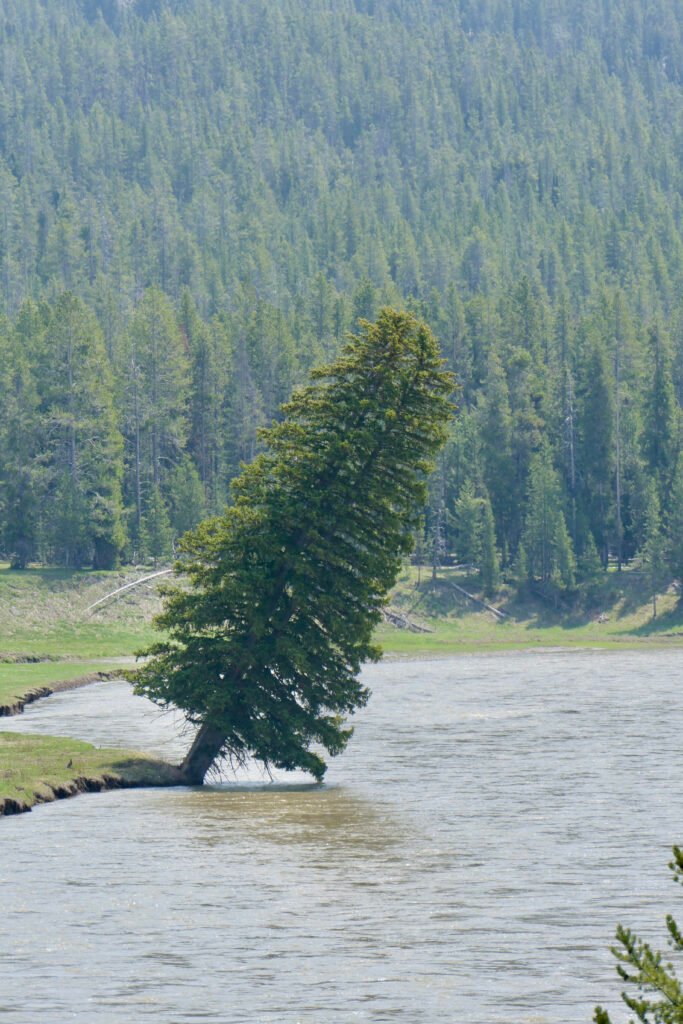
While the more famous Rocky Mountain National Park further north sees over 4 million visitors every year, the Black Canyon, being relatively out of the way, welcomes only around 300,000 annually, but we consider ourselves members of the lucky few. The park boasts natural wonders all around its 2,700 foot cliffs that plunge down to the Gunnison River. The brochure describes it as a small park with a big view, which just shows you that Americans still possess a sense of humour. Small is a somewhat relative word to describe this place compared to somewhere like the Grand Canyon. Gunnison is narrower, and because of this it’s more like a giant chasm, yet somehow manages to feel deeper than its neighbour down the road.

Black Canyon of the Gunnison

The Annual National Park Pass (now $250 from 1 January 2026 for overseas visitors) is still a bargain, especially if you are visiting more than a couple of parks. The ranger at the booth greets us warmly and asked where we’ve come from, obviously with instructions from above to survey the daily intake. I always try to be careful with my accent with Americans, so have learnt to pronounce it “Scatland” instead of Scotland. He looks at me quizzically, and I’m convinced he hasn’t a clue where we come from, but he exclaimed “that’s a long way”. Mind you, in his world, so is Denver! There are 18 Scotland’s in the USA, maybe he was thinking of one of them.  

Painted Wall of the Black Canyon

The South Rim drive itself is short, at seven miles, but there are 12 viewpoints along the way with some of them requiring a short hike. The big four overlooks at Gunnison Point, Chasm View, Painted Wall, and Sunset View provide a sense of wonder at the scale of this magnificent place. Pulpit Rock if you have the time, makes it number five. There are no restaurants in the park, although you would think that after 60 million years at least a coffee shop would have been nice, but you can’t have everything. We didn’t come prepared with a picnic, and neither did we have what would become standard fayre for lunch on our journey – a Subway sandwich. We move on.

Travelling towards Montrose, we shoot past a remote outpost with a ragged sign advertising the “Museum of the Mountain West”. I realise I had listed it as one of the places to visit, so we turn round and find a parking spot. We are the only vehicle there which doesn’t bode well. I park in front of the office, step up to the boardwalk and have to bend down to open the shop door its so small. Its creakiness gives the place a reassuring authenticity, which is comforting. Like being in an old Western movie. 

Two older ladies with big smiles welcome us with open arms and indeed, open tills, as I pay the $15-00 entrance fee. My initial thought is that it’s a steep price to look around half a dozen ramshackle buildings. How wrong could I be? This was another gem found in the wilds of Colorado. The buildings I had designated ramshackle in my first impression of the place, turn out to be little diamonds in their own right. The carriage works, still housing little carriages, the church still echoing God’s words in its old Western way, the school- house with tiny desks where the little people would have learnt more than a little. Behind each structure there is another building, then another. Twenty-eight in total. The blacksmith shop, seemingly abandoned, then the saloon looking pretty much as if it is still in full working order. Back behind the office there is a museum, with a fascinating indoor street adorned with little shops all crammed with artifacts. All 750,000 of them, all catalogued, and all in their right place and digitally recorded. It is quite amazing. A lot of love and attention has been poured into this place.

Then I meet Cory, the museum guide. A wonderful, generous old timer with a full white beard, dressed as a sheriff, who has been helping visitors at the museum for several years. We have a long chat walking through the complex, getting to know each other. He’s just a big kid at heart, with a capacity to express the joy he has in his job and adds to the attraction of this quirky place. I’m convinced he doubles up as Santa at Christmas. Thank you, Cory, it was a pleasure to meet you. For all the wonderful scenery that surrounds us, it is the people you meet that leave the lasting impression. 

We drive on to the town of Ridgeway where John Wayne filmed “True Grit”, and to my surprise it is also the former home of Dennis Weaver who died in 2006 aged 81yrs from prostate cancer. Considering I was thinking about Weaver a couple of hours ago it feels a little spooky.

In the late 1980s, he built his new residence, which incorporated various recycled materials, such as old automobile tires and discarded cans. It also featured passive solar power and other ecotechnologies. Weaver called his home Earthship, where he and his family lived for over 14 years. 

Sliding into Ouray on Route 50, the town sits at 7,792 ft in the San Juan Mountains and was named after Chief Ouray (meaning arrow) of the Ute tribe. American’s penchant for exaggeration is stretched once again as the town is known locally as the “Switzerland of America”. Admittedly high mountains rise almost directly above the town on three sides, but they look somewhat more intimidating than the charm of Europe’s alpine villages.

Uncompahge River, Ouray

The Hot Springs Hotel doesn’t actually offer hot springs, as they are located elsewhere in town, which is a bit of a trade description failure. Here the accommodation sits beside a freezing, snow-melted bubbling river chattering noisily down the valley. What the hotel does have though, is a rather incongruous stagecoach sitting in the middle of the car park on an island surrounded by greenery. Was this originally a stagecoach stop in days gone by, or did John Wayne simply misplace one during his various skirmishes into Indian country? We’ll probably never know. 

Further upstream from our large guestroom and even bigger balcony overlooking the river, is Box Canon Falls, one of the main attractions in town. That is, apart from the Ouray Brewery, the Ouray Liquor store, and the Ouray wine outlet. Which is not surprising, as this was a mining town, recognised by all the clapboard buildings in main street. We snuggle down in our room for the night with a few snacks and an Ouray sourced bottle of wine. Another great day.

Denver to Gunnison

The Hidden Gems Road

The fun starts at the car rental desk at Denver Airport. The cheerful lady agent lobs car keys in my direction a little too cheerfully. I pick them up from the floor and for some unknown reason I actually apologise for my incompetence at not being catcher of the year.

I head off to find our car and seconds later I’m back at the desk. “I think you’ve given me the wrong vehicle” I stutter humbly. She doesn’t even blink “Nope, that’s your car. Have a nice trip !”. Now, I’m not a car enthusiast but even I can tell the difference between a Mazda CX5 and Toyota 4 Runner. It’s about $15,000 dollars on most forecourts, so as I free-climb into the driver’s seat with difficulty, although pleased with my multiple upgrade, there is a nagging doubt in my mind about my sudden elevated status with the rental company. 

The eventual outcome of which, when I get home, I’m charged for two rental cars and it takes nearly three months to get resolved. However, that’s in the future as I tackle the various dashboard controls in front of me. I’m sure Apollo 13 didn’t have as many knobs and dials to deal with.

Boulder main street
Boulder Main Street

Our overnight accommodation near Boulder is a Scottish themed pub and motel. My thinking had been we would ease our way into the American way of life before full immersion. It turns out to be more Scottish than our local pub – without the accents of course. At the adjacent table is Bartender Ron giving a talk to a young American couple on all things Scottish Whisky. Listening in, I learn a lot which I’m not ashamed off because I’m not a big fan of the “water of life”. Ron’s side-line seems to be charging people for a half hour lesson accompanied by a large map of Scotland which he struggles to hold upright. He is knowledgeable enough to know that John O’Groats is at the top, eventually grappling the board into position. I think many a Scotsman has had the same problem after a few malts, even without a map. Ron is a generous soul, giving much of his time to us, talking about his love for Scotland, all of which is made a lot more interesting by offering us a couple of Lagavulin Whiskies on the house. Easing into our road trip the Scottish way wasn’t such a bad idea after all!

I’ve always preferred Boulder to Denver. After all it is a University town, and less formal than its big brother down the road. There is nothing wrong with Denver of course, it can still take your breath away. That’s mainly due to the high altitude, but the mile-high city has many other attractions according to Colorado.com. I love their description of this adventurous city. “With 300 days of sunshine, diverse neighbourhoods, a thriving arts and culture scene, chef-driven dining………” and so on. Wait a minute. Chef-driven? Aren’t all restaurants around the world chef-driven? Don’t you just love American-speak. I appreciate it does suggest expensive, so Macdonalds might not quite reach that category, where the lad cooking a sausage and egg McMuffin is looking forlornly out of the window in the full knowledge that the spaces in the car park opposite are earning more per hour than he is. But chef-driven – really?

A walk round Boulder’s town centre reveals the Dushanbe Teahouse which is so out of place it attracts the curious, not just for its tea but also for its wonderful interior. Not too many Tajikstani residents are in evidence in Boulder, but apparently the Mayor of Dushanbe, which is the capital of Tajikstan visited in 1987 and chose to gift the city the Teahouse which was made by forty artisans who created the stunning decorative walls and ceiling. Which begs the question, what did Boulder gave Dushanbe in return? A boulder maybe?

Before we left the UK, we’d been worried about my partner’s ability to cope with driving the Rocky Mountain roads at high altitude, as she was impacted in her childhood by a lung condition. So much so that I had been in conversation with a specialist altitude doctor I’d found on the internet who lived in Ouray, Colorado in the heart of the Rockies. Like all good doctors he gave me a heap of information, and like all good doctors finished off by saying. “It can affect different people in different ways”.  That’s good. I’m now a mine of information and no further forward. Apparently, anything above 3,000 ft can cause problems for people, and since we were heading for a few 10,000ft mountain passes over the next few days this was a conundrum. To avoid me being partnerless by the time we got to other side of the country, we went in search of oxygen.

The inside of Dicks Sporting Goods Store is somewhat more breath-taking than our Teahouse. Not in an architectural sense, just that we have to trek miles of rails, racks, rudimentary camping equipment and a huge rash of outerwear, where it became almost impossible to find a 10 inch canister of air. However, a friendly server called Bill jumps up from behind the counter and comes to our rescue. A big husky guy, he shouts to John that he may be gone sometime. He reminds me of Scott of Antartica without the snowboots as he wanders off into the bowels of the store. He duly finds what we’re looking for and hands me over to his colleague Jack who takes my credit card, and we joke about the need for oxygen on thick carpets. I think he’d heard that one before. I’m curious but don’t have the heart to ask Bill, John and Jack, if owner Dick only employs people with four letters in their name. They were too nice and I’ve never bought air before as it’s always been plentiful and free but it might just be the best twenty dollars we’ve ever spent. 
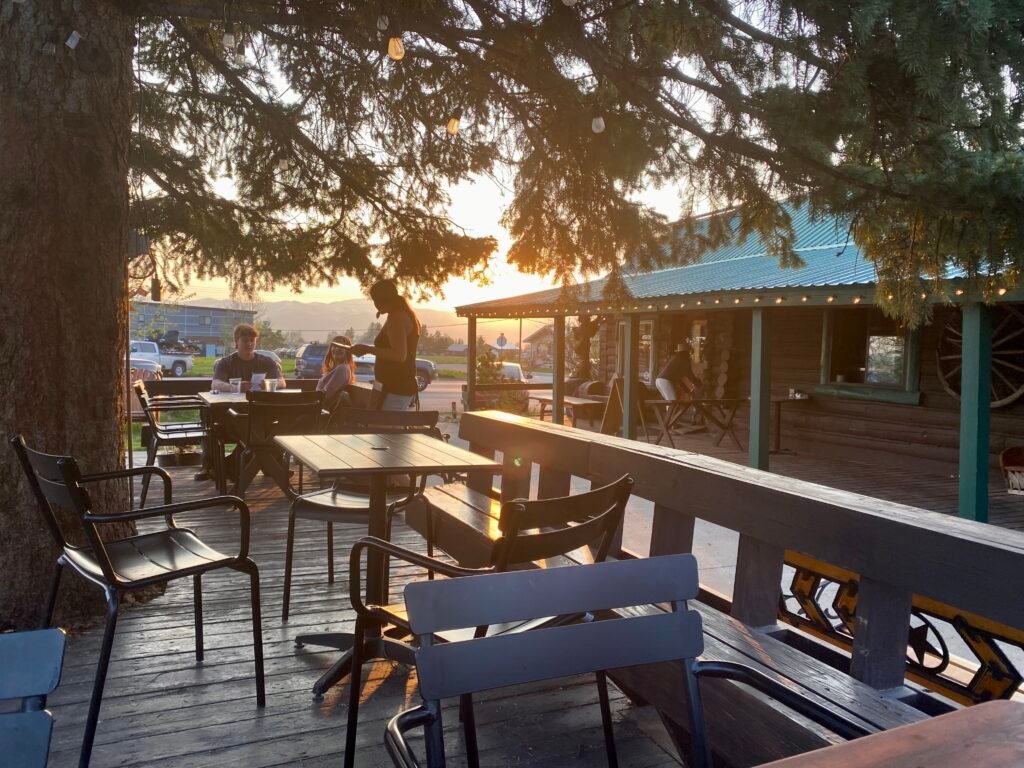
Great Scotty’s Eatery

Leaving Boulder, “Great Scotty’s Eatery” attracts us for breakfast. Well, the name did. Despite sitting on Route 287, it is a typical Route 66 Diner, and although Scotty is nowhere to be seen, it is a great find. Four sides of French toast, some vegetable hash, four eggs and four rashers of bacon with unlimited coffee later, we’re on our way. That order wasn’t all for me I should point out as I would never have been able to climb back into the vehicle-of-not-my-choice. We’ve hardly gone a mile and I find an Autoshop outlet to buy a phone holder for the dashboard. Having just opened, I am surprised to see four old boys running around re-stocking the half-a-dozen aisles who look as though they’d hadn’t been home for weeks. They are all sporting ZZ Top-like beards and damn me if one isn’t called Luke and another called Ryan. Two more four letter names. Does Colorado have legislation banning new-born from having any more than four letters to their name?

With purchase in one hand, a bearded one shook my other hand. “Nice to do business with ya’, you come back and see us all soon now. My name’s Ryan Jack, and I’m here to help”. Good lord! Now it’s four-letter surnames! 

We manage 25 miles on the I93 before detouring just outside the town of Golden and head up Lookout Mountain in search of Buffalo Bill’s Grave and Museum. This place shouldn’t be missed as it is a fascinating insight into this legendary figure and the old cowboy days. Again, we find a Scottish connection, because in 1904 he took his Wild West show to the UK and visited various small towns around the country, including many around the city of my birth Glasgow, which in its own way is known as Scotland’s wild west, especially on Saturday nights, so he would have felt right at home. 

We’re soon stopping again a few miles down the road. This time to test the impeccable acoustics and naturally stunning marvel of the ochre sandstone at Red Rocks Amphitheatre. Higher than Niagara Falls the place echoes to the sound of hundreds of musicians who have performed here.

Red Rocks Ampitheatre

Towns and settlements pass by with imaginative names like Conifer, Will-o-the-Wisp, Shawnee and Fairplay, with captivating scenery everywhere we look. Fair play to Fairplay, the town has the added attraction of a brewery although apparently with only 750 residents to speak of, maintaining the bar and brewery seems to require a lot of passing trade. This in turn means there are a lot of drivers out there who have had a drink, so a little later as we edge out of Fairplay suitably fed, we treat every other road-user with suspicion for the next fifty miles!

Monarch Mountain Pass

We’re heading for our destination Gunnison but have the little matter of negotiating the 11,313 foot Monarch Mountain Pass first, a winding, twisting steep climb over the Continental Divide, prone to poor weather even in spring. The original road was built in 1880 about two miles further north, and as we edge over the summit, we can’t help think about the resilence and ingenuity of those who created this striking mountain highway. I feel high on the wonder around us, although that might just be the elevation talking. The run down the mountain is slow and easy and as the sunshine covers the huge valley in front of us, distant rain clouds hang over the snow-covered Rockies ominously poised to unleash their watery cargo. Rain for some people, is a four-letter word, but for me it’s nature at its best, offering recovery, cleansing the hillsides and stimulating growth again. The water of life is not just whisky. Our canister of oxygen lies untouched the whole trip so maybe it wasn’t the best $20 I’ve spent. Doctor Altitude was right after all. It affects different people in different ways.
We roll into Gunnison and re-fuel. The young lad behind the counter is fascinated by my UK driver’s licence. “Never seen one, probably never will again !” he shouts at me over the roar of the coffee machine. He takes out his cell-phone and takes a photo of it. He is so enthralled I don’t have the heart to tell him that’s not a good thing to do. However, I don’t make an issue of it as he is so amused. Guilty pleasures. I figure it’s highly unlikely he is going to hack into the Licensing database in the UK. Although a little later I thought if he shows the licence to the local sheriff I’ll be on the next wanted list, because I definitely resemble a criminal in the photo.  
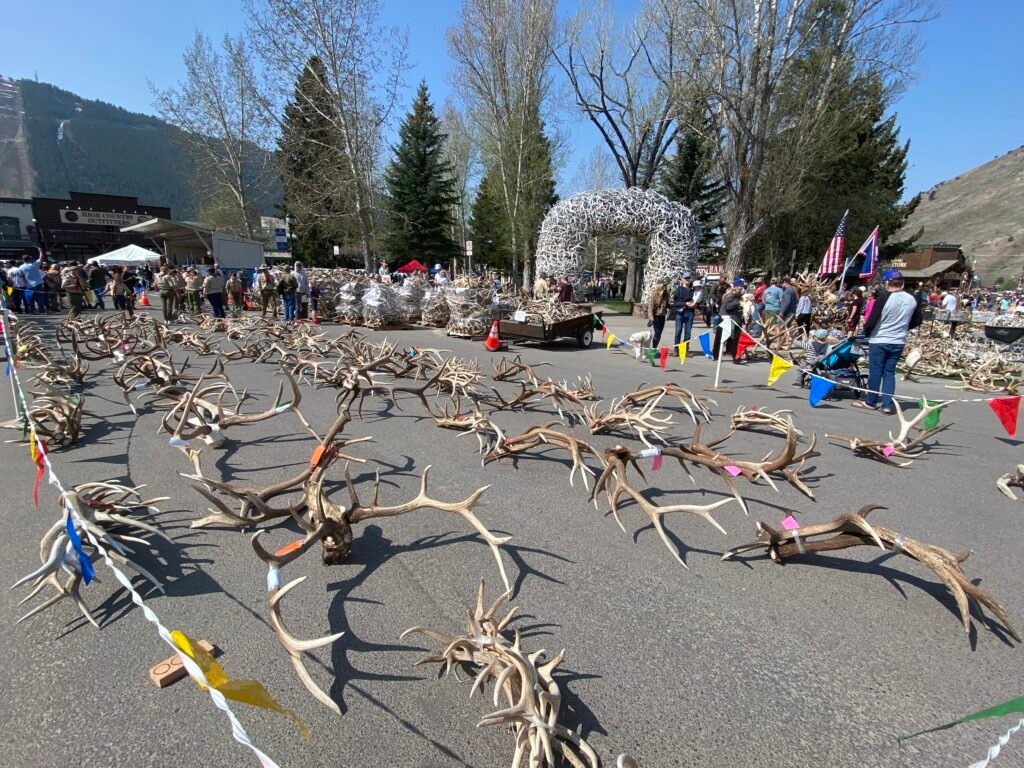
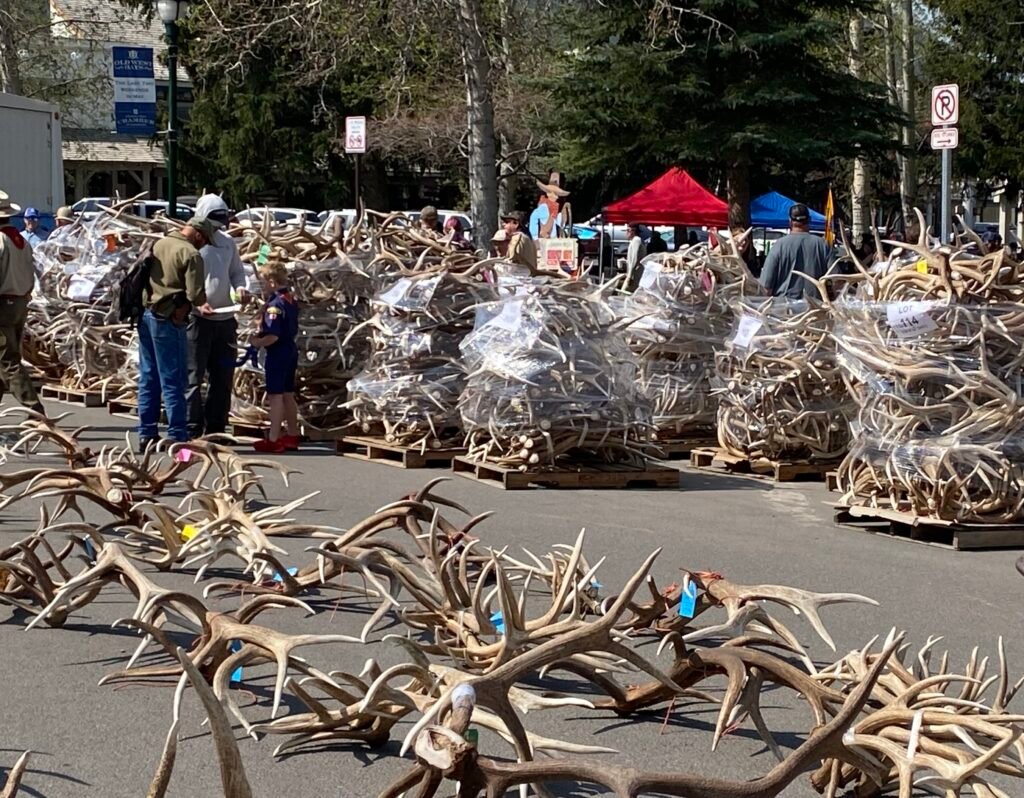
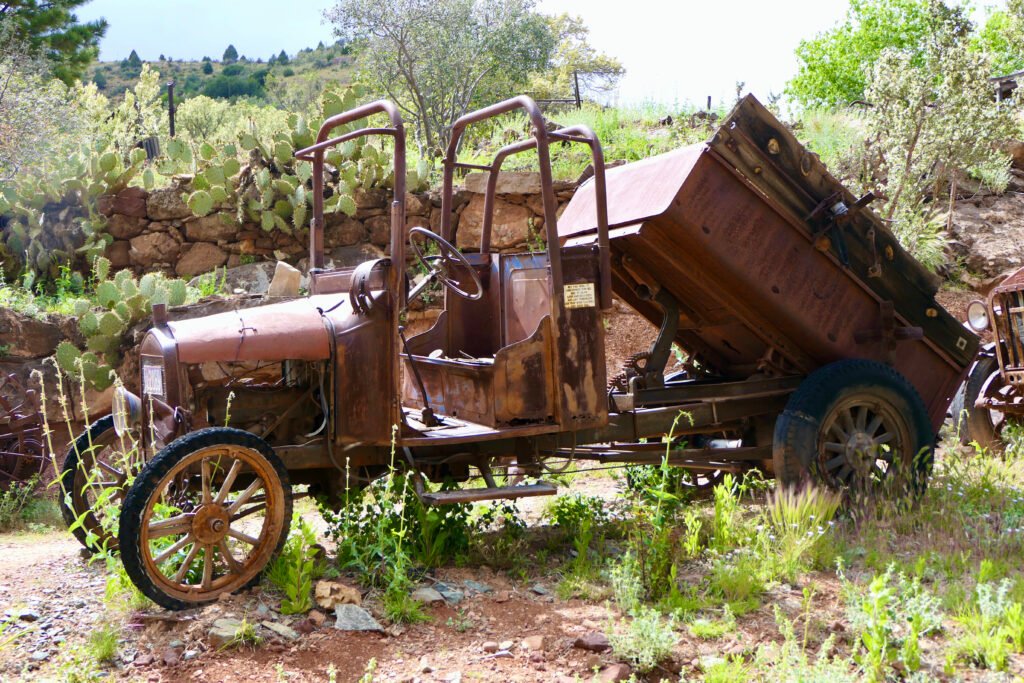
Gunnison

We check into the “Inn at Tomichi Village” – which on a scale of one to ten is a maybe. Room ok, breakfast nah, although it’s a pleasant enough place on the edge of town. The centre of Gunnison has a busy four-way crossroads, but go a 100 yards in each direction and you are almost out of town. However, gems can be found if you look hard enough and as we slide into a booth at the little Pizza Place, we are served by a delightful girl in tight shorts. Maybe Hooters chose not to open a place way out here and this is the Gunnison version, but at least the pizza is good! Tomorrow is the Black Canyon. 

Page 1 of 2

Powered by WordPress & Theme by Anders Norén